


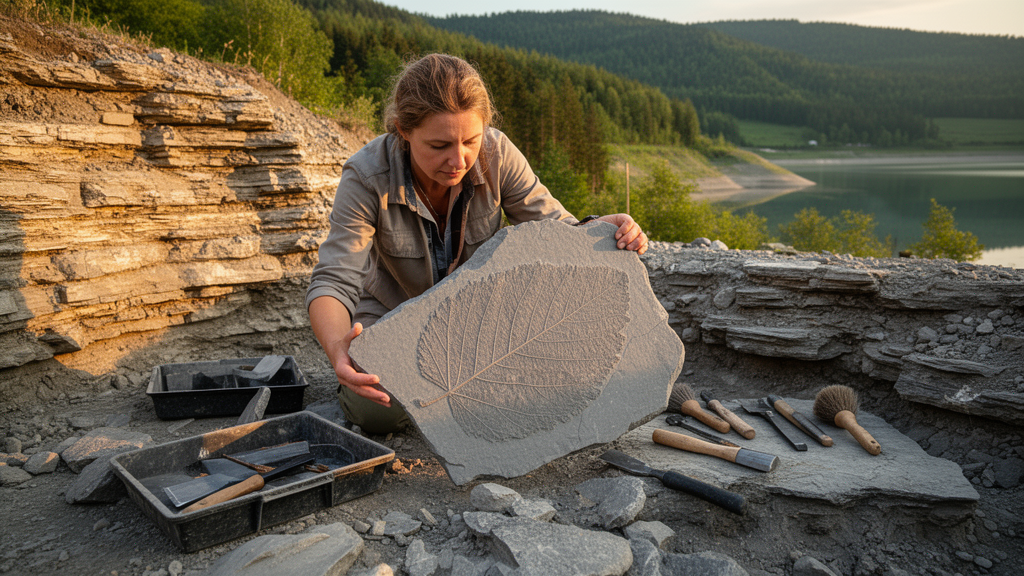
Some 12 million years ago, a shallow lake lay where the twelfth district of Graz now stands. Around its margins grew swamp cypresses, sweetgums, elms, and plane trees, while beech and maple forests covered the well-drained slopes further away. The leaves and fruits these plants shed into the water were pressed into clay and preserved as impressions, waiting in the earth until a Viennese brickmaker began quarrying the deposit in the late nineteenth century. Now, a detailed re-examination of roughly 450 catalogued specimens from the abandoned Wolf clay pit in Graz-Andritz has brought this late Middle Miocene world back into focus, revealing not only what grew around the lake but also how the regional climate behaved and how individual plant lineages spread, diversified, and vanished across Eurasia.
The fossils come from the late Sarmatian Central Paratethys stage, corresponding to the late Serravallian of the global timescale, and were collected in the early 1900s from the clay pit behind the Wolf brickyard, founded in 1870 by Johann Guido Wolf. Clay was excavated there until the 1960s, and brick production finally ceased in 2001. The former mining area has since been converted into a residential neighbourhood, but the plant impressions, now housed in the Universalmuseum Joanneum in Graz and the Natural History Museum Vienna, survive as a snapshot of the vegetation that thrived along the eastern margin of the Alps during a pivotal moment in Earth’s climate history.
The assemblage is dominated by plants of swamp and riparian habitats. Among the most abundant are narrow-leaved willows of the fossil-species Salix varians, sweet bayberry of Myrica lignitum, and the distinctive oblique, asymmetrical leaves of Byttneriophyllum tiliifolium, a member of the mallow family whose maple-like winged fruits were long mistaken for Acer. Elm leaves of Ulmus carpinoides, plane-tree leaves of Platanus leucophylla, and the palmately lobed leaves of Liquidambar europaea round out the riparian picture. Aquatic and wetland herbs are represented by pondweed of Potamogeton stiriacus, cattail of Typha latissima, reed of Phragmites oeningensis, and the giant parallel-veined leaves of Zingiberites borealis, a monocot of uncertain affinity within the ginger order. Horsetail rhizomes bearing whorled tubers of Equisetum complete the wetland inventory.
Crucially, the flora also contains a handful of taxa that almost certainly grew at some distance from the lake, on well-drained lowland and upland soils. These include the small, densely veined leaves of Buxus, the toothed leaflets of Rosa, the elliptical leaves of Fagus haidingeri, the birch-like Betula similis, and the trilobed maple Acer jurenakii. A single moss fragment resembling the modern genus Rhizomnium, a typical element of contemporary beech forests around Graz, reinforces the inference that mesic forest existed in the hinterland. Together with carpological remains from the roughly coeval Gratkorn clay pit just 7.6 kilometres to the northwest, which yielded Nigella, Celtis, and Polygonum, these taxa sketch a landscape of varied vegetation types with vertical zonation, possibly linked to tectonic uplift of the Eastern Alps during this interval.
To characterise the climate, the researchers constructed Köppen profiles for selected fossil-taxa by mapping the modern geographic ranges of their closest living analogues onto the Köppen-Geiger climate classification. For the maple Acer tricuspidatum, a member of the red maple section, the combined profile of three extant East Asian and North American species was used. For Fagus haidingeri, all western Eurasian beech species plus East Asian members of the subgenus were pooled. For Buxus, the modern Buxus sempervirens served as analogue, and for Nigella the entire genus of sixteen species was employed. The resulting profiles show that temperate elements such as Acer section Rubra and Fagus predominantly occupy fully humid Cf and Df climates, while Buxus extends into Mediterranean summer-dry Cs climates, and Nigella shows a clear preference for Mediterranean conditions, consistent with locally drier plant communities on edaphically dry soils.
Coexistence intervals reconstructed from the macroflora of Andritz, using the climate preferences of nineteen fossil-taxa covered by the modern analogue dataset, suggest a mean annual temperature of 14.4 to 15.8 degrees Celsius, a coldest month mean temperature of 2.2 to 6.8 degrees Celsius, and a mean annual precipitation of 843 to 1,179 millimetres. These values align closely with climate parameters previously inferred for several Sarmatian floras in Hungary, which yielded mean annual temperatures of roughly 14 to 16.6 degrees Celsius and precipitation of about 759 to 1,179 millimetres. When the Hungarian values are matched against a global database of more than 2,600 modern climate stations, the closest analogues are fully humid temperate climates of the Cfa type found today in Japan and eastern North America, with a smaller share corresponding to summer-dry Csa climates of France, Italy, and Turkey, and winter-dry Cwa monsoon climates.
The combined evidence points to a temperate climate with both temperature and precipitation seasonality but without severe drought periods. This conclusion contradicts earlier suggestions of arid or savannah-like conditions during the Sarmatian. Berger and Zabusch, writing in 1953 about the Türkenschanze flora of Vienna, had proposed a dry phase and even invoked African savannah, but the new analysis shows that climates occurring today in East African savannah regions differ profoundly from those inferred for the Sarmatian of Europe by their much warmer mean annual temperatures and their almost rainless winters. Similarly, an earlier inference of semi-arid conditions at Gratkorn based on ectothermic vertebrates, suggesting precipitation of 486 plus or minus 252 millimetres, appears to fall at or below the lower limit of the most likely values, given that the minimum annual rainfall for the modern beech Fagus sylvatica, the most common broadleaved forest tree in Austria, is 500 millimetres.
Beyond climate, the flora reveals striking biogeographic patterns. Acer jurenakii, the most abundant maple in the Andritz assemblage, was an endemic element of the Pannonian Basin during the late Neogene, recorded from eastern Austria, Hungary, southern Poland, and western Ukraine, with a stratigraphic range from the Sarmatian into the Early Pliocene. The genus Acer appears to have been species-rich in the European Neogene, with several endemic fossil-species; the roughly coeval flora of Bánhorváti in northern Hungary alone yielded four endemic maples, and three more were described from the Pliocene of Frankfurt. Zingiberites, the enigmatic monocot, shows a similarly restricted distribution, occurring in the Andritz flora and in the roughly coeval flora of Felsőtárkány in northern Hungary. This pattern of regional endemism among temperate elements such as Acer and Berberis appears characteristic of the Neogene of Central Europe.
In contrast, the Byttneriophyllum/Banisteriaecarpum plant tells a story of relictualism. This extinct member of the mallow family, whose leaf and fruit genera almost certainly belonged to a single biological species, has a fossil record spanning all of Eurasia from the late Eocene or early Oligocene to the Pliocene. Recent discoveries of fossil wood, foliage, and winged mericarps attached to a peduncle with five attachment scars suggest affinities with the tropical African genus Triplochiton in the subfamily Sterculioideae, while fruit morphology also resembles Heritiera in the Helicterioideae. Because the characters are intermediary and the leaves are distinct, the researchers propose that Byttneriophyllum/Banisteriaecarpum represents an extinct subfamily of Malvaceae. The lineage appears to have radiated between western North America and Northeast Asia during the early to middle Eocene, migrated to Central Asia by the late Eocene, and expanded into Europe during the Miocene, reaching as far as Denmark, Iceland, and southern Greece. It did not survive beyond the Pliocene, possibly related to the reduction of wetland plant communities.
The flora of Graz-Andritz, though only moderately rich, proves remarkably informative. Because leaf fossils allow taxonomic resolution below the genus level, they can be used to trace the geographic and stratigraphic presence of individual species and to compare them with modern counterparts. Combined with the pollen and spore record from Gratkorn, which captures both local and regional vegetation, and with carpological remains from the same site, the Andritz macroflora strongly suggests that the climate of the Styrian Basin during the late Sarmatian was temperate with seasonality in both temperature and precipitation but without a pronounced dry period. This reconstruction conforms with palaeoclimates previously inferred for the Vienna and Pannonian basins and resolves a long-standing debate about whether the Sarmatian of Central Europe was arid, subhumid, or humid. The answer, it turns out, was none of the extremes: a seasonal temperate world where swamp forests, riparian woodlands, and well-drained beech and maple forests coexisted around a shallow lake, sheltering endemic lineages alongside relicts that had travelled across half of Eurasia before finally disappearing forever.
Subject of Research: Palaeobotany
Article Title: The late Middle Miocene (late Sarmatian) flora of Graz-Andritz (Austria): Environmental, climatic, and biogeographic patterns
Article References: Denk, T., Bouchal, J. M., Dirr, L., Nickel, S., & Gross, M. (2026). The late Middle Miocene (late Sarmatian) flora of Graz-Andritz (Austria): Environmental, climatic, and biogeographic patterns. Fossil Record, 29(1), 333-372. https://doi.org/10.3897/fr.29.187793
Image Credits: AI Generated
DOI: 10.3897/fr.29.187793
Keywords: Miocene, palaeobotany, Austria, Graz, Sarmatian, fossil flora, palaeoclimate, biogeography, Central Paratethys, endemism, late, Middle
Cite Scienmag News
Gavin Prescott. (October 17, 2026). 12-Million-Year-Old Austrian Fossil Leaves Reveal a Lost Miocene Lake Forest. Scienmag. https://scienmag.com/12-million-year-old-austrian-fossil-leaves-reveal-a-lost-miocene-lake-forest/
Gavin Prescott. "12-Million-Year-Old Austrian Fossil Leaves Reveal a Lost Miocene Lake Forest." Scienmag, 17 October 2026, https://scienmag.com/12-million-year-old-austrian-fossil-leaves-reveal-a-lost-miocene-lake-forest/. Accessed 17 October 2026.
Gavin Prescott. "12-Million-Year-Old Austrian Fossil Leaves Reveal a Lost Miocene Lake Forest." Scienmag. October 17, 2026. https://scienmag.com/12-million-year-old-austrian-fossil-leaves-reveal-a-lost-miocene-lake-forest/


