


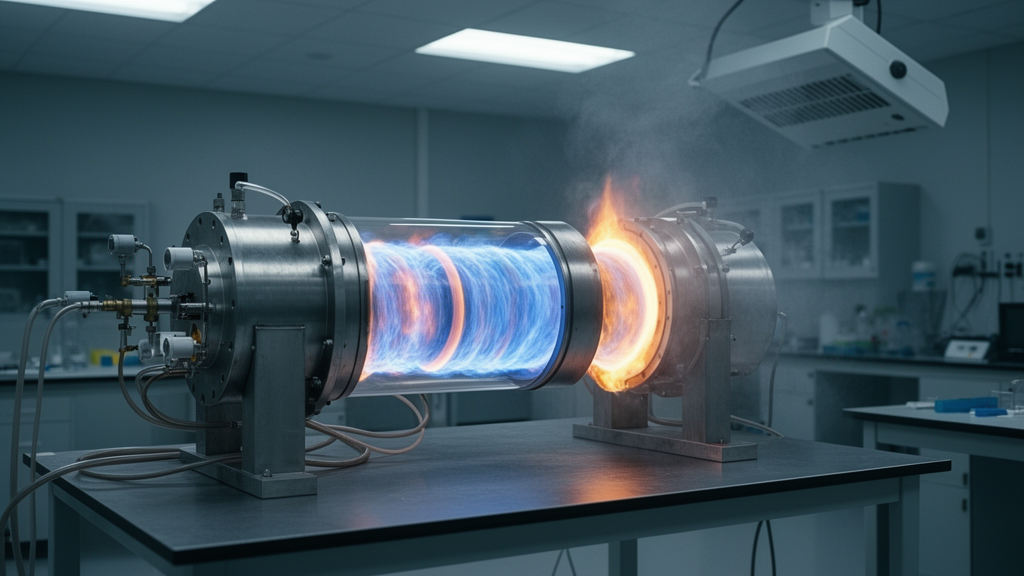
Rotating detonation engines, or RDEs, have long been heralded as the next leap in propulsion technology. Instead of burning fuel through slow deflagration, as in conventional gas turbines, these engines harness a self-sustaining detonation wave that races around an annular chamber at supersonic speeds, compressing and igniting the fuel-oxidizer mixture in a fraction of the time. The thermodynamic advantage is clear: higher efficiency, compact energy release, and the potential to replace the bulky combustors of modern power generation systems. But a critical question has lingered—what about the pollution? Nitrogen oxides, collectively known as NOx, are among the most notorious combustion byproducts, and their formation is exquisitely sensitive to temperature and residence time. Now, a team at the University of Michigan has run some of the most detailed simulations to date, and the answers are surprising.
Using an in-house solver called UMdetFOAM, researchers Caleb Van Beck and Venkat Raman simulated full-scale, three-dimensional RDE configurations burning stoichiometric hydrogen-air mixtures. The simulations, run on roughly 4,000 to 5,000 cores of NASA’s Pleiades supercomputer, incorporated a 13-species, 32-reaction chemical kinetics mechanism based on the extended Zeldovich pathway—the dominant route for thermal NOx production. Two distinct injector designs were tested: one where air is injected axially into the detonation chamber, known as the Axial Air Inlet (AAI) configuration, and another where air is injected radially outward, the Radial Air Inlet (RAI) design. Both used 120 uniformly spaced fuel injectors and a continuous air inlet, but the differences in flow behavior turned out to be dramatic.
The results, published in Frontiers in Aerospace Engineering, reveal that the RAI engine produces far more NOx than its AAI counterpart. At nominally similar mass flow rates, the average exit-plane NOx level in the RAI case reached 83.4 parts per million, while the AAI engine managed just 15.0 ppm—over five and a half times lower. The reason lies in a phenomenon called parasitic combustion. In the AAI design, the injector geometry promotes recirculation of hot product gases back into the refill region near the injection plane. This recirculation burns fresh mixture prematurely, a loss mechanism that weakens the detonation waves, reduces peak pressure and heat release, and ultimately lowers the temperature threshold needed for significant NOx formation. The chemistry is unforgiving: the simulations showed that a threshold temperature of roughly 1,700 kelvin must be reached before meaningful NOx production kicks in.
Parasitic combustion does produce NOx of its own, but the levels are negligible compared to what forms directly in the wake of the detonation waves. The real story is detonation strength. As mass flow rate increases in the RAI engine, peak pressure, peak heat release, and NOx emissions all climb together. But the relationship is not linear. The waves strengthen in a staggered pattern: they intensify with increasing mass flow rate until the system becomes unstable, at which point the waves split into a greater number of counter-propagating waves. This splitting causes a marked dip in wave speed and strength—and, crucially, a corresponding drop in NOx. When the air mass flow rate increased from 320 grams per second to 630 grams per second, maximum pressure and average wave speed rose by 17.2 percent and 2.9 percent respectively. But pushing further to the next condition actually reversed the trend, with pressure and wave speed falling by 14.8 percent and 3.4 percent as the system transitioned from two waves to three.
The wave splitting process reshapes the entire detonation structure. When an additional wave is added, the heights of the detonation waves shrink because the refill region has less time to penetrate axially into the chamber between wave passages. Weaker waves also lower peak pressures, which lengthens the induction zone—the distance required for combustion to ignite—and spreads heat release over a broader region. The result is less compact, less efficient combustion, lower average temperatures, and less NOx. The temporally averaged data confirmed this: in the AAI engine, NOx production clustered near the injector plane where parasitic combustion occurs, while in the RAI engine, long coherent trails of NOx stretched azimuthally behind the detonation fronts where temperatures peaked.
Perhaps the most striking finding is what happens at the combustor exit. Despite the extreme, unsteady conditions inside RDEs—pressures swinging wildly, temperatures spiking past 2,700 kelvin, injectors being temporarily blocked by passing detonation waves—the average exit-plane NOx levels in all cases remained under 100 parts per million. Local spikes in the RAI case did not exceed 200 ppm. For context, stationary gas turbines relying on conventional deflagrative combustion typically exhaust between 22 and 240 ppm of NOx. The detonative process, so radically different from deflagration, does not necessarily produce radically different emissions. This supports a growing body of evidence that the short residence time of gases inside RDEs prevents large quantities of NOx from forming, even with hydrogen fuel at stoichiometric conditions—an upper limit scenario for emissions production.
The simulations also revealed that exit-plane NOx levels serve as a surprisingly reliable diagnostic of engine stability. When the detonation waves remained steady, NOx levels at the exit stayed consistent. But when wave transitions occurred—such as the AAI engine splitting from one wave to two, or the RAI engine transitioning from two to three—significant changes in emissions appeared. In the single-wave RAI case, which experienced the most frequent instabilities from parasitic combustion, exit-plane NOx showed highly oscillatory behavior with local spikes and dips. The emissions levels essentially act as a real-time marker for what is happening inside the detonation chamber, offering engineers a potential feedback signal for controlling these engines in practice.
The relationship between fuel efficiency and NOx is more nuanced. Comparing the AAI and RAI engines at nominally similar mass flow rates, the AAI case had a fuel conversion efficiency of 71.72 percent alongside its low NOx, while the RAI case reached 90.31 percent efficiency with higher emissions. Weaker waves and greater parasitic combustion in the AAI design reduce efficiency but also reduce NOx. However, within the RAI cases alone, efficiency values of 90.31, 87.98, and 88.88 percent were paired with progressively decreasing NOx levels, suggesting the correlation breaks down when geometry stays constant. When wave splitting occurred in the highest mass flow rate RAI case, efficiency dipped slightly from 89.55 to 88.30 percent, consistent with the drop in wave strength and emissions.
The implications for power generation are significant. RDEs could potentially replace conventional lean-premixed swirl combustors in gas turbines, offering higher thermodynamic efficiency and more compact energy release without suffering from dramatically higher emissions. But the tradeoff is real: designing an RDE for maximum efficiency and detonation strength inherently increases NOx levels. Injector design emerges as a critical lever—by controlling recirculation patterns, parasitic combustion, and wave strength, engineers can tune emissions in ways that were previously poorly understood. The study provides a roadmap for how operating parameters and geometry interact to shape the pollution profile of these exotic engines.
What makes this work particularly compelling is the fidelity of the approach. Previous computational studies relied on idealized two-dimensional geometries with continuous premixed injection, missing the non-idealities of practical RDEs with discrete fuel injectors. The new simulations, with meshes containing up to 48 million control volumes and resolutions as fine as 0.1 millimeters in the injector regions, capture the full three-dimensional complexity of the flow. As RDEs move closer to real-world deployment—from rocket propulsion to stationary power generation—understanding how their unique detonative combustion shapes emissions will be essential. The message from Michigan is clear: detonation engines can be clean, but only if we understand exactly where the pollution comes from.
Subject of Research: NOx formation processes in rotating detonation engines
Article Title: NOx formation processes in rotating detonation engines
Article References: Van Beck, C., & Raman, V. (2024). NOx formation processes in rotating detonation engines. Frontiers in Aerospace Engineering, 3, Article 1335906. https://doi.org/10.3389/fpace.2024.1335906
Image Credits: AI Generated
DOI: 10.3389/fpace.2024.1335906
Keywords: formation, processes, rotating, detonation, engines, scientific research
Cite Scienmag News
Denise Maddox. (October 17, 2026). How Detonation Strength Controls Pollution in Rotating Detonation Engines. Scienmag. https://scienmag.com/how-detonation-strength-controls-pollution-in-rotating-detonation-engines/
Denise Maddox. "How Detonation Strength Controls Pollution in Rotating Detonation Engines." Scienmag, 17 October 2026, https://scienmag.com/how-detonation-strength-controls-pollution-in-rotating-detonation-engines/. Accessed 17 October 2026.
Denise Maddox. "How Detonation Strength Controls Pollution in Rotating Detonation Engines." Scienmag. October 17, 2026. https://scienmag.com/how-detonation-strength-controls-pollution-in-rotating-detonation-engines/


