


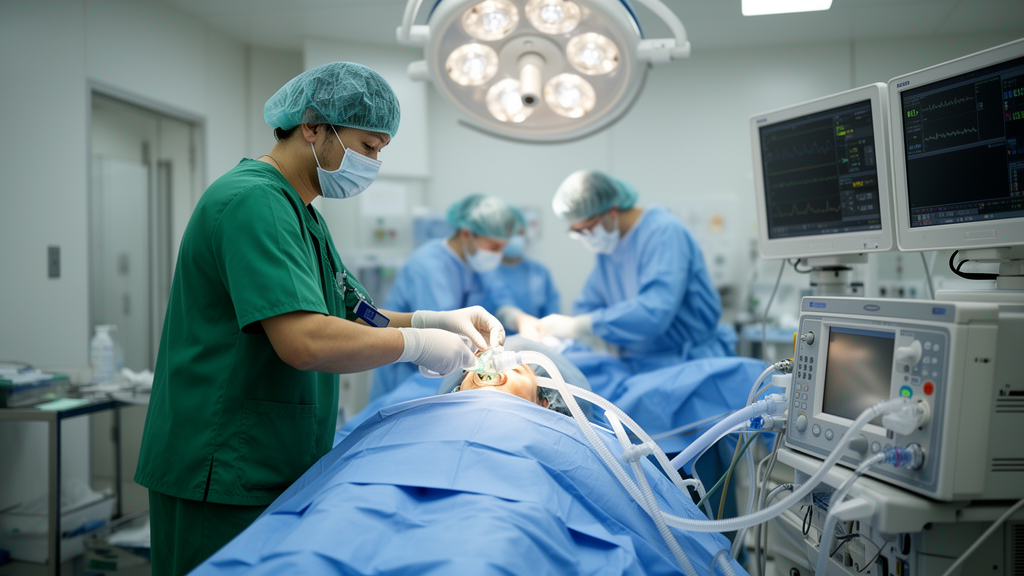
In operating rooms around the world, some of the most delicate chest surgery depends on a deceptively simple trick: collapsing one lung to give surgeons a quiet, motionless field while the other lung keeps the patient alive. This technique, known as one-lung ventilation, is routine for experienced anesthesia teams. But what happens when the anatomy itself makes it impossible? A case report published in Frontiers in Anesthesiology describes how a Chinese anesthesia team faced exactly that dilemma in a 48-year-old woman with a destroyed lung and a dangerous hole between her trachea and esophagus, and how they turned to an unconventional rescue strategy: letting the patient breathe spontaneously through the entire operation.
The patient’s story began years earlier with esophageal cancer, treated with radiation therapy that appeared to control the tumor but left behind a devastating legacy. One lung was progressively destroyed by radiation injury and chronic infection, functioning so poorly that it contributed little to gas exchange. Worse still, a tracheoesophageal fistula, an abnormal connection between the windpipe and the food pipe, had formed, allowing swallowed saliva and food to contaminate the airway and causing repeated, life-threatening pneumonias. When she arrived at the hospital, she was malnourished, anemic, and fighting an active infection in her only functional lung, yet the fistula meant that without surgical intervention she would likely not survive.
The surgical plan was ambitious: a gastric tube reconstruction, in which the stomach is mobilized, pulled up into the chest, and used to replace the diseased esophagus. Such an operation would normally require one-lung ventilation to collapse the left lung and expose the esophagus. But the anatomy made the standard approach impossible. The team’s initial attempt to pass a double-lumen endobronchial tube, the classic tool for splitting the two lungs, failed because the patient’s distorted airway anatomy would not accommodate it. A bronchial blocker, a more flexible alternative, was then positioned successfully, but when ventilation of the right lung began, the surgeons discovered that the collapsed left lung was so densely adherent to the chest wall that it could not be deflated at all, and the surgical field remained obscured by the inflated tissue.
At this point, the team faced a critical decision. Continuing to force mechanical ventilation in the face of a non-collapsible lung risked both poor surgical exposure and dangerous airway pressures in a patient whose remaining lung was already compromised. The anesthesiologists made a bold pivot: they removed the airway splitting devices entirely and allowed the patient to breathe on her own, maintaining only a secure endotracheal tube and a carefully titrated anesthetic that preserved spontaneous respiratory drive while keeping her unconscious and pain-free. To make this possible, they converted the operation from a minimally invasive thoracoscopic approach to an open thoracotomy, giving the surgeons direct access and visibility despite the moving lung.
The physiological reasoning behind this choice is worth unpacking. In a patient with one destroyed lung, the healthy lung must carry the entire burden of oxygenation. Mechanical ventilation with positive pressure can push air into the diseased lung through the fistula, worsening leaks and potentially flooding the airway with secretions. Spontaneous ventilation, by contrast, relies on the patient’s own diaphragmatic effort, which naturally distributes ventilation toward the healthier, more compliant lung tissue and avoids the high pressures that mechanical ventilation can generate. The team supplemented this with careful positioning, continuous monitoring of oxygenation and carbon dioxide levels, and judicious use of oxygen supplementation to keep the patient stable throughout the hours-long procedure.
The operation proceeded successfully. The surgeons completed the gastric tube reconstruction through the open incision, and the patient maintained adequate oxygenation and ventilation throughout, despite the absence of mechanical support. At the end of the procedure, she was awakened, her trachea was extubated in the operating room, and she was transferred to the intensive care unit breathing independently. She recovered, was discharged, and at follow-up was able to eat and drink without choking, a dramatic improvement from her preoperative state in which every swallow threatened her airway.
This case is notable not because spontaneous ventilation is new, but because of where and how it was applied. Awake or spontaneously breathing thoracic surgery has gained attention in recent years as part of the enhanced recovery movement, with some centers performing video-assisted thoracic surgery on sedated, spontaneously breathing patients. But those experiences typically involve patients with two functioning lungs and no airway fistula. Applying the technique as a rescue strategy in a patient with a destroyed lung, a tracheoesophageal fistula, and failed conventional lung isolation represents a different order of difficulty, and the authors are careful to frame it as a case-specific solution rather than a general recommendation.
The report also highlights the importance of preoperative airway imaging and planning. The team had anticipated difficulty with lung isolation based on the patient’s history of radiation therapy and chronic inflammatory changes, and they had backup strategies ready, including the bronchial blocker and, ultimately, the spontaneous ventilation plan. This kind of layered contingency thinking is increasingly recognized as essential in complex thoracic anesthesia, where the anatomy itself can defeat the tools that normally make surgery possible. The authors suggest that in patients with severe airway distortion or fistulas, early consideration of spontaneous ventilation techniques, rather than treating them as a last resort, may prevent the kind of intraoperative crisis that forces improvisation under pressure.
For the broader anesthesia and surgical community, the case adds to a growing literature on individualized ventilation strategies in the most challenging patients. It underscores that the goal of airway management is not to follow a fixed protocol but to match the technique to the patient’s specific physiology and pathology. In this woman’s case, the very thing that made conventional ventilation dangerous, her destroyed lung and fistulous connection, was the same thing that made spontaneous breathing the safest option. The report is a reminder that in medicine, as in engineering, sometimes the most elegant solution is not the newest device but a return to first principles: letting the body do what it is designed to do, while the surgical team carefully manages everything around it.
Subject of Research: Spontaneous ventilation as a rescue technique after failed one-lung ventilation in a patient with a destroyed lung and tracheoesophageal fistula
Article Title: Spontaneous ventilation as rescue after failed one-lung ventilation in a patient with a destroyed lung and a TEF: a case report
Article References: Zhou, Q., Wang, H., & Chen, J. (2026). Spontaneous ventilation as rescue after failed one-lung ventilation in a patient with a destroyed lung and a TEF: a case report. Frontiers in Anesthesiology, 5, Article 1914653. https://doi.org/10.3389/fanes.2026.1914653
Image Credits: AI Generated
DOI: 10.3389/fanes.2026.1914653
Keywords: one-lung ventilation, spontaneous ventilation, tracheoesophageal fistula, thoracic anesthesia, destroyed lung, case report, airway management, gastric tube reconstruction, esophageal cancer, anesthesiology, Spontaneous, ventilation
Cite Scienmag News
Ophelia Keating. (October 17, 2026). When One-Lung Ventilation Fails: Anesthesiologists Let a Patient Breathe Through High-Risk Chest Surgery. Scienmag. https://scienmag.com/when-one-lung-ventilation-fails-anesthesiologists-let-a-patient-breathe-through-high-risk-chest-surgery/
Ophelia Keating. "When One-Lung Ventilation Fails: Anesthesiologists Let a Patient Breathe Through High-Risk Chest Surgery." Scienmag, 17 October 2026, https://scienmag.com/when-one-lung-ventilation-fails-anesthesiologists-let-a-patient-breathe-through-high-risk-chest-surgery/. Accessed 17 October 2026.
Ophelia Keating. "When One-Lung Ventilation Fails: Anesthesiologists Let a Patient Breathe Through High-Risk Chest Surgery." Scienmag. October 17, 2026. https://scienmag.com/when-one-lung-ventilation-fails-anesthesiologists-let-a-patient-breathe-through-high-risk-chest-surgery/


