


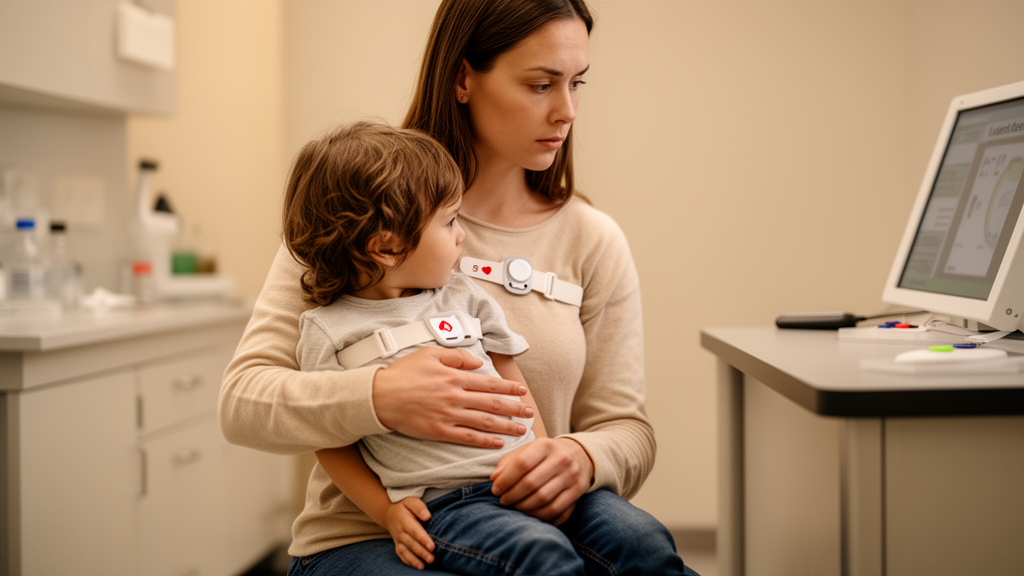
For decades, psychologists have been captivated by a deceptively simple idea: that parents and children, when they are emotionally connected, quite literally fall into physiological rhythm with one another. Their heart rates rise and fall together, their breathing patterns mirror each other, and their nervous systems appear to hum in harmony. This phenomenon, known as biobehavioral synchrony, has been celebrated as a biological signature of secure attachment and effective co-regulation. But a new study published in Frontiers in Child and Adolescent Psychiatry suggests that this popular narrative may be far too simple. When researchers at the University of California, Irvine and Auburn University measured how mothers and their preadolescent children synchronized physiologically during a stressful task, they found that greater synchrony was not uniformly beneficial. Instead, its meaning shifted depending on which physiological signal was measured and which aspect of the child’s well-being was examined.
The research team, led by Christina A. Rowley and colleagues, recruited 173 mother-child dyads with children between the ages of 8 and 12 years. Mothers averaged 41.60 years of age, and just over half of the children were girls. The sample was diverse in racial and ethnic composition, with White, Asian, Latine, mixed-race, Native Hawaiian/Pacific Islander, and Native American/Indigenous families all represented. Each dyad visited the laboratory and completed what the researchers call the Performance Challenge Task, a deliberately frustrating experience in which children attempted a series of six computer-based puzzles adapted from a well-known intelligence test. Crucially, none of the puzzles could actually be solved, although neither the mothers nor the children were told this. Mothers watched from nearby and were instructed to help only if they believed their child truly needed it. The setup was designed to generate genuine, sustained stress in a controlled setting while the parent observed.
Throughout the task, the researchers recorded continuous electrocardiogram data from both mother and child simultaneously, using electrodes placed on the chest and torso. From these signals, they extracted three distinct physiological measures: respiration rate, which reflects broad autonomic activation; respiratory sinus arrhythmia, or RSA, which indexes the parasympathetic nervous system’s influence on the heart and is closely tied to breathing; and the root mean square of successive differences, or RMSSD, another heart rate variability measure that reflects parasympathetic cardiac activity but is less affected by respiration. The sympathetic branch of the autonomic nervous system generally mobilizes the body for action under threat or challenge, while the parasympathetic branch supports regulation and recovery. By measuring all three indices in the same dyads, the team could ask whether different facets of autonomic coordination tell different stories about the parent-child relationship.
The analytical approach was sophisticated. Rather than simply correlating average physiological levels between mothers and children, the researchers used multilevel latent growth modeling to estimate each person’s physiological trajectory across the six one-minute epochs of the task. They then covaried the mother’s and child’s growth curves to quantify what they call trend-level synchrony: the degree to which the two members of a dyad showed similar patterns of physiological change over the course of the stressor. This is distinct from concurrent synchrony, which captures moment-to-moment coordination, and lagged synchrony, which examines whether one partner’s physiological shifts precede the other’s. Trend-level synchrony, the researchers argue, is particularly informative for understanding whether dyads move through a stressful experience along shared physiological paths.
Youth well-being was assessed from multiple angles. Children themselves reported on their positive and negative affect before and after the stressor using the Positive and Negative Affect Schedule for Children, as well as their depressive symptoms, anxiety symptoms, and aggressive tendencies through validated questionnaires. Mothers, in turn, rated their children’s internalizing and externalizing behaviors on the Child Behavior Checklist, a widely used parent-report instrument. This multi-informant design matters because parents and children often perceive psychological symptoms differently, and internalizing difficulties in particular can be less visible to parents than outward-directed behavioral problems.
The results defied easy categorization. Greater RSA synchrony between mothers and children was associated with higher positive affect after the stressor, even after accounting for how positive the child felt beforehand, a finding with a large effect size that aligns with the traditional view of synchrony as adaptive. The same RSA synchrony was also linked to lower mother-reported externalizing symptoms, suggesting that children who rose and fell physiologically in step with their mothers were seen as less impulsive or aggressive. But here is the twist: greater RSA synchrony was simultaneously associated with higher mother-reported internalizing symptoms, a counterintuitive result that complicates any straightforwardly positive interpretation. RMSSD synchrony showed only a nonsignificant trend toward higher youth-reported anxiety, and respiration-rate synchrony showed a marginal trend toward lower mother-reported externalizing symptoms. Most other associations, including all links between synchrony and youth-reported depression, anxiety, or aggression, were nonsignificant.
The authors are careful about what these patterns do and do not mean. Physiological synchrony, they emphasize, is an observed pattern of coordination rather than direct evidence of co-regulation. Depending on the context, it may reflect adaptive coordination, shared arousal, stress contagion, or even mutual dysregulation. During stress, two people whose physiology moves together might simply be catching each other’s distress rather than regulating one another. Conversely, divergence can sometimes be adaptive: a caregiver who remains physiologically calm while a child becomes increasingly aroused may actually be better positioned to provide support. The internalizing finding illustrates this ambiguity vividly. Because synchrony and symptoms were measured concurrently, the direction of association cannot be determined. It is possible that dyads in which children experience more internalizing difficulties show greater physiological coordination, or that preexisting characteristics of the child or family shape how both members respond physiologically under stress.
The study also highlights a methodological caution for the growing field of synchrony research. RSA and RMSSD synchrony factors were highly correlated with one another in this sample, with correlations between 0.94 and 0.96, making it difficult to conclude that differences in their statistical associations with outcomes reflect genuinely distinct physiological mechanisms. The researchers note that replication will be needed to determine whether RSA holds a uniquely informative relationship with post-stressor affect or whether the pattern is a statistical artifact of closely related measures. They also acknowledge that the relatively high educational attainment and household income of the sample, with a median annual income in the $120,000 to $129,000 range, may limit generalizability to more socioeconomically diverse families, and that only mothers participated, leaving father-child and other caregiver relationships unexamined.
What makes this study particularly valuable is its developmental framing. Most synchrony research has focused on infancy and early childhood, periods when children depend heavily on caregivers for physiological and emotional regulation. Preadolescence is different. Children aged 8 to 12 are developing greater autonomy while still relying on parents as attachment figures under stress, and the parent-child relationship increasingly takes the form of a supervisory partnership built on psychological availability and collaborative decision-making rather than physical proximity. These developmental shifts may alter the form and meaning of physiological coordination. A preadolescent who regulates more independently, even while drawing on parental support, may show less physiological similarity to a parent precisely because the regulatory work has shifted from caregiver-led to self-directed.
The takeaway for parents, clinicians, and researchers alike is a call for nuance. Physiological synchrony should not be treated as a uniformly adaptive marker of a healthy relationship, nor should its absence be read as dysfunction. Its meaning depends on the physiological index being measured, the specific outcome being predicted, the developmental period in question, and the interactional context in which the coordination occurs. The authors argue that future studies should assess multiple physiological indices, distinguish among different forms and timescales of synchrony, and pair physiological data with behavioral observations that can clarify what coordinated physiological change actually represents within a particular interaction. Longitudinal designs that track both synchrony and functioning repeatedly over time will be essential for untangling directionality. Until then, the romantic image of two hearts beating as one, at least under stress, deserves a more complicated story: sometimes it signals harmony, sometimes it signals shared strain, and sometimes it may simply mean that a child and a parent are both struggling with an impossible puzzle.
Subject of Research: Mother-youth physiological synchrony during stress and its associations with preadolescent well-being
Article Title: The role of mother-youth biobehavioral synchrony during stress in predicting youth well-being
Article References: Rowley, C. A., Ford, J., Li, F. H., Cuevas-Kovanis, Z. O., Ruiz, M., Somers, J. A., & Borelli, J. L. (2026). The role of mother-youth biobehavioral synchrony during stress in predicting youth well-being. Frontiers in Child and Adolescent Psychiatry, 5, Article 1923350. https://doi.org/10.3389/frcha.2026.1923350
Image Credits: AI Generated
DOI: 10.3389/frcha.2026.1923350
Keywords: physiological synchrony, mother-child dyads, co-regulation, respiratory sinus arrhythmia, heart rate variability, preadolescence, stress, internalizing symptoms, externalizing symptoms, autonomic nervous system, child mental health, biobehavioral synchrony
Cite Scienmag News
Ophelia Keating. (October 17, 2026). When Hearts Beat Together: Mother-Child Physiological Synchrony Under Stress Is Not Always a Good Sign. Scienmag. https://scienmag.com/when-hearts-beat-together-mother-child-physiological-synchrony-under-stress-is-not-always-a-good-sign/
Ophelia Keating. "When Hearts Beat Together: Mother-Child Physiological Synchrony Under Stress Is Not Always a Good Sign." Scienmag, 17 October 2026, https://scienmag.com/when-hearts-beat-together-mother-child-physiological-synchrony-under-stress-is-not-always-a-good-sign/. Accessed 17 October 2026.
Ophelia Keating. "When Hearts Beat Together: Mother-Child Physiological Synchrony Under Stress Is Not Always a Good Sign." Scienmag. October 17, 2026. https://scienmag.com/when-hearts-beat-together-mother-child-physiological-synchrony-under-stress-is-not-always-a-good-sign/


