


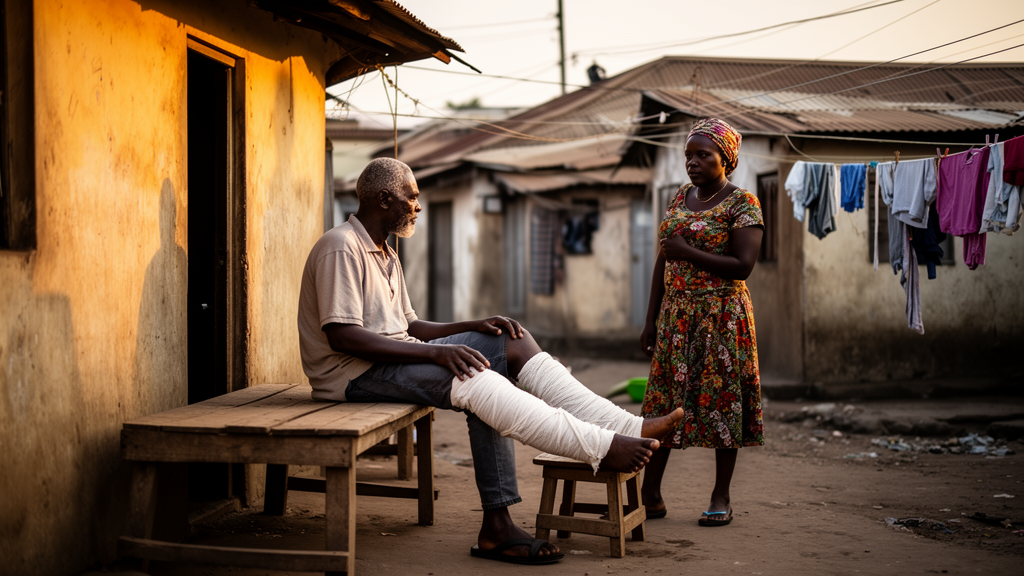
In the sprawling semi-urban and rural neighborhoods of Ikorodu, a local government area on the edge of Lagos, Nigeria, researchers went door to door asking families a question that global health experts rarely think to ask: has anyone in this household died, or become disabled, because of a condition that surgery could have fixed? The answers, gathered in a large community survey published in BMC Public Health, offer one of the most granular snapshots yet of how untreated surgical conditions quietly shape life and death in a West African community, and the picture they paint is both sobering and methodologically revealing.
The study, led by O. A. Elebute of the Department of Surgery at the College of Medicine, University of Lagos, together with a multidisciplinary team spanning Lagos University Teaching Hospital, Duke University, Baylor University, the University of Edinburgh, McGill University and Nationwide Children’s Hospital, deployed the Surgeons OverSeas Assessment of Surgical Need, or SOSAS, tool. SOSAS is a structured household questionnaire designed specifically to measure the burden of surgical disease in low- and middle-income countries, where hospital records capture only a fraction of the true disease landscape. In 2016, the team surveyed 856 households in Ikorodu Local Government Area, covering 3,984 individuals: 1,986 adult informants answering on their own behalf and 1,998 children represented through parental or guardian responses.
The survey’s design reflected a deliberate conservatism. Disability was recorded only when an informant explicitly attributed functional impairment to a surgical condition, rather than allowing interviewers to infer it. Mortality questions covered the twelve months preceding the interview, and for the 43 deaths for which individual age data were available, the researchers calculated years of life lost, or YLL, using the World Health Organization’s 2015 life table for Nigeria. This metric, a cornerstone of the Global Burden of Disease framework, quantifies the gap between the age at death and the age to which a person could have expected to live under standard mortality conditions.
What the team found was striking in its asymmetry. Forty-six deaths were reported across the surveyed population, 32 among adults and 14 among children, but for 36 of those deaths, 78.3 percent, the cause could not be ascertained. The crude all-cause death rate stood at 11.5 per 1,000 persons, with a 95 percent confidence interval of 8.7 to 15.4. The total years of life lost amounted to 1,681.3 years, averaging 39.1 years per death, a figure that underscores how much potential life is extinguished when people die young in a community where life expectancy is already constrained.
On the morbidity side, the survey catalogued 169 classified pathology entries among adults, and the dominant category was unexpected to some observers: conditions of the extremities, meaning disorders of the arms and legs, accounted for 91 entries, or 53.8 percent of all classified surgical pathology. This finding aligns with a growing recognition in global surgery research that musculoskeletal problems, from untreated fractures to chronic infections and deformities, represent an enormous and underappreciated share of surgical need in resource-limited settings, where road traffic injuries and occupational hazards are common and orthopedic capacity is thin.
Yet the disability data told a quieter story. Only 20 adults, or 1.0 percent of the adult sample, and 4 children, or 0.2 percent of the child sample, reported perceived disability attributable to a surgical condition. When the researchers ran an exploratory calculation of years lived with disability, or YLD, using representative disability weights and a conservative one-year duration assumption for affected respondents, the total came to just 1.55 years. Combining this with the mortality burden produced a total of 1,682.9 disability-adjusted life years, or DALYs, equivalent to 422.4 per 1,000 persons. More than 99 percent of that total consisted of years of life lost rather than years lived with disability.
This overwhelming dominance of mortality over morbidity in the DALY calculation is the study’s most consequential technical finding, and the authors are careful to explain why it demands caution rather than celebration. Because 78.3 percent of reported deaths had unascertained causes, the team could not estimate any surgically attributable mortality at all. The DALY figure therefore represents a floor, not a ceiling, for the community’s surgical disease burden. If any of those 36 unexplained deaths were caused by surgically treatable conditions, such as strangulated hernias, obstructed labor, appendicitis, or trauma, the true surgical share of the burden would be higher than the study could detect. Household informants, even when cooperative and well-intentioned, often cannot reconstruct the biomedical cause of a death that occurred months earlier, particularly in settings where many people die at home without formal medical certification.
The low rate of perceived disability raises a parallel methodological question. The SOSAS tool’s strict criterion, requiring informants to explicitly link functional impairment to a surgical condition, is designed to avoid inflating estimates, but it may also undercount disability in communities where chronic limitations are normalized, attributed to other causes, or simply not framed in terms of surgery. A person living with an untreated clubfoot, a chronic burn contracture, or a painful hernia that limits heavy labor may not spontaneously identify their condition as a surgical problem, even though a surgeon would recognize it as one. Cross-national SOSAS studies in Sierra Leone, Nepal, and Uganda have reported higher disability prevalence, suggesting that local framing, awareness, and stigma all shape what households are willing or able to report.
For the researchers, the policy implications are clear even amid the data limitations. The findings support improved access to timely surgical care, stronger referral pathways that can move patients from community health posts to facilities with operating capacity, and, critically, better community mortality surveillance. Without reliable cause-of-death information, planners cannot know how many deaths in a given year were preventable through surgery, and the global movement to embed surgical care within universal health coverage, championed by the Lancet Commission on Global Surgery, depends on exactly this kind of population-level evidence. The 422.4 DALYs per 1,000 persons measured in Ikorodu, even as a conservative lower bound, provides a benchmark against which future interventions, from trauma system development to hernia repair campaigns, can be evaluated.
The study also carries a broader lesson for the science of measuring unmet surgical need. Household surveys like SOSAS are among the few tools capable of reaching populations that never present to hospitals, and their findings repeatedly reveal that the burden of surgical disease in low-resource settings is far larger than operative logs suggest. But this Lagos survey demonstrates that the same instruments face real constraints: mortality attribution is fragile, disability perception is culturally mediated, and conservative assumptions can dramatically compress estimated burden. The authors’ call for community mortality surveillance, systems that systematically record and verify deaths and their causes at the neighborhood level, is thus not merely a technical recommendation but a prerequisite for understanding whether surgical care, one of the most cost-effective interventions in medicine, is reaching the people who die without it. In Ikorodu, as in much of the world, the silent toll of untreated surgical conditions remains largely uncounted, and this study is a step toward making the invisible visible.
Subject of Research: Population-level burden of untreated surgical conditions, mortality and disability in Lagos, Nigeria
Article Title: A community survey of reported deaths and perceived disability associated with potentially untreated surgical conditions in a rural–urban population in Lagos, Nigeria: a SOSAS survey
Article References: Elebute, O. A., Odugbemi, T. O., Bankole, O. B., Makanjuola, A., Alabi, E. O., Abazie, O., Ademuyiwa, I. Y., Okusanya, B., Onwuka, A., Smith, E. R., Tran, T., Gupta, S., Ots, R., Harrison, E. M., Poenaru, D., Seyi-Olajide, J. O., Ladipo-Ajayi, O., Alakaloko, F. M., Bode, C. O., … Ademuyiwa, A. O. (2026). A community survey of reported deaths and perceived disability associated with potentially untreated surgical conditions in a rural–urban population in Lagos, Nigeria: a SOSAS survey. BMC Public Health. https://doi.org/10.1186/s12889-026-29936-z
Image Credits: AI Generated
DOI: 10.1186/s12889-026-29936-z
Keywords: global surgery, SOSAS survey, Nigeria, Lagos, surgical conditions, years of life lost, disability-adjusted life years, household survey, public health, low- and middle-income countries, mortality surveillance, disability
Cite Scienmag News
Phoebe Ingram. (October 17, 2026). Untreated Surgical Conditions Cast a Long Shadow in Lagos Communities, Landmark Survey Reveals. Scienmag. https://scienmag.com/untreated-surgical-conditions-cast-a-long-shadow-in-lagos-communities-landmark-survey-reveals/
Phoebe Ingram. "Untreated Surgical Conditions Cast a Long Shadow in Lagos Communities, Landmark Survey Reveals." Scienmag, 17 October 2026, https://scienmag.com/untreated-surgical-conditions-cast-a-long-shadow-in-lagos-communities-landmark-survey-reveals/. Accessed 17 October 2026.
Phoebe Ingram. "Untreated Surgical Conditions Cast a Long Shadow in Lagos Communities, Landmark Survey Reveals." Scienmag. October 17, 2026. https://scienmag.com/untreated-surgical-conditions-cast-a-long-shadow-in-lagos-communities-landmark-survey-reveals/


