


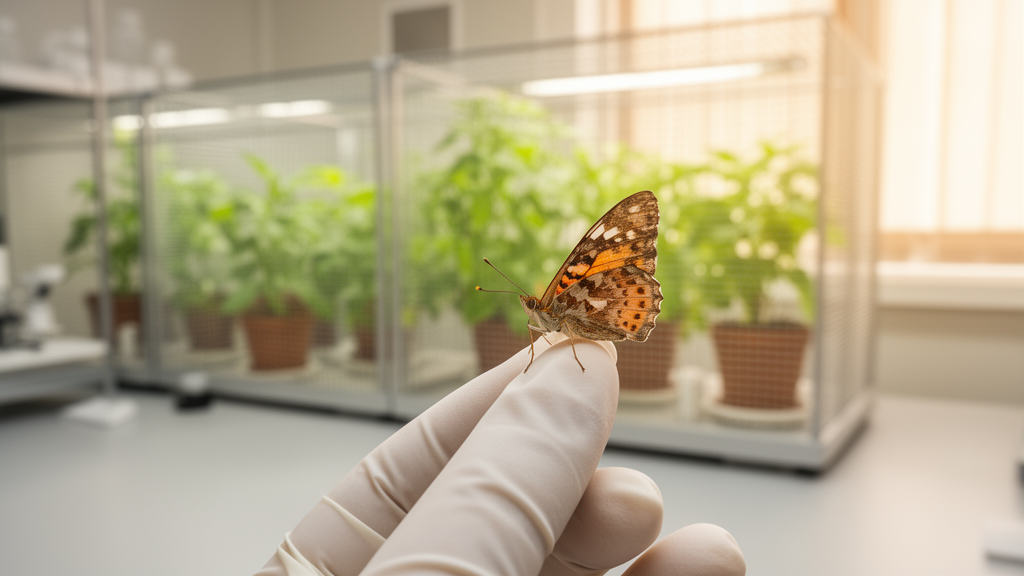
In a quiet park in Somerset West, South Africa, a team of butterfly enthusiasts captured eight unassuming satyrine butterflies in April 2019 and unwittingly unlocked a secret that could matter for the future of a species living on the edge of a changing climate. The butterflies, Dira clytus clytus, are endemic to the southern reaches of the Western Cape province, where they normally fly for just a few months each year, peaking in March. Yet when reared in captivity, these insects did something remarkable: they produced not one but two generations in a single year, emerging months earlier than their wild counterparts ever do. The finding, published in the journal African Invertebrates, offers a rare glimpse into the hidden plasticity of a butterfly whose survival may hinge on exactly this kind of flexibility.
The research formed part of the Caterpillar Rearing Group project run by the Lepidopterists’ Society of Africa, an initiative that enlists citizen scientists to document the life histories of southern African butterflies. On 8 April 2019, the researchers netted eight adults at Geelsloot Park in the Helderberg area of Cape Town, where a small colony appears every year, flying slowly above a grassy plot in the early morning. The butterflies were kept for one day in a netted enclosure alongside cuttings of local grasses. By the end of that day, numerous eggs had been collected from the floor of the enclosure, forming the foundation of what would become a year-long rearing experiment designated specimen code SM19_01.
The eggs themselves were dome-shaped with an indentation on one side and pale yellow in colour, and all of them hatched on 21 April 2019, exactly 13 days after being laid. Roughly 185 larvae emerged from this first batch. When offered four different grass species growing at the collection site, all of them were exotic to South Africa, the larvae made an unambiguous choice: every single one selected Kikuyu grass, Pennisetum clandestinum, and ignored the alternatives entirely. This strict preference is significant, because Kikuyu grass is a common feature of suburban gardens, and previous records had already flagged it as a food plant for this species in urban settings.
Over the following months, the larvae progressed through five instars, each photographed in unprecedented detail for this subspecies. The first instar lasted about nine days, the second roughly 15, the third about 17, and the fourth a lengthy 32 days. The fifth instar proved the longest of all, stretching beyond 64 days. It was during this extended final stage that the larvae entered diapause, a state of suspended development in which they became sluggish, immobile and largely stopped feeding. From 4 July onwards, the researchers repeatedly observed the larvae huddling very close together in dense groups, a behaviour that persisted throughout the cold season and is likely a thermoregulatory strategy to conserve heat, consistent with findings in other insects.
Then came the first surprise. On 10 September 2019, 143 days after hatching, the first three pupae appeared. Notably, two days before this, the region had experienced a heat wave with temperatures exceeding 30 degrees Celsius. The pupae formed on the bottom of the containers, unattached to any substrate, corroborating observations made by earlier naturalists going back to Trimen and Bowker in 1887. The first two adults emerged on 30 September, and in total 59 pupae and 50 adult emergences were recorded from the original batch, a 27 percent survival rate under captive conditions.
But the real revelation lay in the timing. Rather than a single wave of emergence, the data revealed two clearly separate pupal and adult emergence phases. The first phase produced 12 pupae between 10 and 30 September, all of which eclosed successfully, a 100 percent eclosion rate. The second phase was far larger: 46 pupae formed between 2 and 18 November, with one final straggler on 27 November, and 38 of these emerged as adults, an 83 percent eclosion rate. The second phase contained roughly four times more pupae and three times more adult emergences than the first, and its pupal stage was up to three days shorter.
When the researchers compared these pupation dates with daily temperature and rainfall records from the South African Weather Service, a pattern emerged with striking clarity. Both pupal phases began just five to seven days after very cold weather, when average temperatures dropped below 15 degrees Celsius. The second, larger phase also followed about nine days after heavy rainfall exceeding 20 millimetres. The behaviour of the remaining fifth instar larvae reinforced this link: they ceased feeding and became immobile for over a month, then suddenly became active the day after a cold, rainy night, and began pupating about a week later. The evidence points strongly to cold temperatures as the environmental cue that triggers pupation in this species, rather than any internal clock.
This is where the climate change implications become compelling. In the wild, Dira clytus clytus is single-brooded, with adults absent for nine months of the year, and the diapause occurs in the final larval instar rather than in the pupa, whose phase lasts only 17 to 25 days. Yet in captivity, the butterflies produced two broods, in September and November, emerging four to seven months earlier than usual. Intriguingly, no adults were observed flying at the grassy plot just 30 metres away during the same period, confirming that this was a captive phenomenon driven by environmental cues. Earlier studies had noted occasional out-of-season adults in the wild, and the related subspecies D. c. eurina emerges 1.5 months later at sea level than at cooler, higher-altitude sites 80 kilometres away, further supporting the idea that temperature governs emergence timing.
The researchers also collected four subsequent batches of eggs laid by the captive adults, between October and December 2019, with egg phases ranging from 11 to 20 days, extending the previously known range by four days. Unfortunately, none of the larvae from these second-generation batches survived to pupation, leaving open the question of whether a third brood is possible. The failure may reflect specific environmental requirements, such as temperature, humidity or day length, that captivity could not fully replicate, and which may explain why the butterfly remains single-brooded in nature despite its evident capacity for multivoltinism.
For a species with such a restricted distribution, these findings carry real weight. Insect development is acutely sensitive to temperature, and shifts in climate are known to alter the phenology of Lepidoptera, triggering earlier emergence from diapause and increases in the number of annual generations. The observations suggest that D. clytus may be able to respond to changing conditions by pupating and emerging earlier, and by increasing its voltinism, a form of phenotypic plasticity that could prove crucial for adaptation. However, plasticity is a double-edged sword: populations that shift their timing may become more vulnerable to extreme and rapid climatic changes, and phenological mismatches with host plant availability pose serious risks, especially for dietary specialists. The fact that this butterfly feeds on a variety of grasses, including one abundant in suburban settings, and diapauses in its final larval instar, may give it a measure of flexibility. Still, the authors caution that much more research is needed to determine how changing seasonality will ultimately affect this endemic South African butterfly, whose future may depend on how well its hidden plasticity holds up against a warming world.
Subject of Research: Life history and climate change adaptation of the South African endemic butterfly Dira clytus clytus
Article Title: Life history and behavioural observations during the rearing of Dira clytus clytus (Linnaeus, 1764) ( Insecta , Lepidoptera , Nymphalidae ), with notes on implications for climate change adaptation
Article References: Mecenero, S., & Kirkman, S. P. (2025). Life history and behavioural observations during the rearing of Dira clytus clytus (Linnaeus, 1764) (Insecta, Lepidoptera, Nymphalidae), with notes on implications for climate change adaptation. African Invertebrates, 66(1), 65-72. https://doi.org/10.3897/afrinvertebr.66.138082
Image Credits: AI Generated
DOI: 10.3897/AfrInvertebr.66.138082
Keywords: Dira clytus clytus, Lepidoptera, phenology, climate change adaptation, diapause, South Africa, Life, history, behavioural, observations, during, rearing
Cite Scienmag News
Sloane Callahan. (October 17, 2026). Captive Rearing Reveals a South African Butterfly’s Hidden Climate Flexibility. Scienmag. https://scienmag.com/captive-rearing-reveals-a-south-african-butterflys-hidden-climate-flexibility/
Sloane Callahan. "Captive Rearing Reveals a South African Butterfly’s Hidden Climate Flexibility." Scienmag, 17 October 2026, https://scienmag.com/captive-rearing-reveals-a-south-african-butterflys-hidden-climate-flexibility/. Accessed 17 October 2026.
Sloane Callahan. "Captive Rearing Reveals a South African Butterfly’s Hidden Climate Flexibility." Scienmag. October 17, 2026. https://scienmag.com/captive-rearing-reveals-a-south-african-butterflys-hidden-climate-flexibility/


