


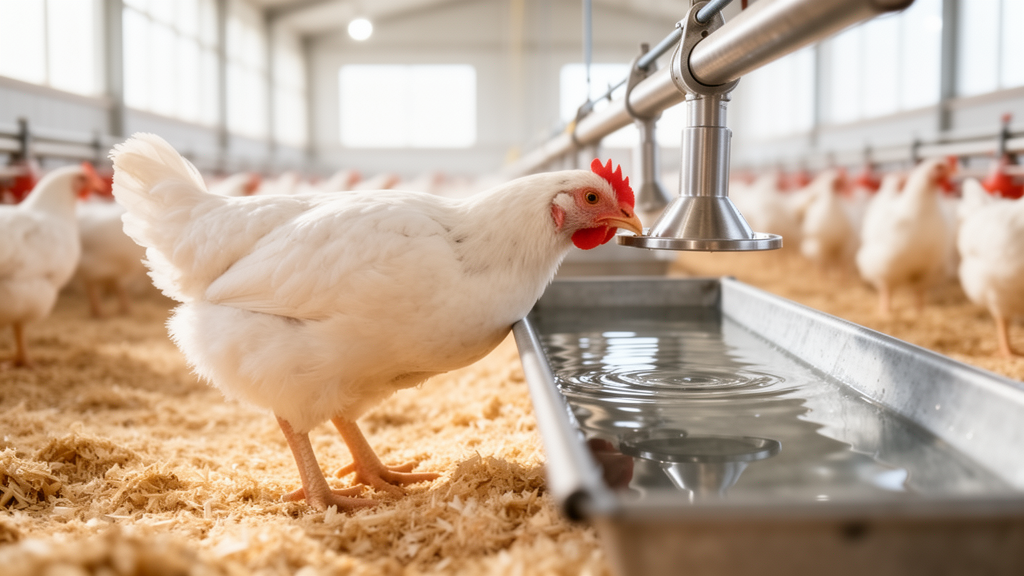
Water scarcity is quietly becoming one of the most pressing threats to global poultry production, and a new study from the University of Arkansas offers a molecular window into how chickens might be bred to drink less without growing less. Published in Frontiers in Physiology, the research examined the intestines of broiler chickens that have been divergently selected for four generations for either high or low water conversion ratio, revealing distinct patterns of gene expression associated with water homeostasis in three intestinal segments of both male and female birds.
The water conversion ratio, or WCR, is defined as grams of water intake per gram of body weight gain. Broilers typically consume roughly 1.6 to 2.0 times more water than feed, and while decades of intensive genetic selection have dramatically improved feed conversion ratio, little attention has been paid to water use efficiency. This is partly because accurately measuring water intake on individual birds is technically difficult and labor-intensive. The Arkansas team overcame this challenge using a novel low-flow water metering device, enabling them to select broiler lines designated LWCR (low water conversion ratio, meaning high water efficiency) and HWCR (high water conversion ratio, meaning low water efficiency) from a base population of modern random bred broilers that represented commercial genetics available in 2016.
In the present study, a 2×2 factorial experiment was conducted with male and female broilers from the fourth generation LWCR and HWCR lines. From 4 to 6 weeks of age, birds were housed in cages with nipple drinkers for individual monitoring of water intake. Nine males and nine females per line were randomly selected and phenotyped for WCR and feed conversion ratio. After the phenotyping period, the five birds per line and gender with the lowest and highest WCR were humanely euthanized, and tissue samples were rapidly excised from the upper duodenum, ileum, and cecum, flash-frozen in liquid nitrogen, and stored at minus 80 degrees Celsius.
Gene expression was determined by quantitative real-time PCR for four groups of water homeostasis-related genes. The first group comprised the arginine vasotocin system, the avian equivalent of the mammalian antidiuretic hormone vasopressin, including AVT itself, the structurally similar diuretic hormone mesotocin, and their receptors VR2, VR1a, VR1b, and MTR. The second group covered the renin-angiotensin system, with angiotensinogen, renin, angiotensin converting enzyme, angiotensin receptors AT1 and AT2, and the sodium-potassium ATPase subunit ATP1B1. The third group included aquaporins AQP1 through AQP5 and AQP11, membrane channels that facilitate water movement across epithelial cells. The fourth group encoded tight junction proteins, specifically occludin and the claudins CLDN2 and CLDN15, which regulate paracellular water movement between cells.
The results revealed segment-specific and sex-specific patterns. In the upper duodenum, the LWCR line exhibited lower mRNA expression of AVT, VR1a, ACE, and aquaporins AQP1, AQP3, and AQP11, while CLDN2 expression was higher compared to the HWCR line. In the ileum, VR1a and AQP11 were down-regulated in LWCR broilers, whereas renin, ATP1B1, and CLDN2 were up-regulated. In the cecum, the LWCR line showed higher expression of VR2, ACE, and CLDN15, and lower expression of angiotensinogen and AQP5. These findings contrast with previous studies in which birds were raised in floor pens rather than cages, suggesting that housing conditions, possibly through litter contact, may influence intestinal gene expression patterns related to water homeostasis.
Sex differences proved equally striking. Female broilers exhibited lower expression of AQP4 in the upper duodenum and lower expression of angiotensinogen, renin, ACE, AT1, and AT2 in the ileum compared to males, indicating a down-regulation of the renin-angiotensin system in the ileum of females. In the cecum, however, females showed elevated levels of the mesotocin receptor, angiotensinogen, ACE, AT1, AT2, aquaporins AQP1, AQP2, AQP3, AQP4, and AQP11, as well as occludin and CLDN2. The authors suggest that this up-regulation of the aquaporin family in the cecum of females might indicate an enhanced capability of water reabsorption from the cecum compared to males.
The renin-angiotensin system has been recognized for over 60 years to play important roles in gut physiology, including effects on gut motility, yet little research has been devoted to studying the functionality of intestinal RAS in any species, and even fewer investigations have been carried out in avian species. The classic action of RAS begins with renin secretion from the kidney, which cleaves circulating angiotensinogen to form angiotensin I, subsequently converted to angiotensin II by ACE. Angiotensin II binding to AT1 receptors promotes vasoconstriction, inflammation, and oxidation, while binding to AT2 receptors causes vasodilation and anti-inflammatory effects. The differential expression of RAS components between LWCR and HWCR lines and between sexes in the present study hints at previously unappreciated roles for this hormonal cascade in avian intestinal water balance.
Tight junction proteins emerged as a consistent theme across intestinal segments. CLDN2 expression was up-regulated in the upper duodenum of LWCR males, in the ileum of LWCR females, and as a main effect of line in both the upper duodenum and ileum. CLDN15 was elevated in the cecum of LWCR broilers. These findings align with previous work demonstrating that LWCR broilers lose less water across the gut epithelium than HWCR broilers under both thermoneutral and heat stress conditions, as measured by fluorescein isothiocyanate-dextran clearance from the blood. Greater tight junction integrity would reduce paracellular water movement into the gut lumen, contributing to the superior water use efficiency of the LWCR line.
The study is the first to report intestinal gene expression associated with water homeostasis in male and female broilers individually phenotyped for high and low water use efficiency. While a clear unified picture of differential expression across all four gene groups was not observed as a main effect of line, the main effect of gender was apparent, with females exhibiting down-regulation of the RAS system in the ileum and up-regulation of both the RAS system and the aquaporin family in the cecum. The authors note that improved WCR in the LWCR group was independent of body weight and body weight gain and was associated with better feed conversion ratio, meaning that water efficiency does not appear to be confounded with growth performance between the lines.
Looking forward, the team has initiated transcriptomic, proteomic, and metabolomic studies in several tissues to delineate water homeostasis mechanisms more clearly in these unique broiler lines. Additional mechanistic studies, including time course experiments targeting specific intestinal proteins and circulating hormones, combined with intestinal water and electrolyte flux measurements and histological assessment, will be required to fully understand the physiological differences resulting from divergent selection for water use efficiency. At the very least, the authors hope this work will provide a roadmap for the development of genetic markers that could be used in commercial breeding programs to improve water use efficiency in broilers worldwide, helping sustain the poultry industry as water scarcity issues continue to intensify across the globe.
Subject of Research: Poultry Physiology and Genetics
Article Title: Water homeostasis gene expression in intestines of male and female broilers divergently selected and individually phenotyped for low and high water conversion ratio
Article References: Lassiter, K., Greene, E. S., Maqaeda, M., Tabler, T., Shafer, K., Roach, B., Wideman, R. F., Jr., Dridi, S., Orlowski-Workman, S., & Bottje, W. G. (2026). Water homeostasis gene expression in intestines of male and female broilers divergently selected and individually phenotyped for low and high water conversion ratio. Frontiers in Physiology, 17, Article 1954752. https://doi.org/10.3389/fphys.2026.1954752
Image Credits: AI Generated
DOI: 10.3389/fphys.2026.1954752
Keywords: broilers, water homeostasis, gene expression, aquaporins, renin-angiotensin system, arginine vasotocin, tight junctions, water conversion ratio, poultry science, genetic selection, Water, homeostasis
Cite Scienmag News
Juliet Wilcox. (October 17, 2026). Water-Saving Chickens: Gene Expression Reveals How Broiler Intestines Manage Water Homeostasis. Scienmag. https://scienmag.com/water-saving-chickens-gene-expression-reveals-how-broiler-intestines-manage-water-homeostasis/
Juliet Wilcox. "Water-Saving Chickens: Gene Expression Reveals How Broiler Intestines Manage Water Homeostasis." Scienmag, 17 October 2026, https://scienmag.com/water-saving-chickens-gene-expression-reveals-how-broiler-intestines-manage-water-homeostasis/. Accessed 17 October 2026.
Juliet Wilcox. "Water-Saving Chickens: Gene Expression Reveals How Broiler Intestines Manage Water Homeostasis." Scienmag. October 17, 2026. https://scienmag.com/water-saving-chickens-gene-expression-reveals-how-broiler-intestines-manage-water-homeostasis/


