


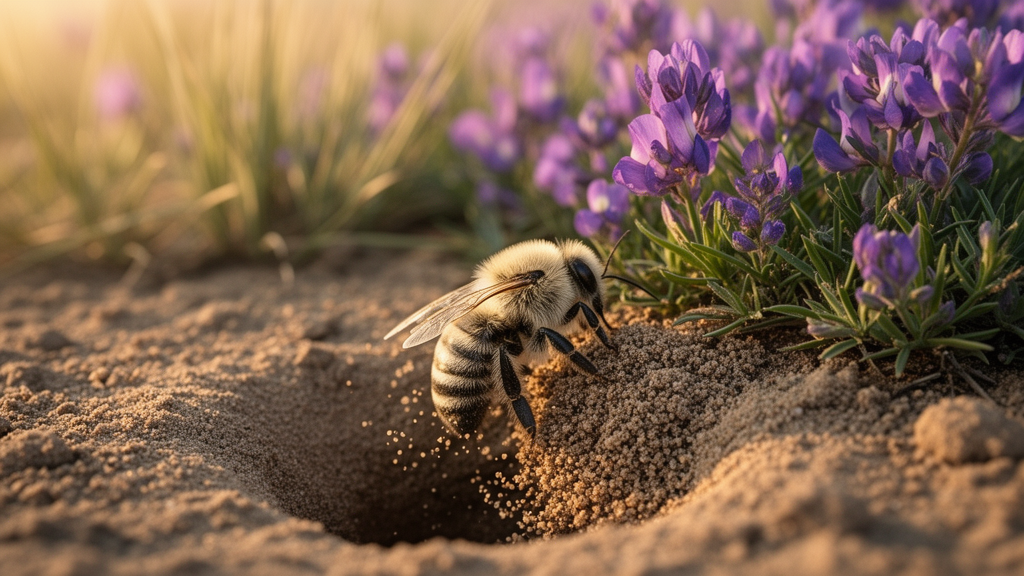
In the restored tallgrass prairies of Crow-Hassan Park Preserve in Hennepin County, Minnesota, a dirt two-track road has turned out to be one of the most valuable pieces of real estate for a rare native bee. Along a 23-meter stretch of that road, researchers from the Minnesota Department of Natural Resources and the Cariveau Native Bee Lab at the University of Minnesota documented an estimated 338 nests of Colletes andrewsi, a little-known cellophane bee that depends almost entirely on the flowers of Heuchera richardsonii, the prairie alumroot. Their new study, published in the Journal of Hymenoptera Research, provides the first detailed account of the nesting biology, foraging distances, mating behavior, and predators of this elusive specialist, whose sightings vanished entirely between 1990 and 2009 before a targeted search for rare bees brought it back into the light.
Colletes is one of the largest genera in the plasterer bee family Colletidae, with roughly 524 valid species on every continent except Australia and Antarctica. All of them are solitary and ground-nesting, and many form gregarious nesting aggregations. Yet the life histories of most species remain poorly described, a gap that falls hardest on rare floral specialists, which are precisely the bees most vulnerable to decline. Colletes andrewsi is a textbook case: prior to this work, researchers knew only that it favored Heuchera pollen and that it ranged across the northern prairie region of North America, from Manitoba south to Colorado and east to Wisconsin. In Minnesota, just five records existed before 2023. After a project targeting rare and specialist bees found the species at numerous new sites by seeking out blooming H. richardsonii, it was ranked as Vulnerable in the state and listed as a Species of Greatest Conservation Need in the Minnesota State Wildlife Action Plan.
The study site at Crow-Hassan offered an unusually favorable setting. Decades of overseeding there had produced an exceptionally large population of Heuchera richardsonii, the only native Heuchera in Minnesota, covering an area roughly 300 meters wide and 500 meters long. At peak bloom on June 10, 2025, the patch held 25,467 flowering stems. The nesting aggregation sat on a dirt road beside this floral bonanza, in predominantly loamy sand classified as excessively well drained. The researchers marked female bees with unique three-color combinations applied to the mesosomal dorsum using non-toxic paint pens, capturing bees from emergence tents, at nest entrances with clear plastic cups, and directly from flowers. Marking appeared harmless; most bees flew off about 30 seconds after release, and many were seen foraging immediately afterward.
Emergence tents placed over the aggregation on May 23, 2025, revealed striking patterns of natal philopatry. Of 49 bees captured in the tents, 34 were females and 15 were males, emerging between May 28 and June 2. Eleven of the 29 marked females were later found nesting in the same aggregation, settling between 1.5 and 13.75 meters from their emergence point, with a mean of 6.22 meters. Excavations confirmed the pattern: brood cells from the previous year were found inside active nests, showing that daughters emerge and nest within the very aggregation where they were born. This nest site fidelity, combined with the bees’ short adult lives, makes the persistence of each aggregation highly dependent on the survival of the site itself.
The nests themselves proved remarkably shallow. Excavation of 16 nests revealed a simple architecture: a small, often inconspicuous tumulus at the surface, a short main tunnel descending vertically or at a slight angle, and a compact cluster of short lateral branches each ending in a vertical brood cell lined with the cellophane-like secretion characteristic of Colletes. From entrance to the deepest cell, nests ranged from just 1.27 to 6.9 centimeters, with a mean of 3.9 centimeters. That is dramatically shallower than the average minimum brood cell depth of around 17 centimeters reported for solitary bees generally, and far shallower than the deepest known solitary bee nest at 270 centimeters. Each nest held 1 to 8 brood cells, averaging 3.93, all provisioned with bright orange-red pollen that the researchers attributed to H. richardsonii based on its color and consistent observations of females collecting only from that plant.
The shallowness carries a cost. Camera traps deployed after the team noticed large patches of dug-up soil revealed a thirteen-lined ground squirrel systematically excavating nests to eat the developing brood and their provisions, in what the authors believe is the first documented account of ground squirrel predation on solitary bee nests. The footage even captured the squirrel catching and eating an adult bee as it flew down to its nest. The predator’s precision was striking: in some cases cell linings remained intact with their contents neatly removed. The researchers note that the shallow nests may facilitate the bees’ habit of constructing multiple nests in quick succession, at least 45 marked females built two nests and eight built three, but the same trait likely leaves brood more exposed to digging mammals. Before the study, there had even been plans to regrade the road at the aggregation site, which would have destroyed every nest.
Foraging data came from 231 trips by 130 uniquely marked females confirmed to be nesting at the aggregation. Distances ranged from 16 to 331 meters, with a mean of 143 meters, on the short end of the spectrum for Colletes, where European species have been recorded foraging 350 to 2,225 meters. The authors suggest this reflects their focus on realized rather than maximum foraging distance. More surprising was the patch fidelity: despite a vast, continuously blooming resource, individual females returned repeatedly to the same spots within the flower patch. One bee foraged 202 meters from the nest on June 4 and was recaptured five days later just 2 meters from the previous sighting. Of 89 fidelity measurements, more than half were within 20 meters of the prior location, and 26 were within 10 meters. Foraging trips averaged 20 minutes and 34 seconds, while females spent an average of only 3.5 minutes inside the nest depositing provisions between trips.
Mating behavior set C. andrewsi apart from many of its relatives. Males, which are typically larger than females, patrolled the H. richardsonii flowers and tackled females as they landed to forage; no males ever patrolled the nest site, and no mating was observed there. Most attempts failed, with both bees tumbling to the ground before separating, but four successful mating events were recorded, each lasting 20 seconds or less. The researchers consider it likely that females mate multiple times throughout their adult lives, though a single-mating scenario cannot be ruled out. Males carried a pungent, musty odor reminiscent of dog food with a hint of citrus, detectable even when walking through flower patches, though unlike in some other Colletes species the scent did not appear to attract mates. Occasional males also tackled other males off flowers, apparently by mistake rather than as territorial aggression.
The aggregation was a stage for other dramas as well. Females fought at nest entrances and inside tunnels when a second female attempted to take over an occupied nest, and marked females were observed starting new nests after their original ones had been usurped. Individuals of the cleptoparasitic bee Epeolus interruptus were seen investigating C. andrewsi nests in 2024, but none appeared in 2025. Ants dragged away only bees that were already dead or dying, and dragonflies, abundant over the prairie, represent a likely but unquantified source of mortality. Many newly emerged bees were found dead or struggling with twisted wings, possibly from disease, though the cause remains under investigation.
The findings translate directly into conservation strategy. Because C. andrewsi depends entirely on H. richardsonii in Minnesota, a plant with a high coefficient of conservatism that favors undisturbed prairie, protecting and restoring high-quality prairie habitat with robust alumroot populations is essential. Because females are philopatric and forage within a few hundred meters, habitat connectivity matters, and the authors suggest that the species’ unusual combination of nest fidelity and flower-based mating warrants population genetics research to understand gene flow. The Crow-Hassan population, roughly six times larger than any other known population of the species, likely owes its size to decades of deliberate overseeding of its host plant, evidence that targeted floral restoration can rescue rare specialist bees. As the authors emphasize, population-level life history studies of solitary and rare bees remain scarce, yet they are exactly what land stewards need to manage and restore habitat for the specialists most at risk of slipping away unnoticed.
Subject of Research: Nesting biology, foraging distance, and mating behavior of the rare specialist bee Colletes andrewsi
Article Title: The nesting biology and foraging distance of the bee Colletes andrewsi ( Hymenoptera , Colletidae ), a rare specialist of Heuchera spp.
Article References: Chase, M. H., Portman, Z. M., Petersen, J. D., Gerjets, N., Kranz, R., LaBry, F., Hudson, D., Lane, I. G., & Cariveau, D. P. (2026). The nesting biology and foraging distance of the bee Colletes andrewsi (Hymenoptera, Colletidae), a rare specialist of Heuchera spp.. Journal of Hymenoptera Research, 99, 703-722. https://doi.org/10.3897/jhr.99.189555
Image Credits: AI Generated
Keywords: Colletes andrewsi, cellophane bees, Heuchera richardsonii, nesting biology, foraging distance, philopatry, floral specialization, solitary bees, prairie restoration, ground squirrel predation, Minnesota, bee conservation
Cite Scienmag News
Margaret Porter. (October 17, 2026). Rare Prairie Bee Digs Surprisingly Shallow Nests and Stays Loyal to One Flower Patch. Scienmag. https://scienmag.com/rare-prairie-bee-digs-surprisingly-shallow-nests-and-stays-loyal-to-one-flower-patch/
Margaret Porter. "Rare Prairie Bee Digs Surprisingly Shallow Nests and Stays Loyal to One Flower Patch." Scienmag, 17 October 2026, https://scienmag.com/rare-prairie-bee-digs-surprisingly-shallow-nests-and-stays-loyal-to-one-flower-patch/. Accessed 17 October 2026.
Margaret Porter. "Rare Prairie Bee Digs Surprisingly Shallow Nests and Stays Loyal to One Flower Patch." Scienmag. October 17, 2026. https://scienmag.com/rare-prairie-bee-digs-surprisingly-shallow-nests-and-stays-loyal-to-one-flower-patch/


