


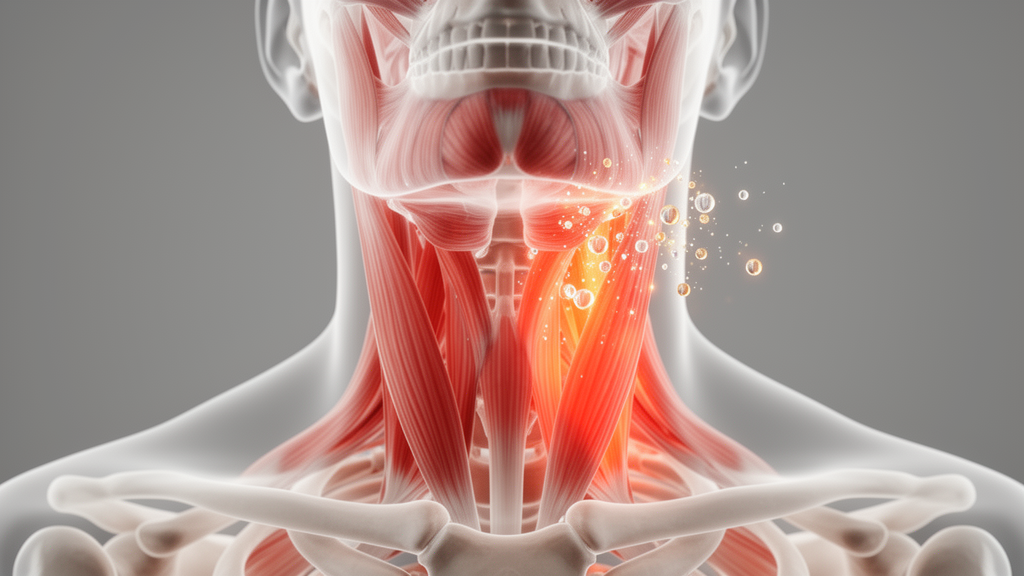
For roughly three out of every four people living with cervical dystonia, the disorder is far more than an uncontrollable head posture. It is a condition defined by pain—described by patients as pulling, aching, deep, or sharp—that often dominates daily life even more than the visible muscle contractions themselves. Among all the dystonia syndromes, cervical dystonia carries the highest rates of pain, and yet the precise geography of that pain has remained surprisingly poorly mapped. A new observational study from University Hospitals Cleveland Medical Center, published in the journal Dystonia, has now generated one of the most detailed heat maps to date of where cervical dystonia pain concentrates in the neck, while also testing whether the location of botulinum toxin injections predicts how much pain relief patients experience afterward.
Cervical dystonia is a neurological disorder characterized by involuntary contractions of the neck muscles, producing abnormal postures of the head and, in many patients, a tremor. The mainstay of treatment is botulinum neurotoxin, injected directly into the overactive muscles, where the toxin blocks acetylcholine release at the neuromuscular junction and weakens the pathological contractions. Decades of clinical trials have established that botulinum toxin improves motor symptoms, quality of life, and pain, and a majority of patients report some degree of pain relief after treatment. But a substantial portion of treated patients remain incompletely satisfied, citing incomplete efficacy, side effects, or logistical burdens—leaving open the question of how injections could be optimized, particularly for patients whose primary complaint is pain rather than posture.
The research team, led by Alexander S. Wang and colleagues, recruited 55 patients with idiopathic cervical dystonia who reported pain and were scheduled for electromyography-guided botulinum toxin injections. On the day of the injection—while still in the untreated state—each patient marked their primary and secondary pain sites on a body diagram and rated their average pain over the previous 24 hours on a Pain Numeric Rating Scale. Two weeks later, in the treated state, they completed a follow-up survey to determine whether the location and intensity of pain had changed. Forty patients completed both surveys and formed the core of the analysis. Whenever possible, the team also assessed dystonia severity using the Toronto Western Spasmodic Torticollis Rating Scale (TWSTRS) motor subscale, and some patients completed the evaluation virtually when time constraints prevented an in-person visit.
The heat map that emerged from the diagram responses tells a clear anatomical story. Most patients localized their pain over the posterior neck musculature, with the strongest concentrations in the regions overlying the superior trapezius and the levator scapulae. To a lesser degree, pain also clustered over the splenius cervicis and splenius capitis, and some patients reported anterolateral neck pain around the sternocleidomastoid. This pattern is anatomically coherent: these are precisely the muscles that tend to be clinically overactive in cervical dystonia, supporting the idea that a large share of the pain is muscular in origin, generated by sustained pathological contractions. Notably, when the team overlaid the pre-treatment and post-treatment diagrams onto a digital grid and measured the pixel distance between marked pain sites, the locations remained relatively stable after treatment—the mean distance between primary pain sites was about 70 pixels, roughly 5 centimeters—suggesting that botulinum toxin relieves pain where it already lives rather than relocating it.
The treatment results confirmed what the existing literature has long suggested. Of the 37 respondents who answered the question, 84 percent said their pain improved following injection, and no side effects related to botulinum toxin were reported. The mean improvement in pain intensity was 30.4 percent, with a mean drop of 2.13 points on the Numeric Rating Scale. Twenty-one of the 40 patients—52.5 percent—reported improvement of at least 30 percent at their primary pain site, and five patients, or 12.5 percent, reported complete resolution of their pain. Those who reported benefit had a mean improvement of 2.44 points at the primary pain site on the visual analog scale in the treated compared to the untreated state.
The more provocative finding, however, was what failed to predict pain relief. The team hypothesized that patients receiving higher total doses of toxin, and those whose injections landed directly in their muscular site of pain, would experience superior improvement. To test this, they collaborated with a medical illustrator to draw the expected locations of the underlying muscles onto the composite heat map, then used clinical documentation to determine whether each patient’s marked pain site had been injected directly—for example, if the pain overlapped with both the splenius cervicis and splenius capitis, injection into either muscle counted as hitting the target. In total, 33 of 53 respondents received injections into their primary pain site, and 21 of 33 into their secondary site. Yet univariate linear regression found no clear effect of age, sex, disease duration, total botulinum toxin dose, dose into specific muscles, TWSTRS motor scores, or change in pain location on the degree of pain improvement.
The direct comparison between targeted and non-targeted injections was equally unconvincing. Patients who received injections into their primary or secondary pain site reported a mean pain improvement of 2.33 points, compared with 1.33 points among those whose injections missed both sites—but the difference was not statistically significant (p = 0.30). The authors caution that the study was not powered to detect such effects; with only 40 completers, a real advantage of chasing the pain could easily have been missed. Larger studies, they argue, may clarify whether clinicians ought to pursue a deliberate chase-the-pain approach in patients for whom pain relief is the priority, rather than relying solely on standard injection patterns aimed at the most overactive muscles.
The study also exposed a subtle but important discrepancy between what patients perceived and what their numerical ratings showed. Of the six respondents who reported no improvement in pain after injection, three nevertheless wrote a lower numerical pain value on the follow-up survey. Conversely, five of the 31 patients who did report improvement recorded either no change or an increased numerical pain value. This mismatch underscores the contribution of recall bias and highlights a limitation of assessing pain with one-time ratings rather than detailed daily pain logs. The authors suggest that future studies employ more granular and validated instruments, such as the recently developed Pain in Dystonia Scale, to capture the temporal texture of pain in dystonia more faithfully.
The muscular account of cervical dystonia pain, while supported by the heat map’s anatomical clustering, is not the whole story. Other lines of evidence have implicated central or multifactorial mechanisms in pain generation. A 2019 study found evidence of abnormal inhibitory control in cervical dystonia patients, and an intriguing case report of bilateral pallidal deep brain stimulation described dissociated pain and motor improvement—pain relief without corresponding motor benefit—pointing to pain circuits that operate partly independently of the motor pathology. If pain in cervical dystonia arises partly from abnormal central processing rather than purely from overactive peripheral muscles, then the location of botulinum toxin injections might matter less than the current muscular model predicts, which is consistent with the present study’s null finding on injection targeting.
For now, the practical takeaways are grounded and reassuring. Botulinum toxin remains an effective treatment for pain related to cervical dystonia, delivering a mean improvement of about 30 percent in pain intensity with no reported treatment-related side effects in this cohort. The new heat map gives clinicians and patients a shared visual vocabulary for the disorder’s pain—concentrated in the upper trapezius, levator scapulae, and splenius muscles of the posterior neck—and confirms that these pain locations stay put through the treatment cycle. What remains unresolved is how to inject smarter for the patients whose pain outlasts their posture improvements. The Cleveland team’s answer is characteristically scientific: the hypothesis was worth testing, the data did not yet support it, and the definitive study will need to be bigger. Until then, the geography of cervical dystonia pain is finally on the map—even if the optimal route to relieving it is still being charted.
Subject of Research: Neuroscience
Article Title: Pain localization and response to botulinum toxin in cervical dystonia
Article References: Wang, A. S., Agharazi, H., Parmar, A., Kilbane, C. W., Cameron, L., Shaikh, A. G., & Gunzler, S. A. (2025). Pain localization and response to botulinum toxin in cervical dystonia. Dystonia, 4, Article 14652. https://doi.org/10.3389/dyst.2025.14652
Image Credits: AI Generated
Keywords: cervical dystonia, botulinum toxin, pain, pain localization, neurology, movement disorders, dystonia, heat map, localization, response, botulinum, toxin
Cite Scienmag News
Cassandra Pierce. (October 17, 2026). Where Neck Pain Lives in Cervical Dystonia—and Why Botulinum Toxin Helps. Scienmag. https://scienmag.com/where-neck-pain-lives-in-cervical-dystonia-and-why-botulinum-toxin-helps/
Cassandra Pierce. "Where Neck Pain Lives in Cervical Dystonia—and Why Botulinum Toxin Helps." Scienmag, 17 October 2026, https://scienmag.com/where-neck-pain-lives-in-cervical-dystonia-and-why-botulinum-toxin-helps/. Accessed 17 October 2026.
Cassandra Pierce. "Where Neck Pain Lives in Cervical Dystonia—and Why Botulinum Toxin Helps." Scienmag. October 17, 2026. https://scienmag.com/where-neck-pain-lives-in-cervical-dystonia-and-why-botulinum-toxin-helps/


