


Competitive athletes over the age of 50 have long trained, raced, and recovered under screening rules built for twenty-year-olds. Now a research team has delivered the first reference values for eccentric hamstring strength in senior athletes, and the numbers tell a story that could change how clinicians and coaches evaluate older competitors. The study, published in Frontiers in Sports and Active Living, measured 203 Masters athletes aged 50 to 91 at the Huntsman World Senior Games and found that even highly active older adults show measurable strength declines with age, while widely used limb asymmetry thresholds may unfairly flag healthy senior athletes as being at risk.
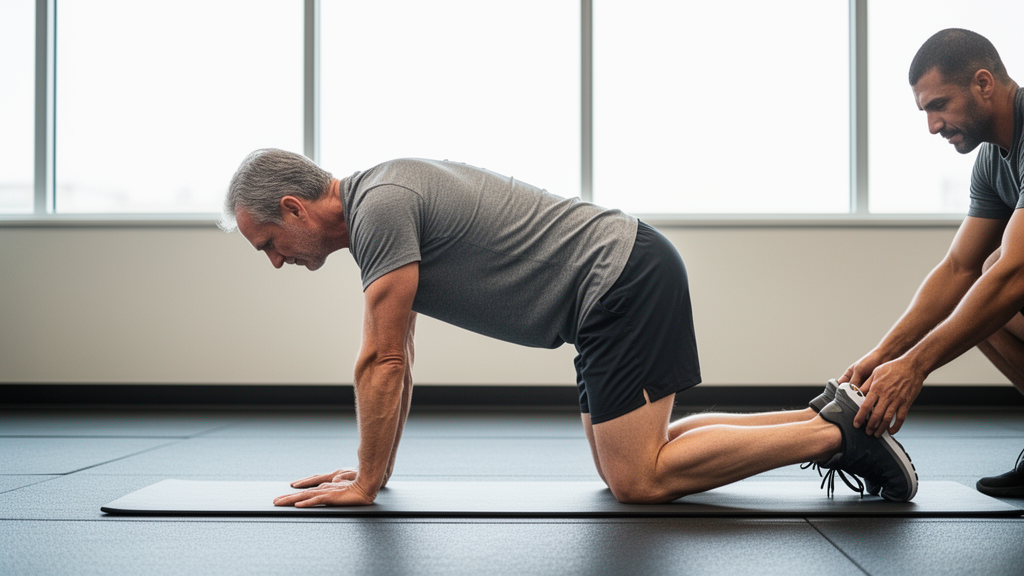
The research matters because hamstring injuries remain one of the most common problems in running and sprinting sports, and advancing age may compound that risk. Programs built around the Nordic hamstring exercise, in which athletes kneel and resist a forward fall to load the hamstrings eccentrically, have been shown to cut hamstring injury rates by up to 51 percent in athletic populations. Instrumented versions of the test, using devices that quantify the force generated as the athlete resists the descent, have become standard screening tools in elite junior, collegiate, and professional cohorts. Until now, however, no reference values existed for older athletes, leaving practitioners to interpret senior athletes’ scores against benchmarks derived from much younger bodies.
The research team set up a performance assessment area at the Huntsman World Senior Games, an annual event that draws more than 11,000 athletes competing in over 40 sports. Across the 2022 and 2023 games, 203 registered athletes, 100 of them female, completed the testing protocol. Each participant warmed up, performed three submaximal Nordic hamstring repetitions at roughly 50, 75, and 90 percent of perceived effort, and then completed three maximal-effort trials separated by 60 seconds of rest. During each repetition, athletes were instructed to resist forward descent as long as possible, and the peak force recorded for each limb was captured by the instrumented device. Reliability testing in a separate sample using the same protocol demonstrated high within-session reliability for peak eccentric force.
The headline numbers are striking. Mean unilateral absolute peak force was 156 newtons in female athletes and 242 newtons in male athletes. When normalized to body mass, those figures correspond to relative values of 2.46 and 2.99 newtons per kilogram, respectively. Median values across the full sample were 186.25 newtons in absolute terms and 2.66 newtons per kilogram in relative terms, with observed forces ranging from 57.25 to 496.75 newtons. The sex difference was very large in absolute terms, with a Cohen’s d effect size of 1.54, and remained moderate even after normalization to body mass, with a d of 0.76. That persistence matters: it suggests body mass alone does not explain the disparity, pointing instead to possible contributions from differences in lean mass distribution, limb dimensions, muscle architecture, tendon properties, and neuromuscular characteristics, along with menopause-related reductions in muscle mass and neuromuscular function in older women.
Age left its mark on the data in a way that surprised no one physiologically but still carries weight practically. Each additional year of age was associated with 2.10 newtons less absolute peak force and 0.020 newtons per kilogram less relative peak force. Expressed practically, a ten-year increase in age corresponded to roughly 21 newtons less absolute force and 0.20 newtons per kilogram less relative force. The regression model for absolute strength explained a moderate proportion of variance, while the relative strength model explained less. Crucially, these declines occurred despite the cohort reporting a median of 660 minutes per week of moderate-to-vigorous physical activity, indicating that sustained athletic participation does not fully prevent age-related reductions in muscle function, even among senior competitors.
The authors interpret the modest magnitude of decline as potentially reflecting partial attenuation of age-related strength loss through continued training. This aligns with broader ageing literature showing that physically active older adults generally retain greater muscle strength and functional capacity than sedentary peers, and with evidence that eccentric strength appears relatively better preserved with ageing than concentric strength, particularly among those performing regular resistance or eccentric training. Masters athlete performance data show progressive reductions in sprint speed, strength, and power output with advancing age, though some evidence suggests these declines may be less steep than previously estimated in highly active older adults. The researchers caution, however, that the analysis was cross-sectional rather than longitudinal, so the observed age association cannot be read as within-person decline over time.
Perhaps the most consequential finding concerns limb asymmetry. Mean absolute asymmetry across the sample was 11.6 percent, with a standard deviation of 8.8 percent and a 75th percentile of 16.1 percent. In younger athletic cohorts, greater eccentric strength asymmetry has been linked to increased hamstring strain injury risk, with one prospective study in elite rugby players reporting that between-limb imbalances of 15 and 20 percent were associated with 2.4-fold and 3.4-fold greater injury risk, respectively. Those findings helped entrench asymmetry thresholds of roughly 10 to 15 percent in screening and return-to-sport settings. Yet in this senior cohort, a quarter of participants exceeded 16 percent asymmetry while continuing to compete at a high level, and asymmetry showed no significant association with either age or sex.
The implication is that common asymmetry thresholds may overclassify high-functioning senior athletes as having concerning inter-limb differences. The authors note that similar asymmetry magnitudes have been reported in healthy older adults, with knee extensor asymmetry values of roughly 10 to 15 percent across middle-aged and older cohorts and mean hamstring asymmetry of about 9 percent in older non-fallers. A systematic review has also cautioned against arbitrary asymmetry cut-points, noting that commonly used thresholds are not robustly supported across the literature. The study’s data support recommendations that asymmetry values be interpreted within population-specific contexts rather than relying on universal cut-points derived primarily from younger athletic cohorts.
For context on how senior athletes compare with younger populations, the reported values sit well below benchmarks from elite and professional cohorts. Elite, subelite, and under-19 rugby players have shown eccentric knee flexor strength values of approximately 343 to 388 newtons, with relative values of 3.65 to 4.03 newtons per kilogram. Elite Australian footballers have demonstrated mean values of roughly 301 to 330 newtons and relative values of 3.81 to 4.18 newtons per kilogram. British track and field athletes have recorded average peak forces of 418 newtons in males and 319 newtons in females, with relative values approaching 5.0 newtons per kilogram in both sexes, and professional soccer cohorts have exceeded 400 newtons in some settings. Even adolescent cohorts commonly demonstrate relative force values near or above 4.0 newtons per kilogram by late adolescence.
The study’s practical payoff is a set of sex-stratified percentile tables, spanning the 10th through 90th percentiles within age bands of 50 to 59, 60 to 69, and 70 and above, that clinicians, coaches, and practitioners can use for benchmarking during athlete monitoring, rehabilitation, and performance testing. The authors acknowledge limitations, including the cross-sectional design, the highly active sample that may not generalize to less active older adults, small subgroups such as males aged 50 to 59, and the use of a specific testing device and protocol that may limit direct comparability with other systems. Injury history, resistance training history, and body composition were not included in the analyses. Still, the work fills a genuine gap: for the first time, practitioners evaluating an athlete over 50 have population-specific reference data rather than benchmarks borrowed from younger bodies, and a reminder that asymmetry numbers once considered alarming may simply be normal for older, high-functioning competitors.
Subject of Research: A cross-sectional study of 203 Masters athletes establishes the first sex-stratified reference values for eccentric hamstring strength measured with instrumented Nordic hamstring testing, quantifying sex and age associations and inter-limb asymmetry in senior competitors.
Article Title: Measuring eccentric hamstring strength in senior athletes: reference values, age and sex associations, and limb asymmetry
Article References: Hinkle, L. J., Mead, J. D., Merrill, E. A., Sponbeck, J. K., Hager, R., & Johnson, A. W. (2026). Measuring eccentric hamstring strength in senior athletes: reference values, age and sex associations, and limb asymmetry. Frontiers in Sports and Active Living, 8, Article 1933413. https://doi.org/10.3389/fspor.2026.1933413
Image Credits: AI Generated
DOI: 10.3389/fspor.2026.1933413
Keywords: Masters athletes, eccentric hamstring strength, Nordic hamstring exercise, aging, injury prevention, limb asymmetry, senior athletes, muscle strength, sports science, reference values, hamstring injuries, biomechanics
Cite Scienmag News
Beatrice Stafford. (October 16, 2026). Nordic hamstring test reveals first strength benchmarks for athletes over 50. Scienmag. https://scienmag.com/nordic-hamstring-test-reveals-first-strength-benchmarks-for-athletes-over-50/
Beatrice Stafford. "Nordic hamstring test reveals first strength benchmarks for athletes over 50." Scienmag, 16 October 2026, https://scienmag.com/nordic-hamstring-test-reveals-first-strength-benchmarks-for-athletes-over-50/. Accessed 16 October 2026.
Beatrice Stafford. "Nordic hamstring test reveals first strength benchmarks for athletes over 50." Scienmag. October 16, 2026. https://scienmag.com/nordic-hamstring-test-reveals-first-strength-benchmarks-for-athletes-over-50/


