


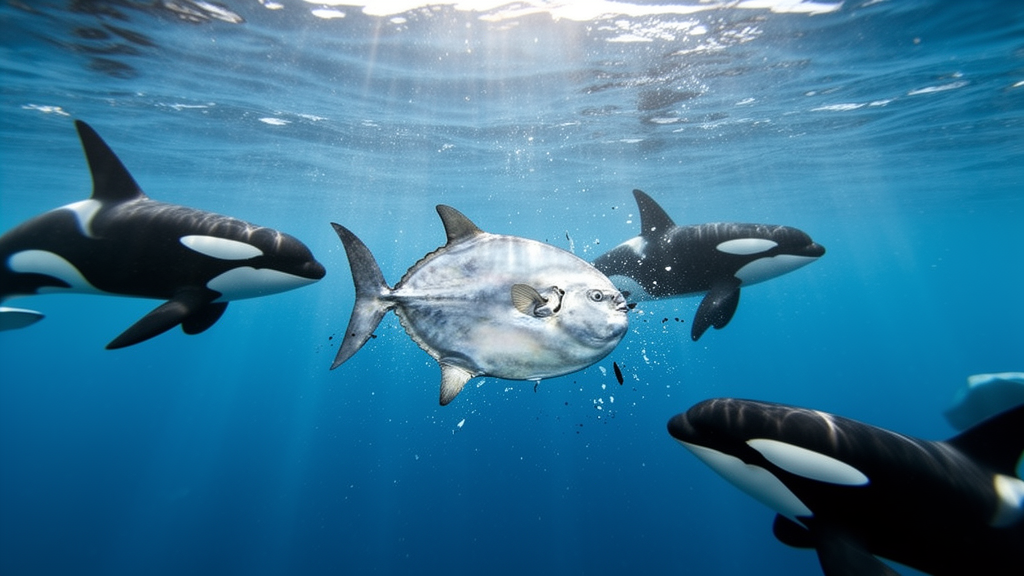
Off the coast of Baja California Sur, Mexico, a team of marine researchers has documented a hunting behavior in orcas that has never been described before: a coordinated, high-speed ramming maneuver that literally shatters the body of a sharp-tail sunfish into fragments. The findings, published in Frontiers in Ethology, reveal a level of cooperative precision in prey handling that adds a remarkable new entry to the predatory repertoire of one of the ocean’s most intelligent apex predators.
The study, led by Kathryn A. Ayres of the conservation organization Beneath The Waves, describes two separate predation events in the southern Gulf of California. In both cases, adult orcas were observed working in tandem: one individual would stabilize a sharp-tail sunfish (Masturus lanceolatus) while another accelerated at high speed and collided with the prey with enough force to cause substantial tissue fragmentation. The researchers have termed this behavior ‘ram-to-fragment,’ and it represents a previously undocumented iteration of orca hunting strategy on molid prey.
The first event occurred on July 29, 2024, at midday near an offshore seamount off the coast of San Jose del Cabo. A group consisting of three adult females, one male, and one juvenile was sighted by a tourism operator. The orcas had already successfully captured and consumed a spine-tail devil ray, which was recorded using a drone. Shortly afterward, an adult female orca was filmed holding the carcass of a sharp-tail sunfish by its clavus—the distinctive rear projection characteristic of this species—in her mouth. Although the primary body of the sunfish remained intact, a large lateral wound indicated that the viscera had already been removed.
What happened next stunned the observers. An adult male orca accelerated ventral side up at high speed toward the sunfish. The female released the prey just before impact, and the resulting collision produced a loud audible sound and caused the sunfish tissue to fragment and disperse throughout the water column. Following the impact, a juvenile orca—estimated to be between 50 and 75 percent of the adult female’s body length—began consuming the smaller suspended fragments while the two adults fed on the split-open body of the molid. Notably, the adult orcas were not observed eating the smaller pieces.
The second event, documented on September 7, 2025, in the channel of Isla Cerralvo, showed a strikingly similar pattern. Three adult female orcas and a calf were present. One adult stabilized a sharp-tail sunfish while a second executed a high-speed ramming maneuver in a dorsal-up orientation. After impact, the ramming individual transitioned to a ventral-up position, and the prey tissue fragmented. A third adult then joined the interaction, and both individuals bit into the remaining portion of the split-open sunfish. The individual that had initially stabilized the prey was subsequently observed swimming through the fragments and manipulating them with its mouth, while the calf extracted tissue from the primary carcass. Remarkably, the same group had been observed preying on a shortfin mako shark earlier that same day.
The researchers propose that this ram-to-fragment behavior may serve multiple, potentially overlapping functions. One compelling interpretation is that it constitutes a form of parental investment. In the first event, the adults appeared to fragment the carcass into smaller, more manageable pieces for the juvenile present, while continuing to target the primary remains themselves. This pattern is consistent with facilitation feeding for younger individuals, a behavior documented in other cetacean species. However, the authors caution that additional non-exclusive functions are possible, including prey processing, social interaction, play, or the equitable distribution of resources among all group members.
The coordination observed between adult orcas during these events suggests a high degree of cooperative precision. The stabilize-and-ram sequence is reminiscent of previously documented orca predation on whale sharks in the Gulf of California, where several individuals held the prey steady while another rammed it. Precision and selective foraging are also well-documented in other orca populations, such as the preference for lipid-rich Chinook salmon in the Pacific Northwest and the surgical removal of livers from white sharks off South Africa. The Gulf of California orcas appear to exhibit similarly refined techniques tailored to the specific characteristics of their prey.
Interestingly, the sharp-tail sunfish in both events were already deceased with their viscera removed at the time of ramming. This suggests that the behavior functions as a tissue-processing technique rather than a killing blow. Molids possess a thick, gelatinous collagen layer called the capsule, composed of nearly 90 percent water, which may respond to high-energy impacts in a particular way. The pronounced clavus of the sharp-tail sunfish—more prominent than in other molid species—may provide an effective grip point for orcas during the ramming maneuver. The fragmentation observed has not been reported in other molid species, suggesting it may reflect a species-specific structural response of sharp-tail sunfish tissue to high-energy impacts.
Beyond the immediate foraging implications, the researchers note that tissue fragmentation could facilitate contact with the prey’s microbiome, mycobiome, and virome, dispersing microbial taxa hosted on the molid’s capsule and outer integument into the surrounding water column. Microbial exchange between hosts and the environment is increasingly recognized as a dynamic process across trophic levels, and the redistribution of nutrients during fragmentation may influence the local microbiome in ways that could provide nutritional or functional benefits to the predators.
The documentation of these events relied heavily on opportunistic footage, including video captured by tourism operators and citizen-generated content from platforms such as YouTube, Instagram, and Facebook. While increased tourism and accessible technologies like drones and underwater cameras have expanded opportunities for behavioral observation, they also introduce potential bias, making it difficult to determine whether increased sightings reflect a true rise in predation events or simply greater observation effort. The rapid growth of wildlife tourism in the region has also raised concerns about disturbance to the animals, prompting Mexican authorities to recently release a management plan intended to regulate swimming with orcas in the Gulf of California. If such activities continue under appropriate management, collaboration between scientists and tour operators can offer valuable opportunities to record rare sightings and behaviors that would otherwise remain undocumented, deepening our understanding of the ecological and evolutionary significance of these extraordinary predatory strategies.
Subject of Research: A novel orca hunting behavior involving high-impact ramming that fragments sharp-tail sunfish prey in the Gulf of California
Article Title: Fragmentation of sharp-tail sunfish (Masturus lanceolatus) caused by high-impact ramming behavior in orcas (Orcinus orca)
Article References: Ayres, K. A., Gallagher, A. J., Avena, C. V., Duarte, C. M., & Higuera Rivas, J. E. (2026). Fragmentation of sharp-tail sunfish (Masturus lanceolatus) caused by high-impact ramming behavior in orcas (Orcinus orca). Frontiers in Ethology, 5, Article 1835536. https://doi.org/10.3389/fetho.2026.1835536
Image Credits: AI Generated
DOI: 10.3389/fetho.2026.1835536
Keywords: orca, killer whale, sharp-tail sunfish, Masturus lanceolatus, Gulf of California, predation, ram-to-fragment, cooperative hunting, parental investment, marine mammal behavior, Molidae, foraging strategy
Cite Scienmag News
Margaret Porter. (October 16, 2026). Orcas Ram Sunfish to Pieces in Stunning New Hunting Behavior. Scienmag. https://scienmag.com/orcas-ram-sunfish-to-pieces-in-stunning-new-hunting-behavior/
Margaret Porter. "Orcas Ram Sunfish to Pieces in Stunning New Hunting Behavior." Scienmag, 16 October 2026, https://scienmag.com/orcas-ram-sunfish-to-pieces-in-stunning-new-hunting-behavior/. Accessed 16 October 2026.
Margaret Porter. "Orcas Ram Sunfish to Pieces in Stunning New Hunting Behavior." Scienmag. October 16, 2026. https://scienmag.com/orcas-ram-sunfish-to-pieces-in-stunning-new-hunting-behavior/


