


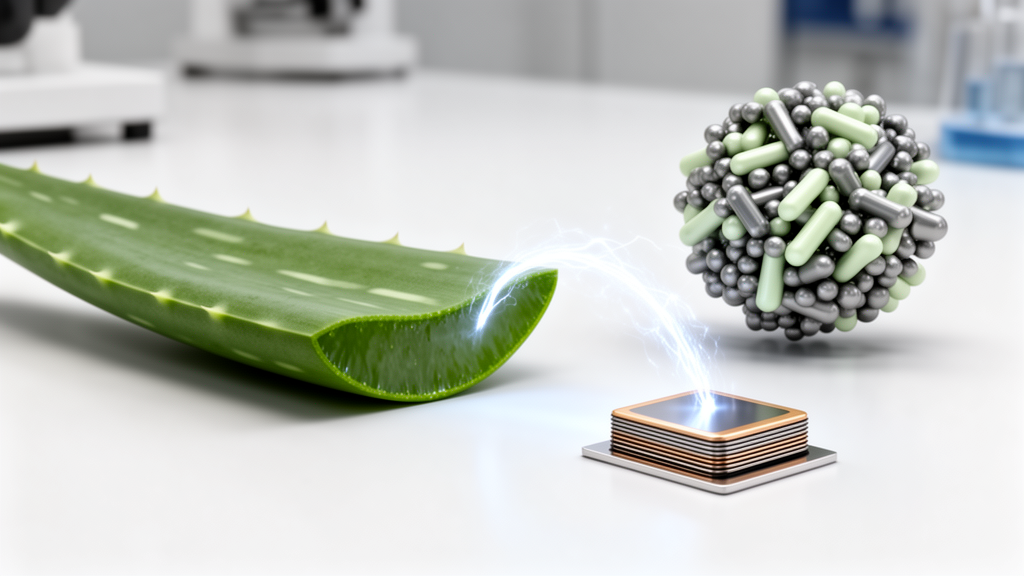
Supercapacitors are prized for rapid charging and long cycle life, but researchers keep searching for electrode materials that are cheap, stable and easy to make. A team at Sardar Vallabhbhai National Institute of Technology in Surat, India, reports a promising new candidate: a barium-strontium nanocomposite synthesised using a simple aloe vera plant extract.
The material was characterised using X-ray diffraction, scanning and transmission electron microscopy, energy-dispersive X-ray analysis, UV-visible spectroscopy, FTIR, and BET surface-area measurements. These techniques confirmed a well-defined crystalline structure with particle sizes in the nanometre range and a porous, high-surface-area morphology.
Electrochemical tests were carried out in a three-electrode configuration with potassium hydroxide as the electrolyte. Cyclic voltammetry showed clear redox peaks, indicating that the material stores charge through fast, reversible surface reactions rather than purely electrical double-layer behaviour.
Galvanostatic charge-discharge measurements revealed a specific capacitance of about 614 farads per gram at a current density of one ampere per gram, with good rate capability at higher currents. Electrochemical impedance spectroscopy showed low charge-transfer resistance, confirming excellent conductivity and ion accessibility.
Most strikingly, the electrode retained roughly 94 percent of its initial capacitance after 5,000 charge-discharge cycles, demonstrating outstanding long-term cycling stability. The researchers attribute this durability to the composite structure, which buffers volume changes during repeated charging.
The team says the aloe vera extract acts as both a reducing and a capping agent during synthesis, eliminating the need for toxic chemicals and making the process environmentally friendly and potentially scalable.
The work, published in the journal Ionics, suggests that alkaline-earth-metal-based nanocomposites could offer a low-cost alternative to conventional metal oxides for energy storage devices.
The researchers now plan to test the material in full two-electrode supercapacitor cells to evaluate its real-world energy and power density, moving the technology closer to practical application.
The choice of potassium hydroxide as the electrolyte in this study reflects a broader convention in supercapacitor research. Aqueous alkaline electrolytes offer high ionic conductivity, low viscosity, and excellent wettability of oxide surfaces, all of which favour fast charge storage. Compared with organic electrolytes, they also avoid flammability concerns, which is one reason supercapacitors are often described as inherently safer than battery systems. The trade-off is a narrower operating voltage window, typically around one volt in aqueous media, which limits the energy density that a single cell can deliver. This is why the reported specific capacity figures, while impressive on a per-gram basis, must ultimately be translated into full-cell performance before the technology can be judged commercially.
The distinction between specific capacity expressed in milliampere-hours per gram and specific capacitance expressed in farads per gram is worth clarifying for readers following this field. When charge storage involves faradaic reactions, as the cyclic voltammetry results here suggest, many researchers prefer to report capacity in coulombs or milliampere-hours per gram, since the classical capacitance formula assumes a linear voltage-charge relationship that battery-like materials do not strictly obey. The value of 118 coulombs per gram reported at one ampere per gram corresponds to the total charge the electrode can store and release in a single cycle, and it provides a common basis for comparison across materials with different storage mechanisms.
Alkaline-earth metals occupy an interesting position in the periodic table for electrochemical applications. Barium and strontium sit directly below calcium and magnesium in group two, and their oxides are strongly basic, hygroscopic, and rich in surface hydroxyl groups when exposed to moisture. In a potassium hydroxide electrolyte, these surface hydroxyls can participate in proton-coupled charge transfer reactions, which is one proposed explanation for the pseudocapacitive behaviour observed in alkaline-earth oxide electrodes. The pairing of two such metals in a single nanocomposite may also introduce lattice strain and defect sites that enhance electronic conductivity relative to the pure parent oxides, although the precise mechanism would require deeper spectroscopic investigation.
The green synthesis route deserves particular attention. Aloe vera gel is a complex biological matrix containing polysaccharides such as acemannan, along with amino acids, vitamins, and a range of phenolic compounds. In nanoparticle synthesis, such biomolecules can serve multiple simultaneous functions: they reduce metal salt precursors to lower oxidation states or to metallic form, they chelate metal ions and control nucleation, and they cap growing particles to prevent agglomeration. The carbohydrate-rich fraction of the gel is especially relevant here, since polysaccharides are known to form viscous networks that physically separate growing crystals. This explains why plant-extract methods frequently yield nanoparticles with narrower size distributions than purely chemical routes, and why the resulting powders often show the porous morphologies that BET analysis is designed to quantify.
Brunauer-Emmett-Teller surface area measurements matter enormously for pseudocapacitive electrodes because charge storage reactions occur at or near the surface. A material with a high specific surface area provides more electroactive sites per gram, and mesoporosity in the two-to-fifty-nanometre range additionally facilitates electrolyte ion transport into the interior of the electrode. The combination of nanoscale primary particles and accessible pore networks is therefore not merely a cosmetic feature of the microscopy images but a direct determinant of the electrochemical performance reported.
Cycling stability is often the most demanding criterion for pseudocapacitive metal oxides. Repeated insertion and removal of hydroxide ions or protons can induce volume changes, particle cracking, and eventual loss of electrical contact with the current collector. Retaining ninety-two percent of initial capacity over five thousand cycles indicates that the barium-strontium composite accommodates these stresses well. Composite structures can help in this regard by distributing mechanical strain across two chemically distinct phases and by maintaining conductive pathways even if one phase partially degrades. It is worth noting, however, that five thousand cycles is a moderate benchmark; commercial supercapacitors are typically expected to survive hundreds of thousands of cycles, so extended testing would be needed to establish true durability.
The three-electrode configuration used for the reported measurements is standard for characterising individual electrode materials, but it can overstate practical performance. In a three-electrode cell, the working electrode is measured against a reference with essentially unlimited headroom, whereas a real device pairs two electrodes whose combined capacitances and voltage windows constrain the energy output. Asymmetric cell designs, in which one electrode stores charge by a different mechanism than the other, are a common strategy for extending the operating voltage of aqueous supercapacitors beyond one volt, and alkaline-earth oxides could plausibly serve as the positive electrode in such architectures.
From a resource perspective, barium and strontium are relatively abundant and inexpensive compared with the ruthenium, cobalt, or nickel oxides that dominate high-performance pseudocapacitor literature. This abundance is a genuine advantage for scale-up, although barium compounds require careful handling because soluble barium salts are toxic. Immobilising barium within an oxide lattice, as done here, mitigates but does not eliminate this consideration, and any future commercialisation would need to address leaching and end-of-life disposal.
The broader context of this work is a growing interest in bio-mediated synthesis across materials chemistry. Using plant extracts rather than synthetic reducing agents aligns with green chemistry principles, reduces the carbon footprint of nanomaterial production, and often avoids hazardous solvents entirely. For energy storage materials, whose environmental credentials are increasingly scrutinised over their full life cycle, such synthesis routes are more than a stylistic preference; they contribute to the overall sustainability case for the technology.
Finally, the study sits within a wider effort to diversify the palette of electrode materials beyond carbon-based double-layer capacitors. Carbons offer excellent stability and power density but modest energy density, whereas transition and alkaline-earth metal oxides can store far more charge per gram through redox reactions. Bridging the gap between these two paradigms, whether through composites, doping, or hybrid architectures, remains one of the central challenges in electrochemical energy storage research, and alkaline-earth nanocomposites of the kind reported here represent one thread of that ongoing investigation.
Subject of Research: Electrochemical evaluation for barium-strontium nanocomposite as electrode material for supercapacitor applications
Article Title: Electrochemical evaluation for barium-strontium nanocomposite as electrode material for supercapacitor applications
Article References: Parveen, S., Kalaiarasi, G., Parthipan, P., Kannan, T., Shanmugapriya, P., Saravanakumar, R., & Kosiha, A. (2026). Electrochemical evaluation for barium-strontium nanocomposite as electrode material for supercapacitor applications. Ionics. https://doi.org/10.1007/s11581-026-07590-0
Image Credits: AI Generated
DOI: 10.1007/s11581-026-07590-0
Keywords: Electrochemical, evaluation, barium-strontium, nanocomposite, electrode, material, supercapacitor, applications, scientific research
Cite Scienmag News
Denise Maddox. (October 16, 2026). Barium-strontium oxide nanocomposite from aloe vera shows promise for supercapacitors. Scienmag. https://scienmag.com/barium-strontium-oxide-nanocomposite-from-aloe-vera-shows-promise-for-supercapacitors/
Denise Maddox. "Barium-strontium oxide nanocomposite from aloe vera shows promise for supercapacitors." Scienmag, 16 October 2026, https://scienmag.com/barium-strontium-oxide-nanocomposite-from-aloe-vera-shows-promise-for-supercapacitors/. Accessed 16 October 2026.
Denise Maddox. "Barium-strontium oxide nanocomposite from aloe vera shows promise for supercapacitors." Scienmag. October 16, 2026. https://scienmag.com/barium-strontium-oxide-nanocomposite-from-aloe-vera-shows-promise-for-supercapacitors/


