


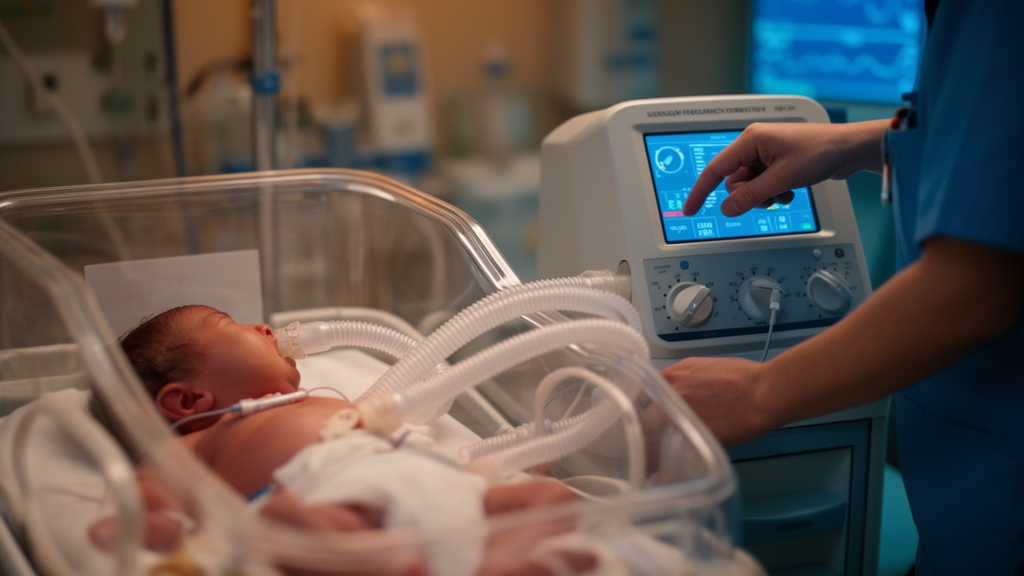
When the smallest and sickest patients cannot breathe on their own, clinicians often turn to high-frequency oscillatory ventilation, a technique that delivers hundreds of tiny breaths per minute through a breathing circuit rather than the familiar large inflations of conventional mechanical ventilation. A new correspondence published in Pediatric Research by Emily M. Ostermaier and Weerapong Lilitwat of Texas Tech University Health Sciences Center School of Medicine argues that one of the field’s most closely watched numbers, the target tidal volume set on modern oscillators, is being misread as a complete description of the mechanical stress delivered to fragile lungs. The authors contend that the target value, while useful, is only one fragment of a much larger picture that includes oscillatory frequency, pressure amplitude, mean airway pressure, inspiratory-expiratory ratio, and the resistance of the patient’s own airway and endotracheal tube.
Their argument arrives at a pivotal moment. Volume guarantee, a feedback mode that automatically adjusts oscillatory pressure to keep delivered breath volumes near a clinician-chosen target, has been gaining traction in neonatal and pediatric intensive care. A systematic review of high-frequency oscillatory ventilation with volume guarantee in infants, published in the same journal in 2025, helped fuel enthusiasm for the approach, and editorial commentary has asked whether the neonatal community is ready for volume targeting during oscillation at all. What the new correspondence adds is a caution grounded in bench physics: the number a clinician types into the ventilator does not, by itself, define the mechanical dose the lung actually receives.
The technical heart of the argument rests on how oscillatory ventilators work. In high-frequency oscillatory ventilation, gas movement is driven by a rapidly oscillating diaphragm or piston superimposed on a constant mean airway pressure that holds the lung open. The oscillatory pressure amplitude determines how far gas swings back and forth with each cycle, while the frequency, typically measured in hertz, determines how many of those swings occur each second. Delivered tidal volume emerges from the interaction of these settings with the impedance of the respiratory system, a combination of resistance and compliance that varies dramatically between patients, between endotracheal tube sizes, and over the course of an illness. Two infants with identical target tidal volumes may therefore experience very different pressure swings, very different frequencies, and very different patterns of lung stress and strain.
Bench evidence underpins the correspondence’s central claim. In a study published in Archives of Pediatric Critical Care Medicine in 2026, Lilitwat and colleague Yodchai Vorakunthada systematically varied ventilator settings in a pediatric mechanical test lung and measured the tidal volumes actually delivered during oscillation. Their experiments demonstrated that frequency, pressure amplitude, mean airway pressure, inspiratory-expiratory ratio, and airway resistance all influence the volume of gas that reaches the test lung. In other words, delivered tidal volume is not a fixed consequence of a target setting; it is an emergent result of the entire configuration of the ventilator and the mechanical properties of the circuit and airway. A target achieved at a high frequency with a low amplitude is not mechanically equivalent to the same target achieved at a low frequency with a high amplitude, even though the volume readout looks identical.
This distinction matters because the mechanical dose delivered to the lung is what drives both benefit and injury. In conventional ventilation, decades of research have established that excessive tidal volumes and pressures stretch and stress alveoli, triggering ventilator-induced lung injury. During oscillation, the relationship between volume and injury is subtler, since the breaths are small and the protective effect of the strategy depends on maintaining lung volume with mean airway pressure while avoiding both overdistension and collapse. If clinicians judge the intensity of support, or the risk of injury, by the target tidal volume alone, they may overlook the contributions of amplitude and frequency to the oscillatory pressure swings, or the role of mean airway pressure in shaping end-expiratory lung volume. The correspondence suggests that this incomplete accounting could complicate the interpretation of clinical trials comparing ventilation strategies.
The authors point to prior work showing that oscillators themselves differ substantially in how they deliver volume and pressure. A 2015 in vitro comparison of eight high-frequency oscillatory ventilators, led by David Tingay and colleagues and published in Neonatology, found marked variability in performance characteristics between devices, raising the question of whether all oscillators are, in fact, created equal. A 2017 study in Pediatric Critical Care Medicine by Raymond Wong and colleagues examined volume and pressure delivery during pediatric high-frequency oscillatory ventilation and documented discrepancies between set and delivered values. More recently, a 2021 study in Pediatric Pulmonology by Gonzalo Solís-García and colleagues reported that in preterm infants with respiratory distress syndrome, low target volumes combined with high frequencies could achieve adequate ventilation, reinforcing the idea that frequency and volume interact in determining the adequacy of gas exchange.
Against this backdrop, the correspondence frames a practical recommendation for the research community. Future studies of high-frequency oscillatory ventilation with volume guarantee, the authors argue, should report not only the target tidal volume and the achieved tidal volume, but also the oscillatory frequency, the pressure amplitude, proxies of airway resistance, the size of the endotracheal tube, and the carbon dioxide response of the strategy. This expanded reporting standard would allow readers to reconstruct the actual mechanical conditions of each study and to compare results across devices, patient populations, and institutions. Without such detail, the authors warn, the literature risks accumulating studies whose headline volume targets conceal fundamentally different mechanical exposures, making meta-analyses and clinical guidelines less reliable than they appear.
The recommendation also has implications for bedside practice. Clinicians adjusting a volume guarantee setting on an oscillator typically watch the achieved tidal volume and the resulting carbon dioxide levels, titrating the target to keep blood gases in range. The correspondence does not dispute the value of this workflow, but it emphasizes that the same achieved volume can be reached through different combinations of frequency and amplitude, and that these combinations carry different mechanical implications for the lung. A patient with high airway resistance, for example, whether from a small endotracheal tube, airway secretions, or disease itself, may require different pressure amplitudes to achieve the same volume as a patient with low resistance. Tracking resistance proxies and tube size alongside volume data gives clinicians a fuller sense of why a ventilator is behaving as it is, and when a change in the underlying mechanics, rather than the target, is driving a change in ventilation.
It is worth noting the nature of the publication itself. The piece is a correspondence, a format used for scholarly commentary and interpretation rather than original data collection, and the authors state explicitly that no datasets were generated or analyzed for it. Its contribution is a synthesis of existing bench and clinical evidence, assembled to make a methodological point at a time when volume guarantee during oscillation is moving from bench curiosity toward routine clinical use. The authors acknowledge using a language model solely to assist with organization and language refinement, while retaining full responsibility for the scientific content. Both authors declare no competing interests, and the journal’s records show the manuscript was received in late August 2026, accepted in mid-September, and published on October 1, 2026.
For a field that has spent decades refining how to protect the smallest lungs, the message is deceptively simple: a number is not a dose. As volume guarantee becomes more widespread on oscillatory ventilators, the correspondence urges researchers and clinicians alike to resist the convenience of a single target value and to report and reason about the full set of mechanical variables that shape what the lung actually experiences. The next generation of trials, armed with richer descriptions of frequency, amplitude, resistance, and tube size, will be better positioned to answer the question that matters most to patients and families, namely which combinations of settings deliver the benefits of oscillatory ventilation while minimizing its hidden mechanical costs.
Subject of Research: Mechanical determinants of delivered tidal volume during high-frequency oscillatory ventilation with volume guarantee
Article Title: Target tidal volume incompletely describes mechanical dose during high-frequency oscillatory ventilation
Article References: Ostermaier, E. M., & Lilitwat, W. (2026). Target tidal volume incompletely describes mechanical dose during high-frequency oscillatory ventilation. Pediatric Research. https://doi.org/10.1038/s41390-026-05571-7
Image Credits: AI Generated
DOI: 10.1038/s41390-026-05571-7
Keywords: high-frequency oscillatory ventilation, tidal volume, volume guarantee, mechanical ventilation, neonatal intensive care, pediatric research, ventilator-induced lung injury, pressure amplitude, airway resistance, mean airway pressure, endotracheal tube, bench testing
Cite Scienmag News
Harold Sullivan. (October 16, 2026). Tidal Volume Targets Alone Fail to Capture the True Mechanical Dose of High-Frequency Ventilation. Scienmag. https://scienmag.com/tidal-volume-targets-alone-fail-to-capture-the-true-mechanical-dose-of-high-frequency-ventilation/
Harold Sullivan. "Tidal Volume Targets Alone Fail to Capture the True Mechanical Dose of High-Frequency Ventilation." Scienmag, 16 October 2026, https://scienmag.com/tidal-volume-targets-alone-fail-to-capture-the-true-mechanical-dose-of-high-frequency-ventilation/. Accessed 16 October 2026.
Harold Sullivan. "Tidal Volume Targets Alone Fail to Capture the True Mechanical Dose of High-Frequency Ventilation." Scienmag. October 16, 2026. https://scienmag.com/tidal-volume-targets-alone-fail-to-capture-the-true-mechanical-dose-of-high-frequency-ventilation/


