


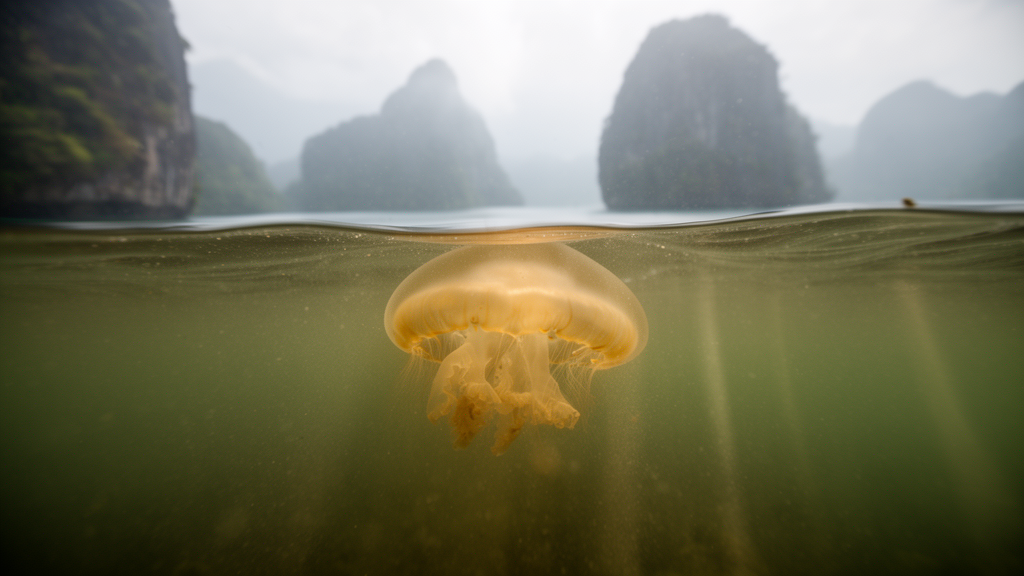
Deep in the limestone islands of Palau, golden jellyfish have drifted through isolated marine lakes for thousands of years, cut off from the ocean by walls of rock and tunnels too narrow for easy exchange. These famous animals, most celebrated in Jellyfish Lake, have long been a textbook case of rapid evolution in a peripheral environment. Yet a new multi-year field study reveals that the most intimate partner in their success story, the microscopic algae living inside their tissues, has not kept pace with the host’s remarkable adaptation. The photosynthetic endosymbionts of jellyfish living in the most isolated and turbid lakes perform significantly worse than those of jellyfish in ocean-connected coves, exposing a hidden physiological fault line in one of the ocean’s most iconic symbioses.
The research, published in Frontiers in Photobiology, was conducted by a team from the University of Bretagne Occidentale, Ludwig-Maximilians-Universität München, Aix Marseille University, James Cook University, and the Coral Reef Research Foundation in Koror, Palau. Between 2010 and 2015, the investigators sampled golden jellyfish, Mastigias papua, across a natural gradient of eleven sites in the Palau Archipelago, ranging from open coves directly connected to the lagoon, through semi-enclosed coves separated by tidal sills, to fully land-locked marine lakes. The sites differ in age, distance from the ocean, nutrient status, and above all in underwater light conditions, providing a set of natural laboratories for testing how isolation and light climate shape the physiology of a tightly integrated mutualism.
Palau’s roughly seventy marine lakes formed at the end of the last ice age, when rising seas flooded low-lying basins in the karstic limestone islands. Deeper basins filled first, some as long as twelve to fifteen thousand years ago, while shallower ones filled later. Each lake has since developed its own distinct physicochemical identity and biological community. Lakes near the lagoon remain oligotrophic and clear, with light regimes resembling the open ocean. Lakes further inland, however, receive humic substances and organic matter washed in from the surrounding tropical forest. Combined with phytoplankton growth, these inputs brown and opacify the surface waters, reducing light penetration and shifting the spectrum that reaches the jellyfish and their symbionts.
The golden jellyfish depend on dinoflagellates of the family Symbiodiniaceae, the same group of algae, often called zooxanthellae, that powers reef-building corals. In Palau, every Mastigias population, despite diverging in morphology, behavior, and genetics from a common ancestor, continues to host endosymbionts of the same genus, Cladocopium. This constancy makes the system ideal for asking whether the algae have adjusted their pigment machinery to the very different light environments their hosts now occupy. The team addressed three questions: whether pigment composition varies with the light environment, whether photosynthetic performance differs along the shore-distance gradient, and whether any photophysiological traits suggest adaptation to lacustrine conditions.
Fieldwork involved snorkeling to collect individual medusae at each site, transporting them in darkened containers to the Coral Reef Research Foundation within an hour, and then excising fragments of oral arms for analysis. Photosynthetic pigments were extracted in ethanol and quantified by high-performance liquid chromatography with certified standards, covering forty-four individual samples from 2010 and 2011. Photosynthetic efficiency was measured on a total of 108 jellyfish using customized AquaPen fluorometers, which record chlorophyll a fluorescence transients after dark adaptation. From these OJIP induction curves, the researchers derived the maximum quantum yield of photosystem II photochemistry and the performance index on an absorption basis, a sensitive composite indicator of environmental stress on photosystem II.
The environmental characterization was equally rigorous. Hyperspectral radiometer profiles from the surface to ten meters yielded the extinction coefficient for photosynthetically active radiation at each site, and where radiometer data were missing, the team estimated light attenuation from an empirical relationship with total phosphorus concentration. Secchi depth readings from a long-term monitoring program confirmed the optical gradient. Extinction coefficients ranged from about 0.03 per meter in the exceptionally clear Tarzan Lake to 0.66 per meter in turbid Ongael Lake, where the Secchi disk frequently vanished at the four-meter bottom. Ngermeuangel Lake, by contrast, offered visibility of nearly thirteen meters.
The pigment results were striking for what they did not show. Across all lakes and coves, the endosymbionts contained a common pool of ten photosynthetic pigments, dominated by peridinin, chlorophyll c2, monovinyl chlorophyll a, and diadinoxanthin, the classic pigment suite of marine dinoflagellates. Multivariate scaling revealed modest differences between years and sites, but nothing resembling a systematic shift toward pigments suited to the reddish, red-shifted light of turbid inland lakes. Normalized baseline fluorescence peaked at blue wavelengths of 455 and 470 nanometers in every sample and declined to a minimum at 590 nanometers, with no significant variation along the shore-distance gradient. The algae, in short, remained optimized for blue light regardless of where they lived.
Photosynthetic performance told a different story. Both quantum yield and the photosystem II performance index were negatively correlated with increasing distance from the seashore across nearly all illumination wavelengths, with the exception of yellow and orange bands. Endosymbionts from isolated, turbid lakes therefore operated at significantly lower photosynthetic efficiency than those from clear, ocean-connected sites. The team also tested whether older lakes, having had more time for adaptation, harbored better-performing symbionts, using maximum depth as a proxy for lake age. No such relationship emerged, indicating that even twelve thousand years of isolation has not produced measurably adapted algal strains in these environments.
The authors interpret this as an evolutionary mismatch between the optical character of the lakes and the pigment machinery of Cladocopium. Marine light environments are typically clear and blue-dominated, and marine Symbiodiniaceae evolved pigments that exploit exactly those wavelengths. Turbid freshwater systems, in contrast, favor green algae efficient at using red light, which is why freshwater symbiotic animals typically host zoochlorella rather than dinoflagellates. Palau’s marine lakes, optically speaking, resemble freshwater lakes more than the open ocean, yet their jellyfish still carry blue-light-optimized marine algae. Because algae can adjust pigment ratios only within limits and generally cannot invent new pigments, the endosymbionts appear constrained by reduced pigment plasticity, and well-adapted alternative strains may simply be absent from the lakes.
The consequences ripple through the energy budget of the holobiont. Lower photosynthetic efficiency implies reduced carbon fixation by the symbionts and a smaller autotrophic contribution to the host’s metabolic demands, potentially forcing lake jellyfish to compensate through heterotrophic feeding in environments where food can be seasonally scarce. Intriguingly, the ecological flexibility of the host exceeds that of its symbiont: lake Mastigias have evolved smaller bells, reduced tentacles, and complex behaviors such as diel vertical migration, which may partly buffer the symbionts’ light shortfall but cannot erase the fundamental spectral incompatibility. The persistence of Cladocopium may reflect historical constraint rather than present-day optimality, since horizontal transmission from a free-living community dominated by lagoon strains, including algae from corals, constantly dilutes any locally adapted lineages. Notably, a recent study found significant adaptive differentiation in Cladocopium associated with corals across Palau’s reefs, where light conditions are uniform and well matched to the genus’s requirements, hinting that cryptic diversity within Symbiodiniaceae could eventually yield strains suited to red-dominated habitats. For now, the golden jellyfish of Palau stand as a vivid reminder that in tightly integrated symbioses, adaptation is a negotiation between partners evolving on different clocks, and that under novel environmental conditions the slower partner’s constraints can become the whole organism’s ceiling.
Subject of Research: Photosynthetic endosymbionts of golden jellyfish in Palau's marine lakes show reduced pigment plasticity and lower photosystem II performance in turbid, isolated lakes compared with ocean-connected coves.
Article Title: Photophysiological performance of zooxanthellate endosymbionts (Symbiodiniaceae) in the golden jellyfish Mastigias papua across a natural environmental gradient in marine lakes of Palau (Micronesia)
Article References: Pondaven, P., Stibor, H., Yu-Tung Huang, J., Stockenreiter, M., Behl, S., Stieglitz, T. C., Patris, S., & Ucharm, G. (2026). Photophysiological performance of zooxanthellate endosymbionts (Symbiodiniaceae) in the golden jellyfish Mastigias papua across a natural environmental gradient in marine lakes of Palau (Micronesia). Frontiers in Photobiology, 4, Article 1670101. https://doi.org/10.3389/fphbi.2026.1670101
Image Credits: AI Generated
DOI: 10.3389/fphbi.2026.1670101
Keywords: Mastigias papua, golden jellyfish, Symbiodiniaceae, Cladocopium, marine lakes, Palau, zooxanthellae, photosynthesis, evolutionary mismatch, symbiosis, photobiology, light spectrum
Cite Scienmag News
Gavin Prescott. (October 16, 2026). Golden jellyfish symbionts falter in Palau’s turbid marine lakes. Scienmag. https://scienmag.com/golden-jellyfish-symbionts-falter-in-palaus-turbid-marine-lakes/
Gavin Prescott. "Golden jellyfish symbionts falter in Palau’s turbid marine lakes." Scienmag, 16 October 2026, https://scienmag.com/golden-jellyfish-symbionts-falter-in-palaus-turbid-marine-lakes/. Accessed 16 October 2026.
Gavin Prescott. "Golden jellyfish symbionts falter in Palau’s turbid marine lakes." Scienmag. October 16, 2026. https://scienmag.com/golden-jellyfish-symbionts-falter-in-palaus-turbid-marine-lakes/


