


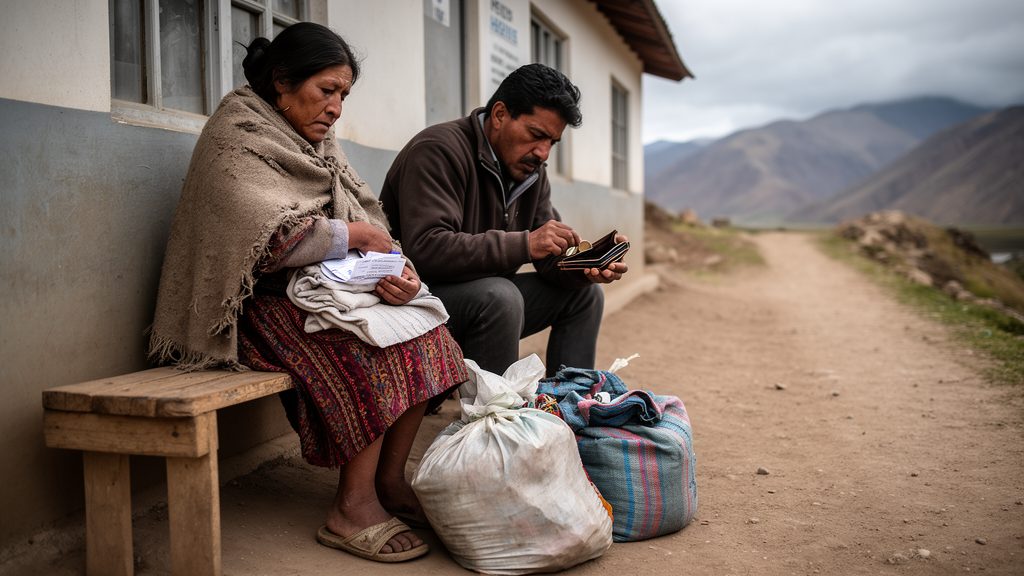
Every year, thousands of Peruvian families who were not poor suddenly find themselves below the poverty line — not because of job loss or crop failure, but because someone in the household fell ill. A new study published in Frontiers in Behavioral Economics quantifies this quiet crisis with unusual precision, tracking twelve years of household survey data to show how direct, out-of-pocket payments for medical care have become a persistent engine of downward economic mobility in the South American nation.
The research team, led by Henry Sucari of the Universidad Nacional del Altiplano in Puno, analyzed microdata from Peru’s National Household Survey (ENAHO) covering 376,016 household heads between 2010 and 2021. Their central finding is stark: 2.7 percent of households that were not poor at the start of the period fell into poverty as a direct consequence of health care spending, a figure that climbed to 4.5 percent during the COVID-19 pandemic. In practical terms, during the worst pandemic years nearly five out of every hundred previously non-poor households crossed the poverty line because of medical bills alone.
The methodology behind these numbers follows a framework developed by the World Health Organization. The researchers first calculated each household’s out-of-pocket health expenditure — direct payments for consultations, medicines, hospitalizations, dental work, and other services — using survey responses recorded across weekly, monthly, and annual recall periods. They then subtracted these payments from total household consumption and checked whether the remainder fell below the subsistence threshold, defined as the monetary poverty line multiplied by the number of household members. If it did, the household was classified as impoverished by health spending, with transport costs and special nutrition excluded from the calculation.
To identify which households were most at risk, the team employed a multivariate logit model, a statistical technique suited to estimating the probability of a binary outcome — in this case, falling into poverty or not. The model incorporated fixed effects for Peru’s 24 departments and for each year, allowing the researchers to control for both regional structural differences and macroeconomic shocks. The pseudo R-squared values of 0.12 for the full sample, 0.16 for urban households, and 0.08 for rural households are typical for logit models applied to low-incidence events in household microdata, and the likelihood ratio tests were highly significant across all specifications.
The results paint a picture of deep territorial inequality. Impoverishment was markedly more pronounced in rural areas, particularly in the Andean highlands and the Amazon rainforest, where access to public health infrastructure is limited and households face additional costs such as transportation to distant facilities. The burden also fell unevenly across insurance schemes: households affiliated with Seguro Integral de Salud (SIS), the public program aimed at vulnerable populations, experienced higher levels of impoverishment than those covered by EsSalud, the contributory insurance scheme tied to formal employment. This gap suggests that enrollment in subsidized insurance does not automatically translate into effective financial protection when coverage exclusions, drug shortages, and unfunded ancillary costs persist.
The statistical analysis revealed a consistent set of protective and risk factors. Each additional year of education for the household head was associated with a 0.05 percentage-point reduction in the probability of impoverishment, while a 1 percent increase in per capita household income reduced that probability by 0.18 percentage points. Attendance at a health facility and EsSalud coverage were associated with reductions of 0.09 and 0.5 percentage points, respectively. These findings align with a well-established body of international evidence showing that human capital and economic capacity act as buffers against health shocks, enabling more efficient use of services and greater capacity to absorb unexpected expenses.
On the risk side, the associations were equally telling. The presence of chronic diseases raised the probability of impoverishment by 0.34 percentage points, permanent disability by 0.30 points, and a higher economic dependency ratio by a striking 1.91 points. Pregnancy in the household added 0.98 percentage points, and having children under three years of age added 0.45 points. Households headed by men faced a probability 0.4 percentage points higher than those headed by women. Perhaps most striking were the environmental factors: the use of solid fuels such as coal, firewood, or dung for cooking was associated with a 0.55 percentage-point increase in impoverishment risk, while inadequate housing, overcrowding, and lack of sanitation each contributed smaller but statistically significant increases.
These environmental associations point to a mechanism that extends far beyond the health system itself. Overcrowded housing, absent sanitation, and polluting cooking fuels are known drivers of respiratory and gastrointestinal disease, which in turn generate recurring demand for medical care and repeated out-of-pocket payments. The study’s authors argue that this creates a compounding cycle in which structural deprivation produces illness, illness produces expense, and expense produces poverty. Comparable patterns have been documented from Vietnam and China to Kenya, where adverse living conditions correlate with higher incidences of catastrophic health expenditure.
The pandemic years amplified every one of these vulnerabilities. The share of households that did not seek care from any health facility jumped from 46.6 percent in 2019 to 54.9 percent in 2020 and 55.6 percent in 2021, a setback of more than nine percentage points driven by fear of contagion, mobility restrictions under Peru’s national state of emergency, and the prioritization of COVID-19 care in public facilities. Interestingly, the time fixed effects showed that the pandemic’s effect on impoverishment probability was statistically significant in urban areas but not in rural ones, suggesting that urban households — perhaps more exposed to private providers and higher monetary costs of care — bore a distinctive financial shock during the first year of the emergency.
The study’s conclusions carry a pointed message for policymakers: health insurance coverage, while essential, remains insufficient if it is not accompanied by substantive improvements in the social determinants of health. The authors recommend consolidating truly universal coverage that goes beyond basic care, guaranteeing the availability of medicines without hidden costs, and investing in drinking water, sanitation, adequate housing, and reduced overcrowding. They also flag the dominance of drugstores and pharmacies as the most common point of care — rising from 19.5 percent of consultations in 2010 to nearly a quarter by 2019 — as a potential risk, since self-medication and information asymmetry may expose households to both health and financial harm. The researchers acknowledge that their observational design establishes statistical associations rather than causal relationships, and they call for future work using methods capable of identifying causality, along with finer analysis of how impoverishment varies by type of care, expenditure category, and population subgroup.
Subject of Research: Impoverishment caused by out-of-pocket health care expenditures in Peruvian households from 2010 to 2021
Article Title: Impoverishment due to out-of-pocket health care expenses in Peruvian households
Article References: Sucari, H., Paredes, R., Tudela, W., Vilca, O., Sucari, W., Rojas-Apaza, R., Chirapo, Y., Barboza, G., Coyla, M., & Quispe, A. (2026). Impoverishment due to out-of-pocket health care expenses in Peruvian households. Frontiers in Behavioral Economics, 5, Article 1747754. https://doi.org/10.3389/frbhe.2026.1747754
Image Credits: AI Generated
DOI: 10.3389/frbhe.2026.1747754
Keywords: out-of-pocket health spending, impoverishment, Peru, health insurance, catastrophic health expenditure, COVID-19, logit model, social determinants of health, rural health, ENAHO survey, poverty, health economics
Cite Scienmag News
Kristina Jarvis. (October 16, 2026). When Sickness Makes Families Poor: Peru’s Hidden Health-Care Poverty Trap. Scienmag. https://scienmag.com/when-sickness-makes-families-poor-perus-hidden-health-care-poverty-trap/
Kristina Jarvis. "When Sickness Makes Families Poor: Peru’s Hidden Health-Care Poverty Trap." Scienmag, 16 October 2026, https://scienmag.com/when-sickness-makes-families-poor-perus-hidden-health-care-poverty-trap/. Accessed 16 October 2026.
Kristina Jarvis. "When Sickness Makes Families Poor: Peru’s Hidden Health-Care Poverty Trap." Scienmag. October 16, 2026. https://scienmag.com/when-sickness-makes-families-poor-perus-hidden-health-care-poverty-trap/


