


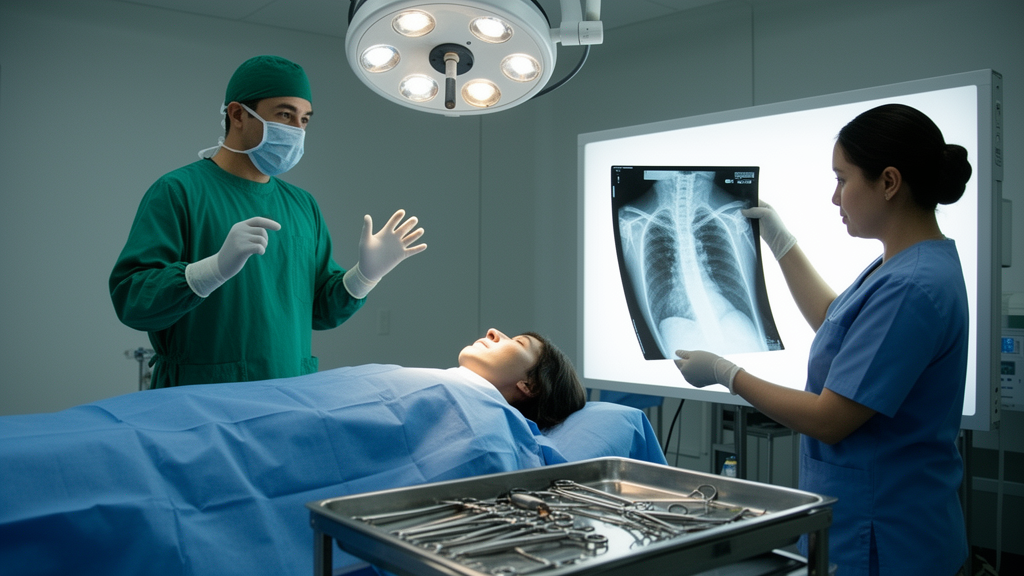
Wrong-site surgery is one of the most chilling categories of medical error: a completely preventable incident in which a surgeon operates on the wrong side of a patient’s body, sometimes with fatal consequences. These incidents are classified as so-called Never Events, a term reserved for severe, avoidable failures that should never occur in a well-run healthcare system. Yet they continue to happen every year, and a surprising proportion of them trace back to a deceptively simple cognitive failure: confusing left with right. A new study published in Frontiers in Cognition introduces a novel behavioral test designed to expose exactly this vulnerability, and its findings challenge the way hospitals currently screen for it.
The research, led by Moritz Thaler and Sebastian Ocklenburg of MSH Medical School Hamburg together with colleagues, set out to answer a question that has long troubled patient safety researchers: do the standard laboratory tests of left-right confusion actually predict who will make laterality errors in a realistic, high-pressure surgical setting? The answer, according to the data, is a resounding no. While the speed with which people process left-right information carried over from classic tests to the new surgical simulation, their error rates did not. Susceptibility to left-right confusion in an applied context appears to be a largely independent, context-specific risk factor that traditional assessments simply cannot capture.
Left-right confusion is more widespread than most people assume. In a large-scale investigation of healthy adults, 14.2 percent of respondents reported frequently confusing left and right, and when objectively measured with experimental tasks, 8.4 percent actually made laterality errors. Nearly 43 percent of people report using some kind of conscious strategy, such as checking which hand they write with, to reliably tell the two sides apart. The ability itself develops slowly: most children can label their own body parts correctly by age seven, but accurate left-right discrimination only reaches adult levels around age twelve. Elevated rates of confusion have also been documented in a range of neurological and psychiatric conditions, particularly those involving damage to parietal brain regions, the cortical areas that handle spatial orientation.
The clinical stakes become clear in the numbers. An analysis of Never Event data from the English National Health Service between 2012 and 2020 found that out of 797 surgical Never Events, 84 occurred because of confusion between left and right. That means a persistent, measurable fraction of catastrophic surgical errors stems from this single cognitive weakness. Hospitals have responded with body markings, checklists and team time-outs, but laterality errors persist nonetheless, which suggests that the underlying cognitive mechanisms are not being adequately addressed by current prevention strategies.
Cognitive psychology has traditionally decomposed left-right confusion into two components. The first is spatial-cognitive ability, which involves mentally rotating and transforming objects in space; the second is verbal-semantic ability, which relies on language processing to label sides correctly. The Bergen Left-Right Discrimination Test, a standardized instrument, targets the spatial component by presenting stick figures viewed from front and back, forcing participants to mentally rotate them to identify a highlighted hand. The Left-Right Commands Task assesses the verbal component by asking participants to follow spoken commands about their own body parts, such as lifting the left hand, with difficulty increasing when commands require crossed limb movements. A self-report questionnaire rounds out the battery by capturing subjective susceptibility. All three measures were included in the new study as benchmarks.
The problem with these established tests, the researchers argue, is ecological validity: the extent to which laboratory findings generalize to real life. A surgeon in an operating theater does not sit at a computer looking at schematic drawings. The surgeon stands over a patient whose body may be oriented in any direction, receives rapid auditory instructions, moves around the table, and must integrate the patient’s anatomy with their own first-person perspective under time pressure. This involves embodied transformation, the simulation of the patient’s spatial relationships from the surgeon’s own body-centered frame, a process that can be complicated by awkward positions and is entirely absent from conventional tests.
To close this gap, the team developed the Never Events in Surgery Test, or NEST. The paradigm uses a life-sized, anatomically correct cardiopulmonary resuscitation training doll lying on a medical examination table. Participants hear standardized verbal commands, generated by text-to-speech software, instructing them to physically point to a specific lateralized body part on the doll, such as tapping the left knee. The doll is placed in four different postures across the experiment: supine on its back, prone on its stomach, and lying on either its left or right side. Participants also start each trial from one of four randomized positions around the table, adding a further layer of spatial complexity and preventing them from settling into a single comfortable viewing angle. Each condition comprised 50 trials, with neutral control trials removed from analysis, yielding 180 critical trials in total. Errors were scored from video recordings, and inter-rater agreement between independent scorers reached an excellent 98.23 percent.
The study included 108 participants, mostly young university-affiliated adults with a mean age of 27.7 years, who completed the NEST alongside the three benchmark tasks. The results on the NEST itself were revealing. Error rates were significantly lower when the doll lay prone compared with either lateral orientation, consistent with earlier findings that facing a stimulus from behind facilitates side congruency and reduces confusion. Reaction times, however, told a different story: the supine position, the clinical standard for many surgical procedures, produced the fastest responses of all, significantly outperforming prone and lateral positions. The researchers suggest that highly visible ventral landmarks such as the face and navel serve as salient spatial anchors, allowing rapid orientation despite the theoretical need for a 180-degree mental rotation. But this speed advantage carries a hidden risk: in the most common surgical orientation, fast processing might mask underlying axial incongruency, potentially producing fast but wrong decisions if the mental transformation is not consciously verified.
The central and most consequential finding emerged from the cross-task analysis. Reaction times correlated strongly between the commands task and the NEST, with the commands task reaction time alone explaining a substantial share of NEST processing speed, reflecting a shared component of general cognitive processing speed. Yet when the researchers built a regression model predicting NEST error rates from the error rates of the established tests and the questionnaire scores, the model failed entirely, accounting for essentially no meaningful variance. The individual benchmark tasks each explained only around five percent of NEST errors, leaving more than 94 percent unexplained. Notably, the anticipated sex differences also vanished on the NEST: while women rated themselves as more left-right confused on the questionnaire, matching a long-standing pattern in the literature, neither error rates nor reaction times differed significantly between men and women on the applied task, suggesting that the procedural demands of embodied, perspective-shifting action may override differences seen in purely mental rotation tasks.
The implications for patient safety are direct. Screening surgical staff with general left-right discrimination tests is insufficient, because those tests measure static, symbolic laterality judgments rather than the dynamic, embodied errors that occur under operational load. The authors argue for a paradigm shift toward context-specific training and screening, integrating NEST-style paradigms into surgical simulation and explicitly incorporating the patient’s physical position into side-verification protocols. Verbalizing the perspective during team time-outs, for example stating that the patient is supine and viewed from the foot, could align the whole team’s mental reference frame. The study does carry limitations: the fixed task order, the young lay sample, and the relatively slow delivery of spoken commands all warrant caution, and future work must validate the paradigm with actual medical professionals and within team settings. But the core message stands: the cognitive machinery that fails in the operating theater is not the same machinery that classic tests measure, and preventing the next wrong-site surgery may require testing people where the failure actually happens.
Subject of Research: Development and validation of the Never Events in Surgery Test (NEST), an ecologically valid behavioral paradigm for measuring left-right confusion in surgical contexts
Article Title: Understanding never events: developing an ecologically valid behavioral test for left-right confusion during surgery
Article References: Thaler, M., Parschau, H., Carstensen, J., Mühlig, L., Kirner, J., Altunkaynak, H., Kändler, G., Petzina, R., & Ocklenburg, S. (2026). Understanding never events: developing an ecologically valid behavioral test for left-right confusion during surgery. Frontiers in Cognition, 5, Article 1802120. https://doi.org/10.3389/fcogn.2026.1802120
Image Credits: AI Generated
DOI: 10.3389/fcogn.2026.1802120
Keywords: left-right confusion, never events, wrong-site surgery, patient safety, NEST, spatial cognition, ecological validity, laterality errors, surgical training, behavioral testing, cognitive dissociation, embodied cognition
Cite Scienmag News
Ophelia Keating. (October 16, 2026). New Test Reveals Why Surgeons Can Still Confuse Left and Right. Scienmag. https://scienmag.com/new-test-reveals-why-surgeons-can-still-confuse-left-and-right/
Ophelia Keating. "New Test Reveals Why Surgeons Can Still Confuse Left and Right." Scienmag, 16 October 2026, https://scienmag.com/new-test-reveals-why-surgeons-can-still-confuse-left-and-right/. Accessed 16 October 2026.
Ophelia Keating. "New Test Reveals Why Surgeons Can Still Confuse Left and Right." Scienmag. October 16, 2026. https://scienmag.com/new-test-reveals-why-surgeons-can-still-confuse-left-and-right/


