


After two decades of essentially flat electricity demand, the United States is entering an era of surging power consumption driven by data centers, electrified industry and manufacturing reshoring. Meeting that demand safely and at scale has revived interest in nuclear energy, particularly in small modular reactors and microreactors that can be deployed closer to where power is needed. Yet the technology is only part of the equation. The nuclear sector faces a severe shortage of engineers, managers and policymakers who understand how to build, regulate and integrate a new generation of reactors, and three major public research universities have now formed an alliance designed to close that gap before it stalls the national nuclear resurgence.
The University of Tennessee, Knoxville, Arizona State University and Purdue University have launched the New Nuclear Academic Consortium, a flexible trilateral partnership intended to build a regional and national ecosystem for nuclear workforce development. Rather than creating another traditional degree program, the consortium aims to prepare graduates across multiple engineering disciplines to deploy, manage and scale what could eventually be thousands of decentralized reactors. The founding institutions span three geographic regions of the country, and each brings a large engineering college with deep connections throughout the nuclear industry.
The workforce shortage has structural roots. Much of the existing nuclear workforce is approaching retirement age, and many new reactor projects are sited in remote areas that struggle to attract qualified applicants. Traditional nuclear engineering programs have historically produced specialized doctoral graduates and design engineers, but the emerging industry needs a much broader professional base: people fluent in systems engineering, grid integration, advanced thermodynamics, supply chain logistics and safety regulation. Executing the deployment of small modular reactors and microreactors at scale requires exactly this kind of cross-disciplinary fluency, which is what the consortium is designed to cultivate.
The University of Tennessee contributes a top-ranked nuclear engineering department within the Tickle College of Engineering, with standalone bachelor’s, master’s and doctoral programs in nuclear engineering and seamless research integration with Oak Ridge National Laboratory. East Tennessee has become an epicenter of the nuclear resurgence, with more than 150 nuclear-related companies located within 50 miles of Knoxville. Among them are the Tennessee Valley Authority, which is moving toward construction of a small modular reactor at the Clinch River site, and the Kairos Hermes 2 demonstration project, giving students proximity to real deployment activity rather than classroom abstractions.
“We are proud to be part of this unique partnership to expand access to education and training about nuclear engineering and the nuclear sector,” said Brian Wirth, TVA Department Head and UT-ORNL Governor’s Chair Professor of Computational Nuclear Engineering at UT. “While we have seen substantial growth in our on-campus student population and the establishment of a new minor in nuclear power engineering, this consortium will support the needed training requirements to grow the nuclear workforce.” His comments underscore how the consortium is meant to complement, not replace, the campus-level growth already underway at the founding institutions.
The consortium concept originated at Arizona State University, which anchors the partnership with its scale in online and technology-enabled education. ASU’s digital learning division, EdPlus, is joined by the Decision Theater’s data-driven policy modeling and Dreamscape Learn’s immersive curriculum tools, forming a digital backbone that could make nuclear education accessible far beyond the three campuses. ASU’s primary initial contribution is a suite of three to five undergraduate micro-certificates launching this year, designed to equip mechanical, civil, electrical, materials and systems engineering students with practical nuclear fluency without requiring them to switch into a dedicated nuclear engineering major.
“The future of new nuclear energy is unfolding in front of us and the nation will need more graduates who are prepared to enter the nuclear industry,” said Kyle Squires, dean of ASU’s Fulton Schools of Engineering. “This new consortium brings together three top public universities, each with tremendous expertise and reach, to increase the number of engineers prepared to work in the new nuclear industry and create courses and microcredentials that can be accessed by engineers at any U.S. university.” The microcredential model is significant because it treats nuclear literacy as an add-on capability for the existing engineering workforce rather than a career path reserved for nuclear engineering specialists alone.
Purdue University brings experimental and regulatory depth to the alliance through its nuclear engineering program and Purdue University Reactor Number One, known as PUR-1, the nation’s first and only U.S. Nuclear Regulatory Commission facility licensed for a fully digital safety and control system. Purdue’s partnership with the NRC stretches back more than 60 years, beginning with the university’s original operating license granted in 1962 and renewed in 2016. In 1997, the NRC established the Institute of Thermal-Hydraulics at Purdue to provide broad technical expertise and conduct reactor safety research, and the commission has also funded graduate fellowships and undergraduate scholarships in nuclear engineering there.
“Through the New Nuclear Academic Consortium, we have an opportunity to combine Purdue’s unique experimental and regulatory capabilities with the complementary strengths of ASU and the UT to create a new model for nuclear education,” said Stylianos Chatzidakis, assistant professor in Purdue’s School of Nuclear Engineering, associate reactor director and director of the Nuclear Engineering Radiation Laboratories, and one of the consortium’s founding partners who co-authored its launch plan. “Our goal is to give students meaningful exposure to real nuclear systems and hands-on advanced digital and cyber-physical technologies, so they are prepared not just to design the next generation of reactors, but to safely deploy and operate them at scale.”
One of the most technically ambitious bilateral projects within the consortium is the Purdue-ASU effort to build high-fidelity, interactive digital twins of PUR-1. Purdue contributes licensing expertise along with the reactor data, physics models and know-how behind its in-house digital twin model of the reactor, while ASU adds its own digital twin knowledge and its digital scale and immersive software engines to host and distribute virtual training models. Beyond making PUR-1 digitally accessible to other colleges and universities, these simulations could eventually stand in for traditional hands-on reactor operations, opening a path toward innovative regulatory certifications that could transform how reactor operators are trained nationwide. Once launched, the consortium plans to invite additional research universities to join over the following six to 12 months, allowing member institutions to adopt or augment the consortium-built micro-certificates, pursue jointly funded research, or link to PUR-1 through digital twins, extending the model well beyond its three founding campuses.
Subject of Research: A university consortium to train the nuclear energy workforce for small modular reactor deployment
Article Title: Powering the nuclear comeback: Three universities form consortium to close a critical workforce gap
Article References: Powering the nuclear comeback: Three universities form consortium to close a critical workforce gap. (n.d.). Original publication
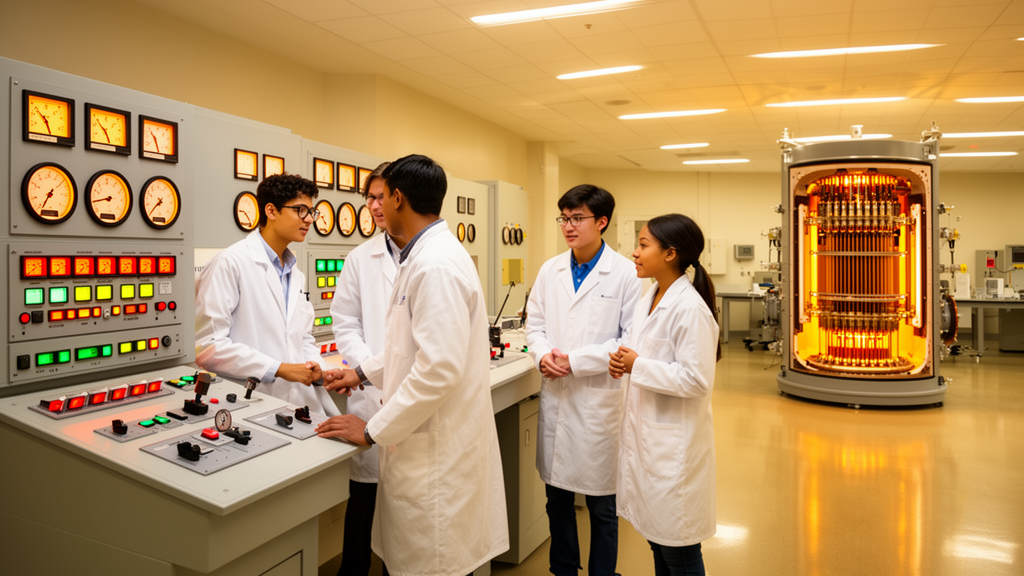
Image Credits: AI Generated
DOI: Not provided
Keywords: nuclear energy, small modular reactors, microreactors, workforce development, University of Tennessee, Arizona State University, Purdue University, digital twin, nuclear engineering education, micro-certificates, Oak Ridge National Laboratory, Nuclear Regulatory Commission
Cite Scienmag News
Courtney Benton. (October 16, 2026). Three Public Universities Launch Consortium to Train the Nuclear Workforce of the Future. Scienmag. https://scienmag.com/three-public-universities-launch-consortium-to-train-the-nuclear-workforce-of-the-future/
Courtney Benton. "Three Public Universities Launch Consortium to Train the Nuclear Workforce of the Future." Scienmag, 16 October 2026, https://scienmag.com/three-public-universities-launch-consortium-to-train-the-nuclear-workforce-of-the-future/. Accessed 16 October 2026.
Courtney Benton. "Three Public Universities Launch Consortium to Train the Nuclear Workforce of the Future." Scienmag. October 16, 2026. https://scienmag.com/three-public-universities-launch-consortium-to-train-the-nuclear-workforce-of-the-future/


