


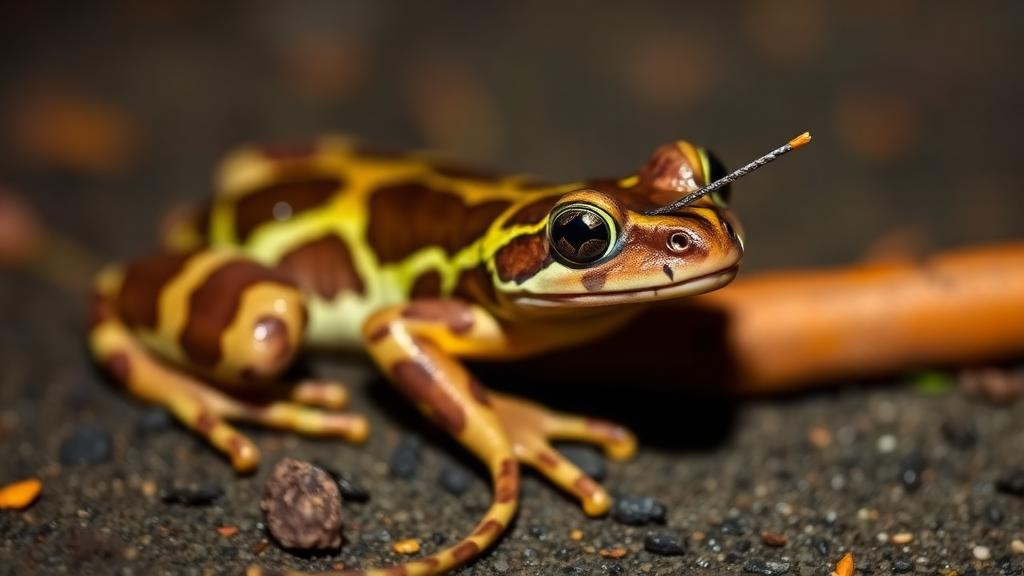
On the remote volcanic islands of São Tomé & Príncipe, rising from the Gulf of Guinea more than 200 kilometers from the African mainland, nearly every frog and reptile species lives nowhere else on Earth. Yet the scientific records documenting this extraordinary herpetofauna have long been scattered across old books, museum drawers and, more recently, smartphone photos uploaded by tourists. A new study has pulled all of these threads together for the first time, assembling more than 6,000 records spanning nearly two centuries and exposing exactly where the gaps in our knowledge lie.
The research, published in the journal Natural History Collections and Museomics, compiled 6,185 unique records of the country’s amphibians and reptiles from four distinct sources: published scientific literature, specimens held in natural history collections, observations logged on citizen science platforms, and recent fieldwork conducted by the authors from 2024 onward. The effort required consulting 156 scientific publications written in five languages and tracking down specimens in 36 museums across 14 countries, most of them in Europe and North America.
The scale of the dispersal reflects a colonial legacy common across Africa. Much of the biodiversity data for former Portuguese colonies was collected, published and stored abroad, and remains difficult for local researchers, students and early-career scientists to access. Publications sit behind paywalls or in archives, museum catalogs are incomplete, and much of the metadata has never made it into global aggregators such as the Global Biodiversity Information Facility. In fact, only about 66 percent of the natural history collection records in the new database are currently available through GBIF.
The islands themselves make the stakes unusually high. São Tomé and Príncipe have never been connected to the mainland, rising instead from the seafloor of the Cameroon Volcanic Line. All nine of the country’s amphibian species are endemic, each confined to a single island, and 17 of the 22 terrestrial reptiles are similarly restricted. Several, including the São Tomé giant treefrog Leptopelis palmatus, the bright yellow caecilian Schistometopum thomense’s relative Hyperolius thomensis, and the recently described São Tomé cobra Naja peroescobari, are classified as Endangered by the IUCN.
Reconstructing the dataset was not straightforward. Roughly 90 percent of bibliographic records turned out to refer to specimens still held in museums, so the team cross-linked citations to catalog numbers to avoid double counting. But some specimens cited in old publications no longer exist. A fire in 1978 destroyed the zoological collections of the Museu Bocage in Lisbon, wiping out much of the material gathered by the naturalist Francisco Newton during his decade-long expedition from 1885 to 1895. Those 93 records survive only because they were described in print, a vivid illustration of why historical bibliography remains irreplaceable even in the digital age.
Georeferencing posed its own challenges. Most pre-2000 records lacked coordinates, so the team used tools such as GEOLocate and OldMapsOnline to pin down vague place names, standardizing toponyms that had changed over time. The country was then divided into a grid of 1-by-1-kilometer cells, 959 covering São Tomé and 201 covering Príncipe, allowing the researchers to quantify sampling effort with unusual precision for a tropical island nation.
The analysis revealed stark geographic bias. Príncipe is better covered than the larger São Tomé: 44.3 percent of Príncipe’s grid cells hold at least one record, versus just 25.5 percent on São Tomé. Within sampled cells, effort is wildly uneven. On São Tomé, 62.4 percent of sampled cells contain only one to five records, while just 2 percent hold more than 150. A handful of heavily visited sites, such as Ribeira Peixe with 358 records, account for a disproportionate share of the total, while remote high-elevation areas remain essentially unsampled.
The temporal picture is equally lopsided. Records cluster around a series of expeditions: Richard Greeff’s 1879-1880 survey, Leonardo Fea’s turn-of-the-century visit, the work of Lisbon’s Centro de Zoologia in the 1950s through 1980s, a massive 1988 expedition by Ronald Nussbaum and Michael Pfrender that alone produced 1,091 records, and the California Academy of Sciences’ Island Biodiversity Race from 2001 onward. Citizen science data, by contrast, only began in 1991 and has grown steadily since 2006, accelerating sharply after 2017 and peaking in 2024.
Comparing the two data streams exposed their complementary strengths and weaknesses. Traditional sources dominate for cryptic species: the fossorial caecilian Schistometopum thomense has 1,061 records from bibliography and collections but only 26 from citizen science. Citizen scientists, meanwhile, excel at photographing conspicuous urban species; the gecko Hemidactylus greeffii is actually better represented in citizen science data than in museums. No species exists exclusively in citizen science records, confirming that platforms like iNaturalist supplement rather than replace voucher-based data. Four species, including the rare São Tomé black coral snake Dendroaspis cf. viridis, known from just three records, are entirely absent from citizen science platforms.
The authors argue their approach offers a replicable model for other under-studied regions, but with caveats. São Tomé & Príncipe is safe, accessible and relatively well studied, conditions that favor citizen science participation; the same may not hold elsewhere. They recommend that future observers record precise localities, dates, counts and collector identities, and urge continued digitization of museum holdings worldwide. For now, the consolidated database, freely available online, gives conservationists the most complete picture ever assembled of one of the planet’s most endemic-rich island faunas, and a clear map of where to look next.
Subject of Research: Biodiversity data mobilization and sampling biases in the herpetofauna of São Tomé & Príncipe
Article Title: Mobilizing bibliographic, natural history collections and citizen science data for addressing biodiversity biases: A case study with the herpetofauna of an endemic rich island nation
Article References: de Sousa, A. C. A., Santos, B. S., Parrinha, D., Barbosa, M. R., Marques, M. P., Passos, P., & Ceríaco, L. M. P. (2026). Mobilizing bibliographic, natural history collections and citizen science data for addressing biodiversity biases: A case study with the herpetofauna of an endemic rich island nation. Natural History Collections and Museomics, 3, Article e184711. https://doi.org/10.3897/nhcm.3.184711
Image Credits: AI Generated
Keywords: São Tomé & Príncipe, herpetofauna, biodiversity data, natural history collections, citizen science, GBIF, endemic species, sampling bias, amphibians, reptiles, data mobilization, island biogeography
Cite Scienmag News
Margaret Porter. (October 16, 2026). Rescuing centuries of frog and snake records on Africa’s isolated islands. Scienmag. https://scienmag.com/rescuing-centuries-of-frog-and-snake-records-on-africas-isolated-islands/
Margaret Porter. "Rescuing centuries of frog and snake records on Africa’s isolated islands." Scienmag, 16 October 2026, https://scienmag.com/rescuing-centuries-of-frog-and-snake-records-on-africas-isolated-islands/. Accessed 16 October 2026.
Margaret Porter. "Rescuing centuries of frog and snake records on Africa’s isolated islands." Scienmag. October 16, 2026. https://scienmag.com/rescuing-centuries-of-frog-and-snake-records-on-africas-isolated-islands/


