


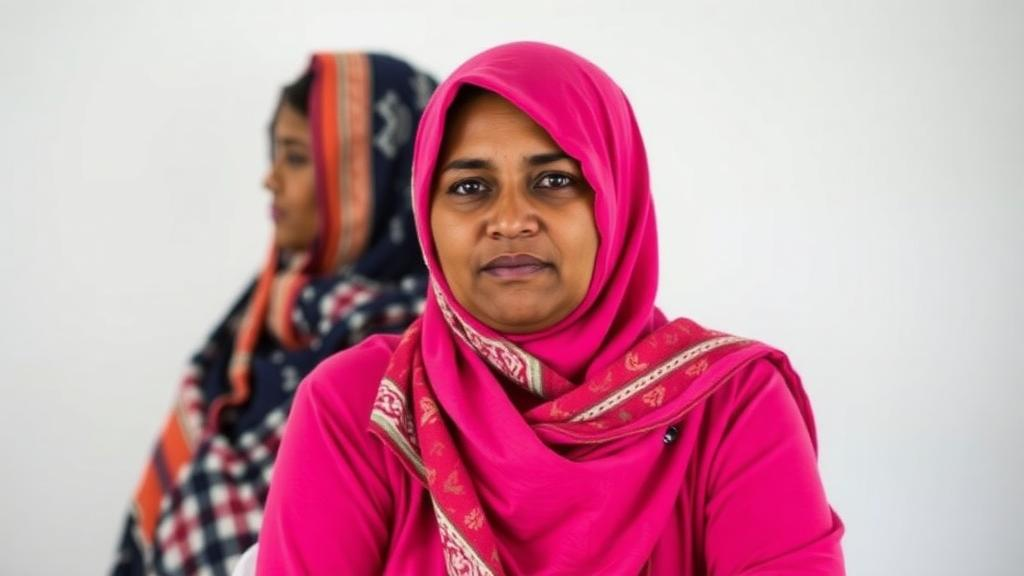
Refugee women in Ohio are navigating a healthcare system that many of them experience as unaffordable, confusing, and, increasingly, frightening. That is the central finding of a qualitative study led by researchers at Denison University’s Department of Global Health, published in the International Journal for Equity in Health. Between May and August 2025, the team conducted in-depth interviews with 40 refugee women of reproductive age, between 18 and 49 years old, to understand how recent shifts in immigration enforcement and public policy are shaping whether, when, and how these women seek medical care. Using a structural vulnerability framework, an analytical lens that locates health risks not in individual choices but in political and economic arrangements, the researchers documented a landscape of overlapping barriers that operate long before a patient reaches an examination room.
The study’s methodology was deliberately community-anchored. Rather than recruiting through clinics, where participants might fear exposure, the team reached eligible women through immigration aid organizations and community networks, including the Bhutanese Community of Central Ohio and the Riverview International Center. Of 45 eligible participants, 40 were included in the final analytic sample. Interviews followed a validated semi-structured questionnaire, were transcribed, and then imported into ATLAS.ti software for coding. The researchers used an iterative coding process with multiple rounds of review to verify transcription and coding accuracy, a quality-control step that matters greatly in qualitative research, where the credibility of themes depends on the rigor of the analytic trail. The study was approved by Denison University’s Institutional Review Board on May 21, 2025, and all participants gave informed consent.
Three overarching themes emerged from the analysis. The first concerned systemic and structural barriers to accessing healthcare under the current administration. The second captured patients’ knowledge gaps and navigation challenges within the American health system. The third addressed perceived quality and cultural responsiveness of care. This tripartite structure is analytically useful because it separates problems that require different remedies: policy-level reform, patient education and navigation support, and provider-level cultural competence. Yet the themes also interact. A woman who cannot afford care and simultaneously fears deportation faces a compounded barrier that neither a leaflet nor a bilingual interpreter alone can resolve.
The numbers reported in the study are striking. Two-thirds of participants, 67.5 percent, cited a lack of affordable care as a barrier, and 62.5 percent reported out-of-pocket expenses even when they held insurance. Perhaps most alarmingly in the current political climate, 27.5 percent said they had avoided seeking care because of fear of deportation. That figure quantifies a phenomenon public health researchers have long worried about: when immigration enforcement intensifies, the chilling effect extends beyond undocumented individuals to entire communities, including legally resettled refugees who are, in principle, protected. The perception of risk, whether or not it matches legal reality, is enough to suppress care-seeking, with consequences that accumulate silently in the form of delayed diagnoses, untreated chronic conditions, and foregone preventive services.
Informational barriers proved nearly as consequential as financial ones. Half of the participants, 50 percent, reported limited understanding of how the U.S. healthcare system works, including confusion about the differences between types of care, such as the distinction between primary care, urgent care, and emergency services. Many also struggled to understand how insurance operates, a system that even native-born Americans find opaque. Language difficulties were cited by 45 percent of participants, and transportation issues by 30 percent. These are not minor frictions; they are gatekeeping mechanisms. A refugee woman who cannot describe her symptoms in English, cannot decipher an insurance explanation of benefits, and cannot reach a clinic without a car faces a series of sequential filters, each of which can independently terminate a care-seeking attempt.
The third theme, care quality and cultural responsiveness, revealed a more mixed picture. A majority of participants, 67.5 percent, said they felt respected in healthcare encounters, which the researchers note as a genuinely positive signal. But 65 percent reported long wait times for appointments, and 30 percent described experiences of discrimination. The coexistence of these findings is important: respect and discrimination are not mutually exclusive across a population, and a system can be welcoming on average while failing specific individuals. For refugee women, who may carry trauma from displacement and who often come from medical cultures with different norms around consent, modesty, and gender, perceived disrespect or bias can deter future engagement with care even when a single visit is clinically adequate.
The structural vulnerability framework that anchors the study deserves attention because it reframes the analytical question. Traditional health services research often asks why individuals fail to use available services, implicitly locating the problem in patient behavior. A structural vulnerability approach instead asks how political, economic, and institutional arrangements produce vulnerability in the first place. Under this lens, fear of deportation is not a psychological quirk to be counseled away but a rational response to a policy environment; unaffordable care is not a budgeting failure but the predictable output of a financing system that leaves gaps even for the insured; and navigation confusion is the foreseeable result of a system designed around assumptions of literacy, English fluency, and familiarity with insurance mechanics.
The timing of the research is significant. The interviews were conducted in mid-2025, under an administration that had intensified immigration enforcement, and the authors explicitly frame the study as an examination of healthcare access under current policy conditions. The abstract notes that recent changes in immigration enforcement and public policy raised concerns about effects on healthcare-seeking behaviors among refugee communities, and the findings appear to confirm those concerns. The researchers also connect their results to policy, arguing that addressing the barriers requires a coordinated, multi-sectoral response encompassing systemic policy changes, community-rooted support systems, culturally competent care, and a more inclusive public health narrative. That last phrase is notable: it suggests that how public health institutions talk about refugees, and whether refugees see themselves as legitimate participants in the health system, is itself part of the access problem.
For readers outside migration health, the study offers a compact lesson in how policy ripples through clinical encounters. A change in enforcement posture in Washington does not need to touch a single clinic in Columbus to alter what happens inside it. It reaches patients through rumor, community networks, and news coverage, and it manifests as missed appointments, untreated infections, and pregnancies entering prenatal care late or not at all. Because the study focused on women of reproductive age, the implications extend to maternal and child health, where delayed care carries measurable risks for both mothers and infants. The authors’ recruitment through community organizations also demonstrates a practical model: trusted intermediaries can reach populations that formal health systems cannot, and partnerships with groups like the Bhutanese Community of Central Ohio are not merely recruitment conveniences but infrastructure for health outreach.
The study’s limitations are those inherent to qualitative design: 40 participants in one state cannot be generalized to all refugee women in the United States, and self-reported experiences are shaped by recall and by what participants feel safe disclosing. Yet the specificity of the findings, and their convergence with a broader literature on immigrant health under restrictive policy climates, give them weight. What the research documents most clearly is that healthcare access for refugee women is not a single problem with a single fix. It is a lattice of financial, informational, linguistic, logistical, and political constraints, each reinforcing the others. Dismantling it, the authors argue, will require action on all strands at once, from insurance design and interpretation services to the political signals that determine whether a woman believes a clinic is a safe place to walk into.
Subject of Research: Barriers to healthcare access and utilization among refugee women in Ohio
Article Title: Healthcare access and utilization among refugee women in Ohio: a qualitative study using a structural vulnerability framework
Article References: Healthcare access and utilization among refugee women in Ohio: a qualitative study using a structural vulnerability framework. (n.d.). https://doi.org/10.1186/s12939-026-03073-w
Image Credits: AI Generated
DOI: 10.1186/s12939-026-03073-w
Keywords: refugee health, healthcare access, Ohio, structural vulnerability, immigration policy, qualitative research, women's health, health equity, deportation fear, cultural competence, maternal health, public health
Cite Scienmag News
Courtney Benton. (October 16, 2026). Fear of Deportation Keeps Refugee Women in Ohio From Seeking Care, Study Finds. Scienmag. https://scienmag.com/fear-of-deportation-keeps-refugee-women-in-ohio-from-seeking-care-study-finds/
Courtney Benton. "Fear of Deportation Keeps Refugee Women in Ohio From Seeking Care, Study Finds." Scienmag, 16 October 2026, https://scienmag.com/fear-of-deportation-keeps-refugee-women-in-ohio-from-seeking-care-study-finds/. Accessed 16 October 2026.
Courtney Benton. "Fear of Deportation Keeps Refugee Women in Ohio From Seeking Care, Study Finds." Scienmag. October 16, 2026. https://scienmag.com/fear-of-deportation-keeps-refugee-women-in-ohio-from-seeking-care-study-finds/


