


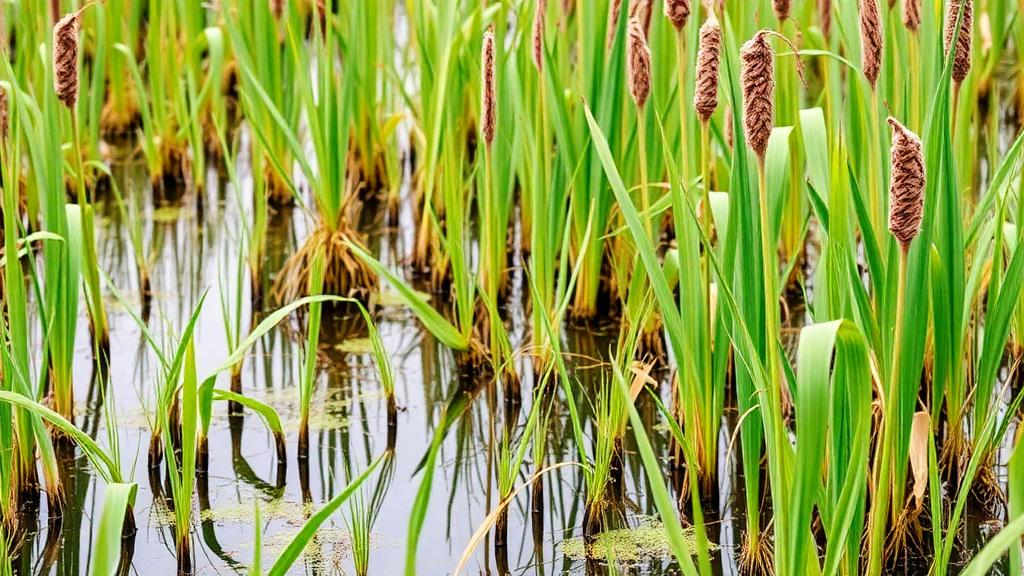
Europe’s reed beds, cattail stands, and tall-sedge marshes are getting a long-overdue legal cleanup. In a paper published in Vegetation Classification and Survey, an international team of vegetation scientists led by Flavia Landucci and including Milan Chytrý, Iemelianova, Šumberová, and Jean-Paul Theurillat has opened a formal nomenclatural revision of the class Phragmito-Magnocaricetea, the phytosociological class that encompasses the freshwater and brackish marsh vegetation of Eurasia. The work, grounded in the fourth edition of the International Code of Phytosociological Nomenclature, presents five conservation and rejection proposals and three requests for binding decisions, together with the validation of one order name and the typification of several widely used association and alliance names. It is the kind of technical housekeeping that rarely makes headlines, yet it determines which names appear in national vegetation surveys, habitat assessments, and conservation legislation across the continent.
The class Phragmito-Magnocaricetea was first described by Klika in 1941 and has since become the standard umbrella for marsh communities dominated by tall emergent plants such as the common reed Phragmites australis, cattails of the genus Typha, club-rushes, and large sedges of the genus Carex. A formalized classification of European marsh vegetation was published by Landucci and colleagues in 2020, but that work focused on methodology rather than nomenclature, so most syntaxon names were adopted from other sources, including the EuroVegChecklist and national syntheses. When the fourth edition of the Code appeared in 2021, introducing several novelties relevant to nomenclatural revision, the team began a comprehensive re-examination of every name in the class. That analysis revealed problems with some of the most important and widely used names in European wetland ecology.
The centerpiece of the revision concerns the common reed association itself. Two names for the reed-dominated community were published in the same year, 1926: Scirpo-Phragmitetum by the Swiss botanist W. Koch in March, and Phragmitetum communis by the Russian botanist Savich in the latter half of the year. Under Principle IV and Article 22 of the Code, Koch’s name has priority. But Koch explicitly defined his association as a conceptually broad unit that includes multiple communities, each dominated by a different tall emergent species: common reed, narrow-leaved and broad-leaved cattails, Schoenoplectus lacustris, and Glyceria maxima. Most contemporary authors reject such broad associations, arguing that stands dominated by a single tall emergent species are sharply delineated and visually distinct, and they prefer narrow, single-species associations instead.
The team’s bibliometric analysis underscores how the field has already voted with its feet. A Google Scholar search conducted in September 2025 found 1,112 results for Scirpo-Phragmitetum in all its variations, compared with 3,619 for Phragmitetum australis s.l. More strikingly, the usage has shifted over time: between 1926 and 2010, Scirpo-Phragmitetum accounted for 663 results, but between 2011 and 2025 it dropped to 449, while Phragmitetum australis rose from 1,417 to 2,202. Since Šumberová and colleagues reintroduced the forgotten name Phragmitetum australis Savich 1926 in the book Vegetation of the Czech Republic in 2011, it has become the most widely used name in recent publications. The team therefore proposes, under Article 52, to conserve Phragmitetum australis nom. corr. against Scirpo-Phragmitetum, a solution that prevents the older name from being applied to monodominant stands and guarantees nomenclatural stability.
The problems with Koch’s name run deeper than mere priority. The authors note that Scirpo-Phragmitetum may be a nomen ambiguum under Article 36, because although the holotype is dominated by common reed, Koch and later authors used the name in a broad sense to include communities dominated by species that sometimes do not even occur in the type. In the WetVegEurope database, the name appears in the original classification of relevés dominated by no fewer than nine species, mostly dated between 1940 and 1970, all of which were subsequently reclassified. It may also be a nomen dubium under Article 37, since Koch’s entire diagnosis and the wide ecological and geographical extent of the holotype, stretching roughly 0.1 square kilometers along the Swiss shore between Schmerikon and the mouth of the Aabach River, indicate a vegetation complex rather than a single homogeneous stand. It is impossible to assign the name unequivocally to any one association recognized today.
Because the class name Phragmito-Magnocaricetea is built on the order Phragmitetalia, which in turn rests on the alliance Phragmition communis, any doubt about the reed association cascades upward. If Scirpo-Phragmitetum were rejected as a nomen dubium, the alliance, order, and class names would all become nomina dubia under Article 38, a domino effect with serious consequences for the stability of the entire classification. To avert this, the team proposes under Article 53 to conserve the alliance name Phragmition australis nom. corr. with Phragmitetum australis as its conserved type, severing the nomenclatural chain from Koch’s problematic association.
Three further names are proposed for rejection as nomina dubia: the association Glycerio-Sparganietum neglecti W. Koch 1926, the alliance Glycerio-Sparganion Braun-Blanquet et Sissingh in Boer 1942, and the order Nasturtio-Glycerietalia Pignatti 1953. Koch intended his association to encompass communities dominated by several species, including Sparganium erectum subsp. neglectum, Glyceria notata, G. fluitans, Catabrosa aquatica, Berula erecta, Nasturtium officinale, and Veronica beccabunga. The lectotype selected by Koska in 2004 is a co-dominated stand of Sparganium and Nasturtium, yet most modern authors restrict the name to Sparganium-dominated stands, excluding its own type. The syntaxonomy of the order has always been controversial, with partial conceptual overlap with Phragmitetalia, Magnocaricetalia, and Oenanthetalia aquaticae. Only one alliance, Glycerio-Sparganion itself, unequivocally belongs to the order, raising the question of whether the order is even necessary if alliance and order are conceptually identical.
If the three names are rejected, the team proposes a cleaner architecture. Communities dominated by Sparganium erectum s.l. could be named Sparganietum erecti Philippi 1973 and assigned to Phragmition australis. Vegetation dominated by short emergent species such as Nasturtium officinale, Berula erecta, and Helosciadium nodiflorum, or by floating forms of Glyceria and Catabrosa, would fall under the alliance Apion nodiflori Segal in Westhoff et Den Held 1969, which the team corrects to Helosciadion nodiflori nom. mut. nov. following the transfer of Apium nodiflorum to the genus Helosciadium. This alliance is placed in the order Oenanthetalia aquaticae, whose name the authors formally validate as Oenanthetalia aquaticae Hejný ex Landucci et al. ord. nov., with Oenanthion aquaticae Hejný ex Vicherek 1962 as holotype. The previously listed names in the EuroVegChecklist were invalid under Articles 2b and 3f for lack of sufficient diagnosis or type designation.
The revision also introduces the lectotype of the name Typho-Scirpetum mucronati Tallon 1950, the neotypes of Oenantho aquaticae-Rorippetum amphibiae Lohmeyer 1950 and Scrophulario auriculatae-Helosciadietum nodiflori Maas ex Westhoff et Den Held 1969 nom. corr. et mut. nov., and requests binding decisions on the name-giving taxa of the class Phragmito-Magnocaricetea itself, Typho-Scirpetum mucronati, and Typho-Schoenoplectetum tabernaemontani. For the class, the team requests completion to Phragmito australis-Magnocaricetea elatae, reflecting the union of the alliance names Phragmition and Magnocaricion elatae on which the original diagnosis was built. For the two cattail associations, the requests propose Typha angustifolia and Typha domingensis as name-giving taxa respectively, based on constancy in the original tables and the composition of the lectotypes.
The proposals and requests will now be considered by the Committee for Change and Conservation of Names under the International Code of Phytosociological Nomenclature. Whatever the committee decides, the outcome will shape the vocabulary of European wetland science for decades, affecting everything from national vegetation classifications to the designation of protected habitats under the European Union’s nature directives. The revision is ongoing, and the team expects further nomenclatural issues to surface as the comprehensive treatment of the class Phragmito-Magnocaricetea continues. For now, the common reed, one of the most familiar plants of European waterways, stands at the center of a quiet but consequential battle over what its plant community should legally be called.
Subject of Research: Nomenclatural revision and proposals for marsh vegetation syntaxa of the class Phragmito-Magnocaricetea
Article Title: Nomenclatural revision, proposals (40–44) and requests (8–10) regarding some syntaxa of the class Phragmito-Magnocaricetea Klika in Klika et Novák 1941
Article References: Landucci, F., Chytrý, M., Iemelianova, S., Šumberová, K., & Theurillat, J.-P. (2025). Nomenclatural revision, proposals (40–44) and requests (8–10) regarding some syntaxa of the class Phragmito-Magnocaricetea Klika in Klika et Novák 1941. Vegetation Classification and Survey, 6, 209-220. https://doi.org/10.3897/vcs.146260
Image Credits: AI Generated
DOI: 10.3897/VCS.146260
Keywords: Phragmito-Magnocaricetea, phytosociological nomenclature, Phragmites australis, Scirpo-Phragmitetum, nomen dubium, nomen conservandum, marsh vegetation, International Code of Phytosociological Nomenclature, Glycerio-Sparganion, Oenanthetalia aquaticae, Helosciadion nodiflori, syntaxonomy
Cite Scienmag News
Margaret Porter. (October 16, 2026). Scientists Move to Rename Europe’s Reed and Sedge Marsh Communities. Scienmag. https://scienmag.com/scientists-move-to-rename-europes-reed-and-sedge-marsh-communities/
Margaret Porter. "Scientists Move to Rename Europe’s Reed and Sedge Marsh Communities." Scienmag, 16 October 2026, https://scienmag.com/scientists-move-to-rename-europes-reed-and-sedge-marsh-communities/. Accessed 16 October 2026.
Margaret Porter. "Scientists Move to Rename Europe’s Reed and Sedge Marsh Communities." Scienmag. October 16, 2026. https://scienmag.com/scientists-move-to-rename-europes-reed-and-sedge-marsh-communities/


