


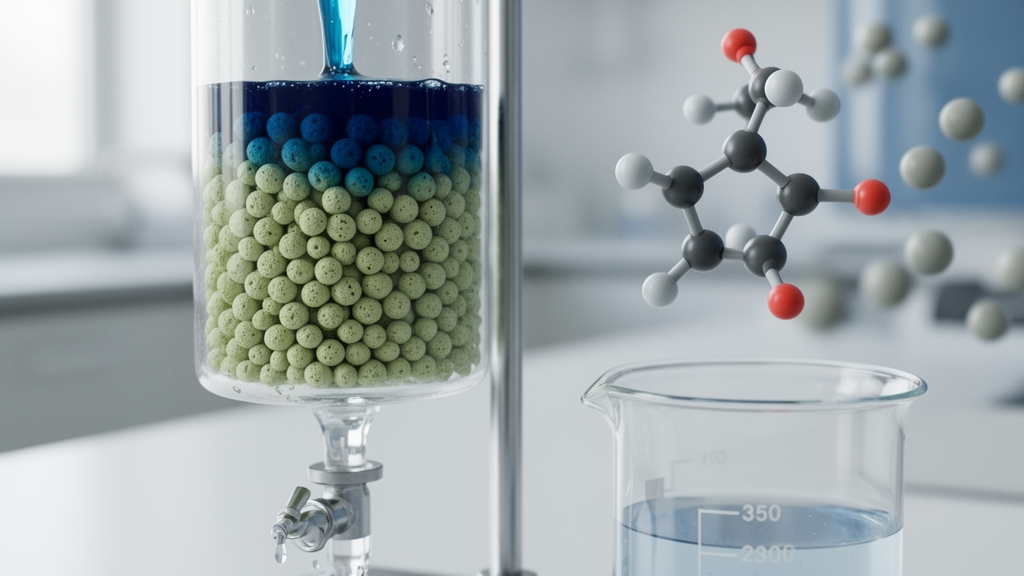
Molecular docking, fixed-bed analysis, and life cycle assessment reveal how NiO@chitosan beads strip CBB-G dye from wastewater. A research team spanning Kalinga Institute of Industrial Technology in Bhubaneswar, Mahindra University in Hyderabad, and Hanyang University in Seoul has developed composite adsorbent beads made of nickel oxide nanoparticles embedded in a chitosan matrix that remove Coomassie Brilliant Blue G (CBB-G), a persistent synthetic dye used in textile processing, biochemical staining, and pharmaceutical manufacturing. The work, published in Frontiers in Chemical Engineering, is notable not only for its adsorption performance but also for the unusual breadth of its analysis: the team combined batch and fixed-bed column experiments with molecular docking simulations and a full life cycle assessment (LCA) to evaluate performance, mechanism, and sustainability in a single integrated framework.
The environmental case for targeting CBB-G is straightforward. Synthetic dyes discharged into aquatic systems resist biodegradation because of their complex aromatic structures and chemical robustness. CBB-G carries sulfonic acid groups that make it highly soluble in water and chemically stable, allowing it to persist in wastewater and natural environments. Its presence reduces light penetration, impeding photosynthesis in aquatic flora and algae, lowering dissolved oxygen, and disrupting ecosystems. At elevated concentrations the dye has been reported to induce cytotoxicity and oxidative stress in exposed cells. Conventional treatment options such as coagulation-flocculation, membrane filtration, advanced oxidation, and biological degradation each carry drawbacks including high operating cost, sludge generation, membrane fouling, incomplete degradation, or strict operational requirements. Adsorption, by contrast, offers simplicity, low cost, and fast kinetics, provided the adsorbent itself is well designed.
Chitosan, a biopolymer derived from deacetylated chitin, is an attractive green adsorbent because it is biodegradable, non-toxic, and rich in amino and hydroxyl functional groups that can engage dye molecules through electrostatic interaction, hydrogen bonding, and surface complexation. Raw chitosan, however, suffers from limited mechanical stability and swelling. The team addressed this by synthesizing NiO nanoparticles through co-precipitation: nickel chloride hexahydrate was dissolved in deionized water, ammonium hydroxide was added dropwise until pH 9 to induce precipitation, the suspension was aged for 12 to 18 hours, and the resulting nickel hydroxide intermediate was calcined for 4 hours at 450 degrees Celsius. The nanoparticles were then homogenized in a chitosan solution in 2 percent acetic acid and dropped into 0.5 M sodium hydroxide to form stable spherical beads. Characterization by X-ray diffraction confirmed a face-centered cubic NiO phase with peaks at 2θ = 37.27, 43.24, 62.99, 75.54, and 79.44 degrees corresponding to the (111), (200), (220), (311), and (222) planes. Fourier transform infrared spectroscopy identified Ni-O stretching at 669 cm⁻¹ alongside chitosan carbonyl and N-H vibrations. Field-emission scanning electron microscopy showed well-dispersed NiO nanoparticles of roughly 28 nanometers embedded in the polymer matrix, and Brunauer-Emmett-Teller analysis revealed a mesoporous structure with a specific surface area of 34.56 m²/g and an average pore diameter of 12.29 nm.
Batch experiments mapped how five operational variables govern removal efficiency. Increasing stirring speed from 50 to 250 revolutions per minute reduced adsorption efficiency because faster agitation shortens interaction time and thickens the boundary layer around the beads; 150 r/min proved optimal. Adsorbent dosage showed a clear optimum at 54 g/L, beyond which particle aggregation attenuated the gains from additional active sites. Initial dye concentration was optimized at 30 mg/L, since higher concentrations trigger site competition. The point of zero charge of the beads, determined at pH 7.75, guided the selection of pH 7, where electrostatic relationships between the anionic dye and the adsorbent surface are favorable. Temperature raised adsorption up to 45 degrees Celsius, consistent with an endothermic process driven by increased molecular mobility and diffusion. Under these conditions the NiO@chitosan beads achieved nearly 99 percent dye removal, compared with roughly 72 percent for pure chitosan beads under identical conditions, a 27 percentage point improvement attributable to the additional active sites and the synergy between NiO and the chitosan functional groups.
Kinetic and equilibrium modeling pinned down the mechanism. The pseudo-second-order model fit the batch data with R² = 0.9993, indicating that the adsorption rate is governed primarily by the availability of active sites rather than by irreversible chemical reaction. The intraparticle diffusion model achieved only a moderate fit (R² = 0.7865), suggesting pore diffusion contributes but is not the sole rate-controlling step; external mass transfer and surface adsorption participate as well. Equilibrium data were best described by the Langmuir isotherm (R² ≈ 0.99), confirming monolayer adsorption on a finite number of energetically favorable sites distributed over a relatively homogeneous surface. Thermodynamic analysis yielded ΔH° = 39.58 kJ/mol, indicating spontaneous, endothermic, physisorption-dominated uptake. The Langmuir adsorption capacity of 15.19 mg/g exceeds those of natural agalmatolite (11.29 mg/g), acid-treated agalmatolite (9.84 mg/g), α-chitin nanoparticles (8.55 mg/g), and the Purolite A420S anion-exchange resin (5.17 mg/g), although it falls below oyster shell-derived hydroxyapatite microspheres (83.82 mg/g) and Fe₃O₄ magnetic nanoparticles (124.33 mg/g), which involve more complex synthesis.
Fixed-bed column studies translated the batch findings into a continuous-flow format relevant to real treatment trains. Using a borosilicate glass column of 10 mm diameter and 500 mm height packed with beads, the team varied bed depth (3, 6, and 9 cm corresponding to 2, 4, and 6 g of adsorbent), influent concentration (3, 5, and 7 mg/L), and feed flow rate (10, 15, and 20 mL/min). Increasing bed height from 3 to 9 cm extended breakthrough time from 10 to 66 minutes and raised removal efficiency from 53.54 to 68.25 percent, because deeper beds provide longer contact time and more adsorption sites. Higher influent concentrations accelerated saturation, shortening breakthrough from 22 to 6 minutes, while increasing flow rate from 10 to 30 mL/min collapsed breakthrough time from 10 to 2 minutes due to insufficient residence time. The Thomas and Yoon-Nelson models both fit the breakthrough data with R² ≈ 0.99, and the Clark model validated their predictive accuracy, establishing that column performance can be reliably forecast from bed height, concentration, and flow velocity.
Molecular docking simulations using the Adsorption Locator module in BIOVIA Materials Studio 2020 provided atomistic-level insight into why the beads bind CBB-G so effectively. Two adsorbent models were constructed: the overall optimized bead structure and a cleaved surface along the NiO (111) crystallographic plane, chosen for its chemical activity and energetic stability. Monte Carlo simulated annealing with 100,000 loading steps and three annealing cycles of 15,000 steps each, described by the Universal Force Field, sampled possible adsorption sites and orientations. The dominant docked configuration showed the dye’s extended aromatic backbone aligned for maximum surface contact, with its negatively charged sulfonate groups engaging protonated amino groups of chitosan and positively polarized Ni²⁺ sites on the (111) surface through electrostatic attraction. Hydrogen bonding between dye N-H and C-H donors and surface oxygen and nitrogen atoms, together with van der Waals and π-surface dispersion interactions, further stabilized the complex. The adsorption energy distribution peaked sharply at approximately -16 kcal/mol, indicating weak to moderate non-covalent interactions consistent with reversible physisorption rather than irreversible chemisorption.
Reusability and ecotoxicological testing addressed practical deployment. The beads retained nearly homogeneous removal efficiency through four adsorption cycles, with only a modest 10 to 15 minute increase in equilibrium time in later cycles, likely from partial surface saturation. Regeneration required only washing with distilled water and air drying. An agar well diffusion assay using Escherichia coli as the test organism showed a 2.6 cm inhibition zone for wells containing untreated CBB-G solution, demonstrating the dye’s antibacterial activity, whereas treated water and deionized controls showed 100 percent bacterial growth with no remaining toxicity. This confirms that adsorption onto the beads strips the dye’s microbiological activity, meaning the treated effluent poses minimal eco-impact if discharged or reused.
The life cycle assessment, conducted with openLCA software, the Ecoinvent 3.11 database, and the ReCiPe 2016 v1.03 (H) midpoint method under ISO 14040, is the study’s most sobering contribution. Two system boundaries were evaluated: gate-to-gate for production of 1 kg of beads, and gate-to-use for treatment of 1 m³ of dye-contaminated water. Bead production generated approximately 105 kg CO₂-eq per kilogram, with acetic acid production contributing 56.146 kg CO₂-eq per kilogram of beads and electricity consumption modeled on the Indian Eastern Grid identified as a common hotspot. Scale-up calculations showed that 6.94 kg of beads are required to treat 1 m³ of wastewater, leading to a total climate impact of roughly 852 kg CO₂-eq per cubic meter of treated water. Non-carcinogenic human toxicity reached 1,674.9 kg 1,4-DCB-eq per cubic meter, with significant footprints in acidification, eutrophication, and water use attributed largely to proxy data for nickel chloride hexahydrate. Compared with porous chitosan beads reported at 910 kg CO₂-eq/kg and silicate-titanite nanotube/chitosan beads at 2,313 kg CO₂-eq/kg, the NiO@chitosan production footprint is comparatively favorable, but the use phase accounted for roughly 14 percent of total emissions, and the beads retained 36 percent removal efficiency after four cycles. The authors conclude that further optimization of synthesis, reduced bead dosage, and renewable electricity are essential before NiO@chitosan beads can be considered a fully sustainable adsorbent for large-scale wastewater treatment.
Subject of Research: Mechanistic insight into CBB-G removal by NiO@chitosan beads using molecular docking, fixed-bed analysis, and life cycle assessment
Article Title: Mechanistic insight into CBB-G removal by NiO@chitosan beads using molecular docking, fixed-bed analysis, and life cycle assessment
Article References: Mishra, S., Khare, D., Kumar, R., Banerjee, S., Jeon, B.-H., Nayak, J., Chakrabortty, S., & Tripathy, S. K. (2026). Mechanistic insight into CBB-G removal by NiO@chitosan beads using molecular docking, fixed-bed analysis, and life cycle assessment. Frontiers in Chemical Engineering, 8, Article 1887485. https://doi.org/10.3389/fceng.2026.1887485
Image Credits: AI Generated
DOI: 10.3389/fceng.2026.1887485
Keywords: Mechanistic, insight, CBB-G, removal, chitosan, beads, molecular, docking, fixed-bed, analysis, life, cycle
Cite Scienmag News
Denise Maddox. (October 16, 2026). Molecular docking, fixed-bed analysis, and life cycle assessment reveal how NiO@chitosan beads strip CBB-G dye. Scienmag. https://scienmag.com/molecular-docking-fixed-bed-analysis-and-life-cycle-assessment-reveal-how-niochitosan-beads-strip-cbb-g-dye/
Denise Maddox. "Molecular docking, fixed-bed analysis, and life cycle assessment reveal how NiO@chitosan beads strip CBB-G dye." Scienmag, 16 October 2026, https://scienmag.com/molecular-docking-fixed-bed-analysis-and-life-cycle-assessment-reveal-how-niochitosan-beads-strip-cbb-g-dye/. Accessed 16 October 2026.
Denise Maddox. "Molecular docking, fixed-bed analysis, and life cycle assessment reveal how NiO@chitosan beads strip CBB-G dye." Scienmag. October 16, 2026. https://scienmag.com/molecular-docking-fixed-bed-analysis-and-life-cycle-assessment-reveal-how-niochitosan-beads-strip-cbb-g-dye/


