


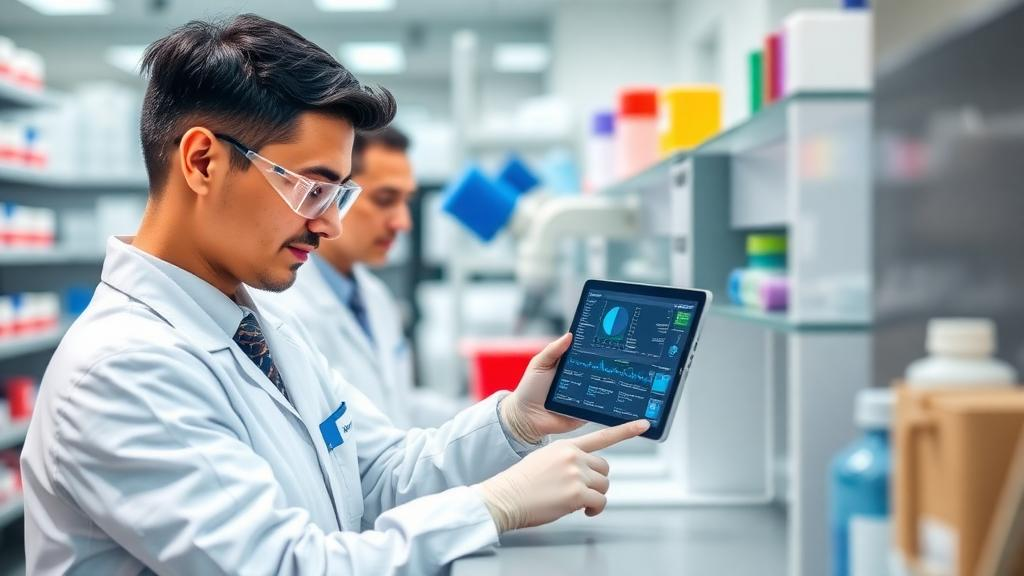
Pharmaceutical manufacturing is racing into the digital age, but the students being trained to run its factories have largely been left behind. Now a quasi-experimental study from Fuyang Normal University in China offers some of the strongest evidence yet that a carefully engineered curriculum can close that gap. The research, published in Discover Education, developed and tested an Intelligent Pharmaceutical Manufacturing curriculum module built around industry-education integration, and the results were striking: students who took the module outperformed their conventionally taught peers on every measure, with the largest gains in exactly the area where traditional education fails most badly, digital manufacturing competency.
The study, led by Yan Peng and Mengqi Li of Fuyang Medical School, responds to a transformation that is reshaping drug production worldwide. Modern pharmaceutical manufacturing is moving away from traditional batch-based production toward digitalized, continuous, data-driven systems driven by Industry 4.0, smart manufacturing, and regulatory modernization. Technologies such as Quality by Design (QbD), Process Analytical Technology (PAT), Manufacturing Execution Systems (MES), electronic batch records (EBR), digital twins, and artificial intelligence-assisted process optimization are becoming essential components of production and quality assurance. Yet conventional pharmaceutical education remains largely theory-centered and textbook-based, leaving graduates with limited exposure to real production scenarios, digitalized manufacturing systems, and data-driven decision-making.
The mismatch is not trivial. Practical teaching in pharmaceutical production is constrained by high costs, safety requirements, and the regulatory complexity of GMP-compliant facilities, so students often graduate with insufficient practical competency and digital manufacturing literacy. To address this, the research team designed a curriculum module that transformed scattered intelligent manufacturing topics into a coherent learning system spanning six content areas: QbD and PAT for real-time quality monitoring; MES and EBR for digital production scheduling and data traceability; digital twins and virtual simulation; AI-assisted process optimization; GMP compliance, validation, and data integrity; and enterprise-based innovation projects built on authentic industrial problems.
The pedagogical engine of the module is a four-integration teaching model. Curriculum content was integrated with industrial standards, aligning teaching with GMP requirements and enterprise production practices. Classroom learning was integrated with production scenarios, using real enterprise cases, deviation records, and quality risk situations. Physical practice was integrated with virtual simulation, compensating for the constraints of pharmaceutical production training with safe, repeatable digital environments. Finally, knowledge learning was integrated with innovation projects, requiring students to apply theory to team-based tasks such as electronic batch record optimization, PAT-based process monitoring, and digital twin modeling. The whole framework was supported by an industry-education co-cultivation mechanism in which enterprise experts helped design the curriculum, delivered case-based lectures, mentored projects, and co-evaluated student outputs alongside university instructors.
To test whether this elaborate framework actually worked, the team ran a quasi-experimental pretest-posttest control group study with 92 undergraduate students in pharmaceutical engineering and related majors during the 2025 academic term. Two intact classes of 46 students each were assigned to the intervention or control group. Because random assignment at the individual level was not feasible, the researchers rigorously tested baseline equivalence across all outcome measures and used analysis of covariance (ANCOVA) with pretest scores as covariates to control for residual baseline differences. Both classes were taught by the same instructor to minimize instructor effects. The intervention group received the eight-week module with two contact hours per week plus project activities; the control group received conventional lectures and textbook-based instruction covering similar basic topics but without systematic modules on MES, digital twins, AI optimization, or enterprise mentoring.
The measurement instruments were engineered with unusual care for an education study. The 30-item knowledge test covered QbD, PAT, MES, EBR, digital twins, AI-assisted optimization, GMP, validation, and data integrity, achieving a Scale-Level Content Validity Index of 0.92 and Cronbach’s alpha of 0.82. Practical competency was assessed with a blinded two-rater performance rubric (inter-rater reliability ICC = 0.86), while digital manufacturing competency was measured through scenario-based tasks such as interpreting MES data showing a trend of increasing tablet hardness across three batches and proposing data-driven optimization strategies. Learning engagement was measured with a 12-item scale covering behavioral, cognitive, and emotional engagement (alpha = 0.90). Parallel pretest and post-test versions drawn from the same item bank correlated at r = 0.85 to minimize practice effects.
The results were dramatic. In knowledge acquisition, the intervention group achieved a mean learning gain of 22.8 points versus 13.8 points in the control group, a large effect (Cohen’s d = 0.95). Practical competency gains were 24.5 versus 15.2 points (d = 0.98). Learning engagement rose more in the intervention group (1.13 versus 0.61 points, d = 0.76). But the standout result was digital manufacturing competency: the intervention group gained 25.1 points against only 11.7 points for the control group, a very large effect of d = 1.25, with the intervention group’s advantage reaching 13.4 points, the widest gap of any outcome. ANCOVA confirmed that group membership remained a significant predictor of post-test scores for all four outcomes after controlling for baseline, with the strongest effect on digital manufacturing competency (F = 32.56, p < 0.001, partial eta squared = 0.27).
Qualitative evidence reinforced the numbers. Students in the intervention group completed team-based innovation projects on authentic problems including electronic batch record optimization, PAT-based monitoring, digital twin modeling, and data integrity risk assessment, earning an average project score of 86.3 out of 100. Enterprise mentors rated the projects with the same rubric, and the correlation between mentor and instructor scores was r = 0.89, indicating strong convergence. Six mentors rated the module highly on relevance to workplace needs (4.3 out of 5) and student readiness for industrial practice (4.0 out of 5). One mentor noted that a student project on electronic batch record optimization was directly applicable to the company’s current digital transformation initiatives. Student satisfaction with the virtual simulation and digital twin tools was high (4.15 out of 5 for perceived utility), with overall module satisfaction at 4.08.
Thematic analysis of student feedback identified four major themes: enhanced understanding of real industrial pharmaceutical manufacturing, improved digital manufacturing awareness, increased learning motivation, and a need for more training in data analysis. One student reflected that previously they only understood pharmaceutical manufacturing from textbooks, but through the virtual production line and enterprise cases they realized how process parameters, quality attributes, equipment, and data systems are connected. Another observed that future pharmaceutical manufacturing requires not only knowledge of pharmaceutics but also the ability to understand data, digital systems, and intelligent equipment. The recurring complaint was that the AI optimization component was useful but difficult, particularly for students with limited programming or statistics backgrounds, suggesting future iterations should include more scaffolded training in data analytics and computational thinking.
The study’s limitations are acknowledged by the authors: the quasi-experimental design lacked individual randomization, the sample came from a single institution with two intact classes, the eight-week intervention did not assess long-term retention, and some assessment tools were developed specifically for this study. Still, the framework offers a transferable template for institutions worldwide grappling with the same challenge, since pharmaceutical manufacturers everywhere are adopting digitalized production systems, electronic quality management, and data integrity requirements. The four-integration teaching model and industry-education co-cultivation mechanism may be adaptable to other applied disciplines facing digital transformation, from biotechnology to chemical engineering. For a field where graduates must integrate pharmaceutical science, engineering practice, digital technologies, and regulatory thinking, the message is clear: the curriculum of the future cannot be built from textbooks alone.
Subject of Research: Education
Article Title: Development and evaluation of an intelligent pharmaceutical manufacturing curriculum module under industry–education integration: a quasi-experimental study
Article References: Peng, Y., & Li, M. (2026). Development and evaluation of an intelligent pharmaceutical manufacturing curriculum module under industry–education integration: a quasi-experimental study. Discover Education, 5(1), Article 1179. https://doi.org/10.1007/s44217-026-02148-8
Image Credits: AI Generated
DOI: 10.1007/s44217-026-02148-8
Keywords: pharmaceutical manufacturing, digital twins, curriculum innovation, industry-education integration, virtual simulation, competency-based education, GMP, quasi-experimental study, Development, evaluation, intelligent, pharmaceutical
Cite Scienmag News
Denise Maddox. (October 16, 2026). Pharma Goes Digital: New Curriculum Module Trains Students for Smart Manufacturing. Scienmag. https://scienmag.com/pharma-goes-digital-new-curriculum-module-trains-students-for-smart-manufacturing/
Denise Maddox. "Pharma Goes Digital: New Curriculum Module Trains Students for Smart Manufacturing." Scienmag, 16 October 2026, https://scienmag.com/pharma-goes-digital-new-curriculum-module-trains-students-for-smart-manufacturing/. Accessed 16 October 2026.
Denise Maddox. "Pharma Goes Digital: New Curriculum Module Trains Students for Smart Manufacturing." Scienmag. October 16, 2026. https://scienmag.com/pharma-goes-digital-new-curriculum-module-trains-students-for-smart-manufacturing/


