


Every pregnancy depends on a remarkable organ that most people never think about: the placenta. It delivers oxygen and nutrients to the developing fetus, clears waste, and acts as a hormonal control center for the entire gestation. When the placenta fails, the consequences can be devastating. Pre-eclampsia, a disorder of abnormal placental blood vessel development, remains one of the leading causes of maternal and newborn death worldwide, and its burden falls overwhelmingly on low- and middle-income countries. Now a large study from West and East Africa suggests that something as basic as the water a household drinks and the toilet it uses may be quietly shaping that risk.
The research, published in PLOS Global Public Health, drew on data from PRECISE, a prospective observational cohort that enrolled 5,745 unselected pregnant women in The Gambia, Kenya and Mozambique. Unlike many studies that focus on women already attending specialist clinics, PRECISE recruited participants from the general population, giving researchers a picture of pregnancy complications across ordinary communities. The team, led by Joseph Wells and colleagues spanning institutions in all three countries and the United Kingdom, asked a deceptively simple question: are household water, sanitation and hygiene conditions associated with placenta-related complications?
The complications examined were pre-eclampsia, small-for-gestational-age birth, in which the fetus grows more slowly than expected, and stillbirth. These outcomes are connected by a common thread of impaired placental function. Restricted blood flow through the placenta can starve the fetus of oxygen and nutrients, producing growth restriction, and in severe cases fetal death. Pre-eclampsia, meanwhile, arises when the placenta fails to remodel the maternal blood vessels that should supply it, setting off a cascade of maternal hypertension and organ damage. What all three share is a placenta under stress, and the study set out to test whether the household environment might be part of that stress.
To measure exposure, the researchers classified each household’s water source and toilet facility using standard improved and unimproved categories familiar from global monitoring programs. Water piped directly into a dwelling or plot represented the best case, while other improved sources such as public taps or protected wells, and unimproved sources such as unprotected wells or surface water, represented progressively riskier situations. Sanitation was similarly graded from improved facilities to unimproved ones. The analysis then used multivariable modified Poisson regression with robust standard errors, a statistical approach well suited to estimating relative risks for common binary outcomes, adjusting for a panel of potential confounders. Missing exposure and covariate data were low, under five percent, and were handled with multiple imputation to reduce bias.
The results were striking in their consistency. Compared with women whose homes had water piped into the dwelling or plot, those relying on other improved water sources had an eighteen percent higher risk of experiencing any of the selected placenta-related complications, with an adjusted relative risk of 1.18 and a 95 percent confidence interval of 1.07 to 1.31, a finding that was statistically significant at p equals 0.002. Women using unimproved water sources fared even worse, with an adjusted relative risk of 1.23, a confidence interval of 1.00 to 1.50, and a p value of 0.049, just crossing the conventional threshold of significance. Unimproved sanitation told a similar story: relative to improved facilities, unimproved toilets were associated with a fifteen percent increase in risk, with an adjusted relative risk of 1.15, a confidence interval of 1.02 to 1.30, and a p value of 0.019.
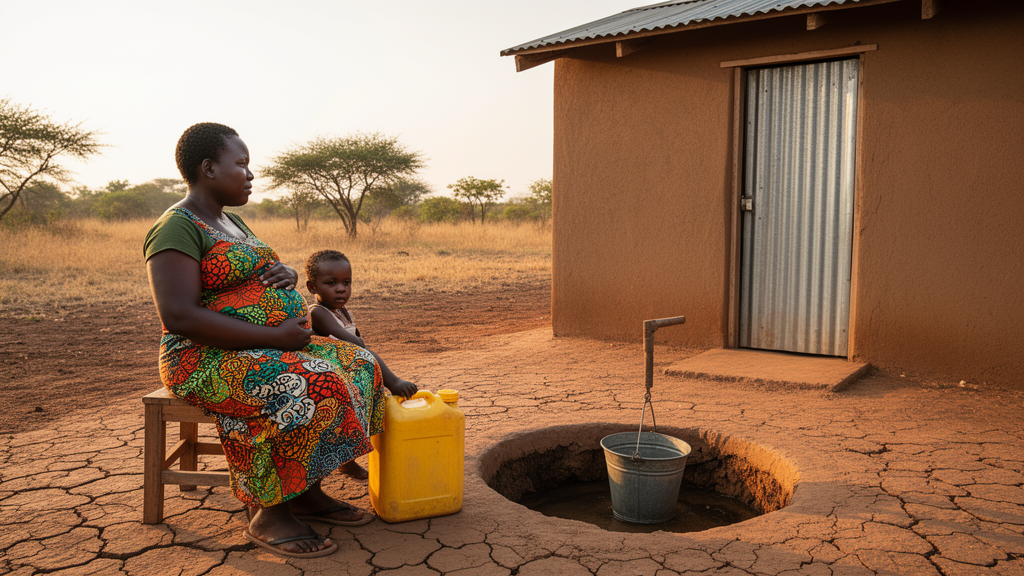
What makes these numbers particularly interesting is the pattern within them. The risk was elevated not only for unimproved water but also for improved sources that fall short of piped supply. This points to a subtler mechanism than simple access. Water from a protected well or communal tap may still become contaminated during collection, transport and storage in the home, the stages of the water journey that occur after the source itself. Each transfer is an opportunity for enteric pathogens to enter, and the physical burden of hauling water, often over considerable distances and in repeated trips, adds its own strain on pregnant bodies. The authors suggest that household WASH conditions may influence placental health through both direct and indirect pathways, and the data are consistent with that interpretation.
The direct pathway runs through infection. Unsafe sanitation increases exposure to fecal pathogens, and gastrointestinal infections during pregnancy are not merely uncomfortable. Enteric inflammation can drive systemic immune activation, and mounting evidence from other settings links maternal infection and inflammation to placental dysfunction, altered fetal growth and adverse birth outcomes. Repeated low-grade exposures, the kind that come from chronically contaminated water rather than a single dramatic illness, may be particularly insidious because they never announce themselves as a clinical event. The indirect pathway operates through the sheer physical labor of water collection, which falls disproportionately on women and can intensify during pregnancy when energy demands are already elevated.
Pre-eclampsia adds another layer of biological plausibility to the WASH connection. The disorder is increasingly understood as involving abnormal immune responses and endothelial dysfunction, processes that environmental exposures can influence. Some researchers have proposed that repeated exposure to enteric pathogens and the chronic inflammatory state they induce could interact with the immunological adaptations of pregnancy, potentially contributing to the failed placental vascular remodeling that underlies pre-eclampsia. The current study was not designed to test mechanisms, and its observational design means the associations it reports cannot be read as proof of causation, but the consistency of the water and sanitation findings across exposure types lends weight to the hypothesis that the household environment matters.
The implications for policy are potentially significant. If household WASH conditions genuinely contribute to placenta-related complications, then targeted WASH interventions, from extending piped water supplies to improving household water treatment and storage practices and expanding access to improved sanitation, could become part of the toolkit for reducing maternal and perinatal mortality in low- and middle-income countries. Such interventions would complement existing clinical strategies rather than replace them, but they address a root exposure that clinical care alone cannot touch. The authors argue that these interventions warrant investigation as a potential strategy to improve maternal and neonatal health outcomes, and the scale of the population affected means even modest risk reductions could translate into substantial public health gains.
Future research faces two clear tasks. The first is mechanistic: understanding precisely how water contamination, sanitation-related infection and the physical demands of water collection translate into placental pathology, whether through inflammation, nutritional stress, hypertension or other pathways. The second is interventional: testing whether comprehensive WASH improvements actually reduce the incidence of pre-eclampsia, small-for-gestational-age birth and stillbirth in affected communities. The PRECISE cohort, with its large size and its coverage of three distinct African settings, provides a foundation for both lines of inquiry. For now, the study adds a new dimension to a familiar message: the health of a pregnancy is shaped not only by what happens in clinics and hospitals, but by the water that flows, or fails to flow, into the home.
Subject of Research: The association between household water, sanitation and hygiene conditions and placenta-related pregnancy complications in sub-Saharan Africa
Article Title: Evaluating the association between household water, sanitation and hygiene (WASH) and selected placenta-related complications in The Gambia, Kenya and Mozambique
Article References: Wells, J., Waiswa, J., Vala, A., Golla, B., Mwashigadi, G., Jah, H., Temmerman, M., Okello, R., Mwaniki, I., Cossa, H., Mukhanya, M., Sevene, E., Idris, Y., Wanje, O., Koech, A., Roca, A., Braun, L., Volvert, M.-L., Touray, F., … the PRECISE and PRECISE-DYAD Networks (2026). Evaluating the association between household water, sanitation and hygiene (WASH) and selected placenta-related complications in The Gambia, Kenya and Mozambique. PLOS Global Public Health, 6(10), e0005004. https://doi.org/10.1371/journal.pgph.0005004
Image Credits: AI Generated
DOI: 10.1371/journal.pgph.0005004
Keywords: WASH, placenta, pre-eclampsia, small-for-gestational-age, stillbirth, maternal health, The Gambia, Kenya, Mozambique, water contamination, sanitation, PRECISE cohort
Cite Scienmag News
Harold Sullivan. (October 16, 2026). Poor Household Water and Sanitation Linked to Dangerous Pregnancy Complications in Africa. Scienmag. https://scienmag.com/poor-household-water-and-sanitation-linked-to-dangerous-pregnancy-complications-in-africa/
Harold Sullivan. "Poor Household Water and Sanitation Linked to Dangerous Pregnancy Complications in Africa." Scienmag, 16 October 2026, https://scienmag.com/poor-household-water-and-sanitation-linked-to-dangerous-pregnancy-complications-in-africa/. Accessed 16 October 2026.
Harold Sullivan. "Poor Household Water and Sanitation Linked to Dangerous Pregnancy Complications in Africa." Scienmag. October 16, 2026. https://scienmag.com/poor-household-water-and-sanitation-linked-to-dangerous-pregnancy-complications-in-africa/


