


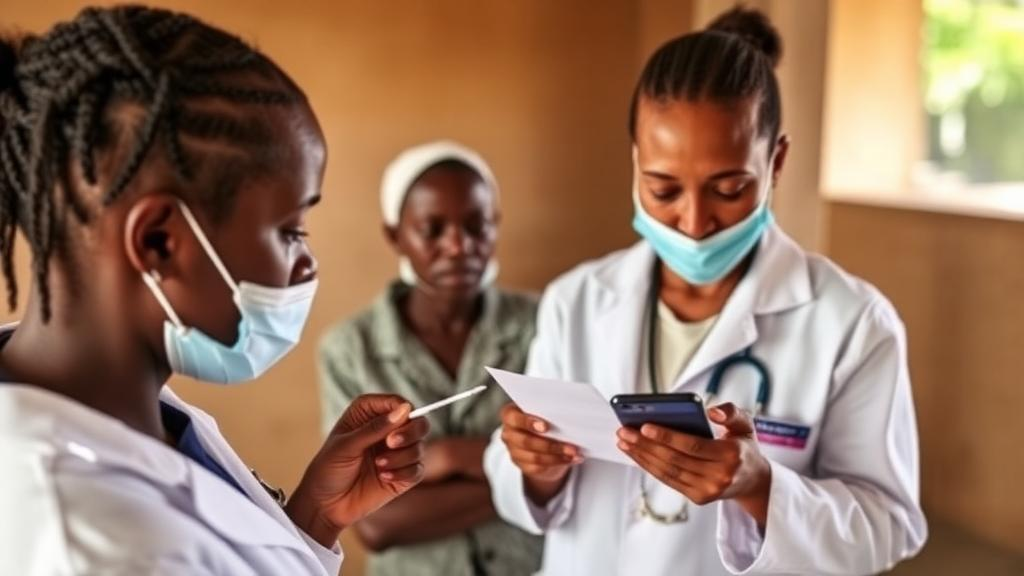
In the volcanic foothills of Rwanda’s Rubavu district, a quiet diagnostic revolution is underway. Community health workers, armed with nothing more than a smartphone running the World Health Organization’s Skin-NTD application or a simple paper-based clinical algorithm, have matched the diagnostic judgment of a trained dermatologist in identifying podoconiosis, a devastating and long-neglected swelling disease of the legs. The findings, published in Frontiers in Tropical Diseases, suggest that the frontline of detection for one of the world’s most overlooked tropical diseases may not need a specialist at all.
Podoconiosis is a non-infectious form of elephantiasis triggered by prolonged barefoot exposure to irritant minerals in red clay soils. Unlike lymphatic filariasis, which is caused by parasitic worms transmitted by mosquitoes, podoconiosis is entirely environmental and therefore entirely preventable. Yet it affects an estimated four million people across Africa, parts of Latin America, and Southeast Asia, causing progressive swelling, skin nodules, fibrosis, and the disfiguring mossy lesions of advanced disease. The World Health Organization formally recognized it as a neglected tropical disease in 2011, but diagnosis remains stubbornly difficult because there is no laboratory test or point-of-care device that can confirm it.
The diagnostic challenge hinges on distinguishing podoconiosis from other causes of leg swelling, particularly lymphatic filariasis, before irreversible lymphedema sets in. The disease progresses through five clinical stages, from early reversible swelling that subsides with rest to advanced elephantiasis with permanent skin changes. Catching it in stages one and two, when foot hygiene, compression, and consistent footwear can still halt progression, is the entire point of community screening. Miss those windows, and patients face lifelong disability, recurrent acute inflammatory episodes known as dermatolymphangioadenitis, and profound social stigma that can cost them work, marriage prospects, and community standing.
The research team, led by Misbah Gashegu of the University of Rwanda and Rwanda Biomedical Centre, together with collaborators at Brighton and Sussex Medical School and other institutions, set out to test whether community health workers could reliably make this distinction using two different tools. The first was the WHO Skin-NTD mobile application, an offline digital decision-support system that walks users through a structured assessment based on patient history and physical examination, incorporating criteria such as bilateral lower limb swelling, chronic progression, a history of barefoot exposure to irritant soil, and the systematic exclusion of infectious or systemic causes. The second was a validated clinical algorithm originally developed by Deribe and colleagues in 2017, which relies on the same clinical logic but requires no technology beyond a trained observer.
The study enrolled 216 adults with leg swelling of any cause across twelve sectors of Rubavu district, identified through health facility records, outpatient registers, and community health worker listings. After exclusions for missing reference diagnoses, 196 participants entered the final accuracy analysis. Each participant was assessed independently by two separate community health workers, one using the mobile application and one using the clinical algorithm, while a single dermatologist, blinded to both assessments, served as the clinical reference standard. The dermatologist recorded the distribution and laterality of swelling, symptom duration, characteristic skin changes, history of acute episodes, footwear habits, and features used to rule out lymphatic filariasis, chronic venous insufficiency, cardiac failure, renal disease, and traumatic lymphedema.
The results were striking. Of the 196 participants, 137, or 69.9 percent, were confirmed by the dermatologist as having podoconiosis. The mobile application correctly identified 89.8 percent of these true cases, with a specificity of 88.1 percent, meaning it accurately ruled out the disease in nearly nine out of ten people who did not have it. The clinical algorithm performed even better on sensitivity, catching 96.4 percent of confirmed cases, with a specificity of 86.4 percent. Overall diagnostic accuracy, expressed as the average of sensitivity and specificity, reached 0.89 for the mobile application and 0.91 for the clinical algorithm, both figures that would be respectable even in well-resourced clinical settings.
Perhaps the most consequential difference between the two tools lay in their negative predictive value. When the clinical algorithm returned a negative result, it was correct 91.1 percent of the time, compared to just 78.8 percent for the mobile application. In practical terms, this means the paper-based approach is more trustworthy when it tells a health worker that a patient does not have podoconiosis, reducing the risk of false reassurance and missed early-stage disease. Both tools achieved similarly high positive predictive values, around 94 percent, meaning that when either flagged a case, it was almost certainly right.
The demographic profile of those diagnosed tells its own story. Women made up 86.9 percent of confirmed podoconiosis cases, and 81.8 percent of those diagnosed had no formal education. A striking 41.6 percent of people with podoconiosis reported a first-degree family history of the disease, compared to just 7.9 percent of those with other causes of swelling, consistent with the known genetic susceptibility to the condition. Most participants reported wearing shoes consistently and washing their feet daily, yet the disease persisted, underscoring that prevention requires more than individual behavior change in areas where irritant soils are ubiquitous.
The authors are careful about what these numbers do and do not mean. Because participants were recruited from existing case registers rather than through population-wide screening, the study population was enriched with clinically apparent disease, which may inflate apparent accuracy compared to what would be seen in true community screening. The study was also not powered to formally prove that one tool outperforms the other, and participants were not stratified by disease stage, leaving open the question of whether either approach excels specifically at catching the early, reversible cases that matter most for prevention.
What the study does establish is that the choice between digital and paper-based diagnosis need not be binary. The clinical algorithm, requiring no devices, connectivity, or technical support, is the natural choice for remote and resource-constrained settings. The WHO Skin-NTD application, with its standardized decision support, digital data capture, and potential integration into national surveillance systems, adds value where mobile infrastructure exists. The authors argue for a flexible, context-dependent deployment strategy rather than simultaneous use of both tools, paired with structured and repeated training of community health workers to maintain diagnostic consistency. As Rwanda and other endemic countries push toward elimination, this study offers a pragmatic roadmap: the most sophisticated diagnostic tool is not always the one with the most features, but the one that actually fits the hands and circumstances of the people doing the work.
Subject of Research: Diagnostic accuracy of digital and clinical tools for community-based podoconiosis detection in Rwanda
Article Title: Diagnostic performance of digital and clinical approaches for detection of podoconiosis by community health workers in Rwanda: a comparison with dermatologist diagnosis
Article References: Gashegu, M., Ndahindwa, V., Mutesa, L., Rujeni, N., Muvunyi, C. M., Musanabaganwa, C., Seruyange, E., Siddig, E. E., Semrau, M., Anagnostopoulou, V., Rugema, L., & Davey, G. (2026). Diagnostic performance of digital and clinical approaches for detection of podoconiosis by community health workers in Rwanda: a comparison with dermatologist diagnosis. Frontiers in Tropical Diseases, 7, Article 1802400. https://doi.org/10.3389/fitd.2026.1802400
Image Credits: AI Generated
DOI: 10.3389/fitd.2026.1802400
Keywords: podoconiosis, Rwanda, community health workers, WHO Skin-NTD app, clinical algorithm, neglected tropical diseases, lymphedema, diagnostic accuracy, digital health, lymphatic filariasis, dermatology, public health
Cite Scienmag News
Phoebe Ingram. (October 16, 2026). Community health workers in Rwanda match dermatologists at spotting podoconiosis with app and paper tools. Scienmag. https://scienmag.com/community-health-workers-in-rwanda-match-dermatologists-at-spotting-podoconiosis-with-app-and-paper-tools/
Phoebe Ingram. "Community health workers in Rwanda match dermatologists at spotting podoconiosis with app and paper tools." Scienmag, 16 October 2026, https://scienmag.com/community-health-workers-in-rwanda-match-dermatologists-at-spotting-podoconiosis-with-app-and-paper-tools/. Accessed 16 October 2026.
Phoebe Ingram. "Community health workers in Rwanda match dermatologists at spotting podoconiosis with app and paper tools." Scienmag. October 16, 2026. https://scienmag.com/community-health-workers-in-rwanda-match-dermatologists-at-spotting-podoconiosis-with-app-and-paper-tools/


