


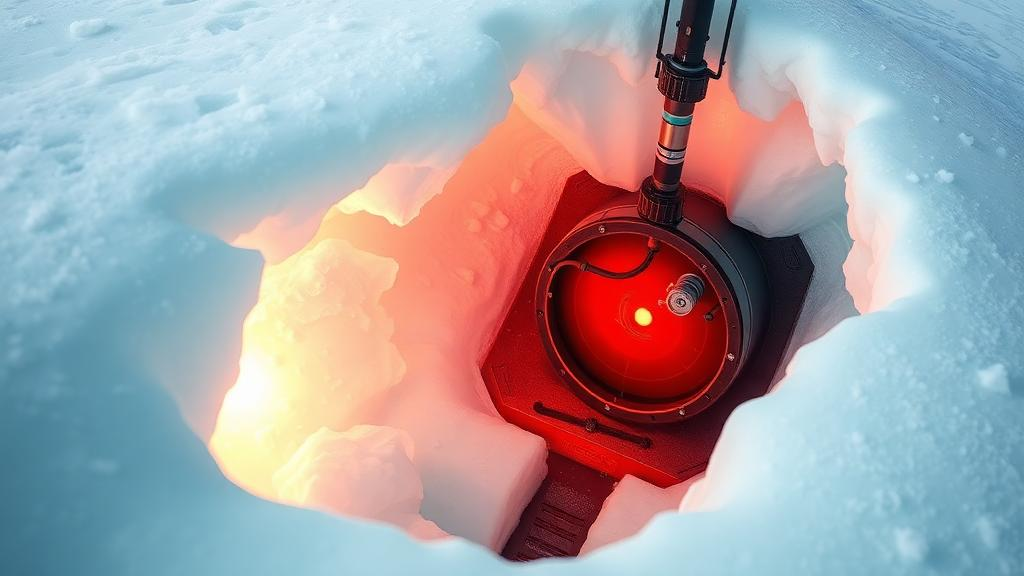
Beneath the frozen shells of Europa and Enceladus lie global oceans of liquid water, and beneath the thick polar ice of Mars may lurk pockets of brine. Reaching those hidden reservoirs is one of the most compelling challenges in the search for life beyond Earth, and a team of engineers at Honeybee Robotics, a Blue Origin company, together with Michigan Technological University and Caltech, has now taken a significant step toward solving it. In a study published in Frontiers in Space Technologies, the researchers report the first proof-of-concept tests of the SLUSH probe, short for Search for Life Using Submersible Heated drill, a hybrid device that melts and drills its way through ice simultaneously.
The problem SLUSH addresses is fundamental. Two established methods exist for penetrating ice: thermal probes that melt their way down, and mechanical drills that cut. Each has a crippling weakness. Mechanical drilling breaks ice efficiently but cannot move the resulting chips out of the way once the probe is fully encased, causing the drill to stall. Thermal melting transports material smoothly behind the probe but wastes enormous energy, because it must heat the entire volume of ice ahead of it from frigid ambient temperatures all the way to the melting point. SLUSH, as its name suggests, splits the difference through a technique the team calls slushing: a rotary-percussive drill fractures the ice into chips, and heat partially melts those chips into a flowable slurry that can be transported behind the probe by an auger and by buoyancy.
The physics behind the approach is grounded in a simple observation. Breaking ice mechanically costs far less energy than melting it, roughly 0.03 watt-hours per cubic centimeter in the team’s tests compared with 0.31 kilojoules per cubic centimeter for melting. By melting only enough of the cuttings to mobilize them as a slurry, rather than melting the full column of ice, the probe dramatically reduces its thermal budget while retaining the transport advantages of a melt probe. The team also introduced a conceptual power-balance framework that decomposes the total slushing power requirement into mechanical and thermal contributions, benchmarked against an idealized conventional melt probe modeled with the most recent analytical tools in the field.
To test the concept, the researchers built a scaled prototype with a probe body 5 centimeters in diameter and a drill bit about 6.4 centimeters across, leaving a narrow 0.7-centimeter annular gap for chips and slurry to travel. Two independently controlled brushless DC motors drive the rotary and percussive mechanisms, while four ceramic heaters embedded in the auger and bit partially melt the cuttings. The team then subjected the prototype to three environments designed to mimic the conditions a planetary probe would encounter: warm ice at 260 kelvin at ambient pressure, analogous to the layers near a subsurface ocean; cryogenic ice at 130 kelvin at ambient pressure, representing the upper ice shell after the borehole closes; and cryogenic ice under vacuum below the triple point of water, simulating the first few meters of penetration at the surface of Europa or Enceladus.
The results were striking. In warm ice, slushing achieved a penetration rate of 1.10 meters per hour at a specific energy of 0.08 watt-hours per cubic centimeter, compared with just 0.05 meters per hour and 0.42 watt-hours per cubic centimeter for thermal-only melting under the prototype’s hardware constraints. Mechanical-only drilling was fast at 0.42 meters per hour but stalled once the auger was fully submerged, as dry chips accumulated in the borehole with no way to clear them. In cryogenic vacuum, the environment most hostile to melting, slushing reached 1.14 meters per hour while thermal-only drilling managed only 0.16 meters per hour, because without a liquid phase there is no effective medium to carry heat from the drill tip into the ice.
Perhaps the most unexpected discovery came from the vacuum tests. Below the triple point of water, liquid cannot exist, so heating ice drives it directly from solid to vapor. During slushing in vacuum, the team observed that water vapor generated at the heated auger built up enough pressure to blow cuttings out of the borehole entirely, a self-clearing mechanism that kept the drill advancing. This vapor-driven ejection of mechanically generated chips, the authors note, appears uncharacterized in prior literature. It offers a major advantage during the initial descent through the upper ice shell, though the effect weakens as the borehole closes and pressurizes behind the probe.
Against the theoretical melt-probe benchmark, calculated for a perfectly efficient thermal probe of the same diameter and power budget, slushing performed comparably in warm ice, achieving 1.1 times the efficiency and 1.3 times the speed. In cryogenic ice at ambient pressure, it fell short, reaching only about 0.43 times the benchmark’s speed and efficiency, likely because side-wall heat losses grow dramatically as the temperature difference between the melting point and the environment widens. The team estimated that roughly 640 watts of thermal power may have been lost through the borehole wall in that test. But in cryogenic vacuum, the environment expected at the top of an icy world’s shell, slushing was about 2.3 times faster and 1.3 times more efficient than the idealized benchmark.
The team also tested a fully integrated prototype probe, complete with anti-torque skates, a tether bay, and onboard electronics, in a 1.5-meter column of warm ice. The probe drilled under its own weight at roughly 0.90 meters per hour, forming a visible ice slurry and demonstrating end-to-end functionality. As expected, integration imposed penalties: specific energy roughly doubled and speed dropped to about 0.8 times the drilling-subsystem value, reflecting heat lost along the full heated length of the borehole wall and friction from the anti-torque assembly. Even so, the integrated probe exceeded the theoretical melt-probe benchmark, achieving 1.19 times the efficiency and 1.6 times the speed at the same power budget.
The full-scale flight concept for SLUSH envisions a probe about 5 meters long and 50 centimeters in diameter, powered by NASA’s Kilopower fission reactor, which can be switched on and off and self-moderates its heat output. The authors point out a counterintuitive reality of planetary nuclear probes: the dominant thermal challenge will be keeping the probe cool, not warm. A 10-kilowatt radioisotope generator on a one-ton metallic probe with no heat sink would raise its temperature by 100 degrees Celsius in an hour, a problem that makes technologies developed for Venus exploration directly relevant to icy-world missions.
The study’s authors are careful to note the limitations of this first campaign. Each condition was tested only once, the ice was pure distilled water rather than the salt- and dust-laden ice expected on Europa, Enceladus, or Mars, and the slurry’s liquid fraction and chip size were not measured. Still, the results establish that slushing is viable across all three environments and uniquely avoids both the chip-transport stalling of mechanical drilling and the thermal bottleneck of melt-only probes. With parametric optimization, repeat testing, and experiments on impurity-bearing ice ahead, the SLUSH approach offers a promising path toward the subsurface oceans where the solar system’s most tantalizing questions about life may be waiting.
Subject of Research: Thermo-mechanical ice-penetrating probe testing for accessing subsurface oceans on Europa, Enceladus, and Mars
Article Title: Testing of SLUSH ice penetrating probe in Europa, Enceladus, and Mars environments
Article References: Stolov, L., Lang, C., Zacny, K., Mellerowicz, B., Palmowski, J., Bywaters, K., Sheeran, F., van Susante, P., & Ehlmann, B. L. (2026). Testing of SLUSH ice penetrating probe in Europa, Enceladus, and Mars environments. Frontiers in Space Technologies, 7, Article 1887929. https://doi.org/10.3389/frspt.2026.1887929
Image Credits: AI Generated
DOI: 10.3389/frspt.2026.1887929
Keywords: SLUSH probe, Europa, Enceladus, Mars, ice drilling, cryobot, thermo-mechanical drilling, subsurface ocean, astrobiology, Honeybee Robotics, vacuum testing, planetary exploration
Cite Scienmag News
Denise Maddox. (October 16, 2026). SLUSH Probe Melts and Drills Through Ice to Reach Alien Oceans. Scienmag. https://scienmag.com/slush-probe-melts-and-drills-through-ice-to-reach-alien-oceans/
Denise Maddox. "SLUSH Probe Melts and Drills Through Ice to Reach Alien Oceans." Scienmag, 16 October 2026, https://scienmag.com/slush-probe-melts-and-drills-through-ice-to-reach-alien-oceans/. Accessed 16 October 2026.
Denise Maddox. "SLUSH Probe Melts and Drills Through Ice to Reach Alien Oceans." Scienmag. October 16, 2026. https://scienmag.com/slush-probe-melts-and-drills-through-ice-to-reach-alien-oceans/


