


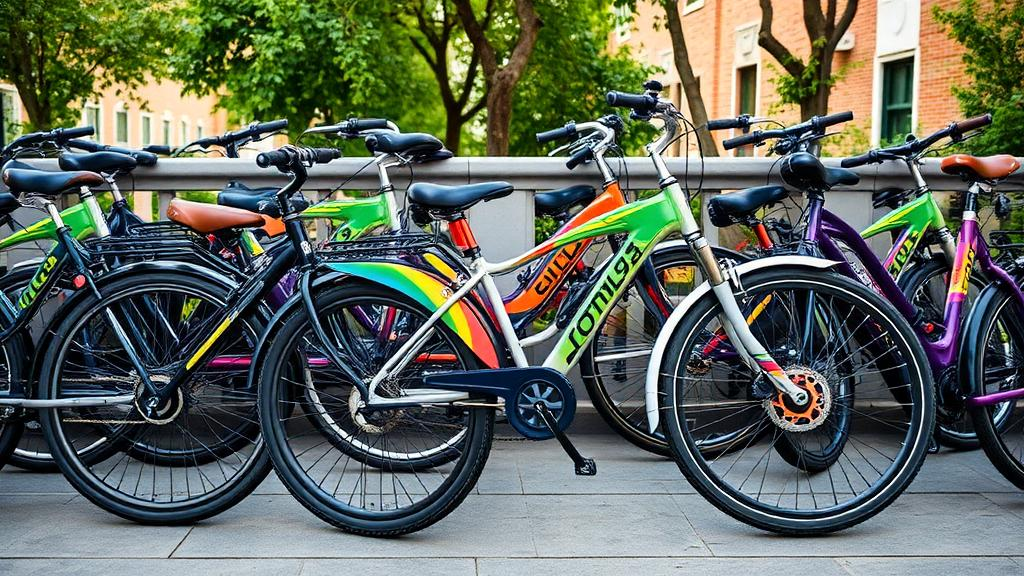
Dockless bike-sharing has transformed urban mobility across China and beyond, letting riders grab a bicycle with a quick QR-code scan and leave it wherever their journey ends. But the very flexibility that makes these systems popular also creates two stubborn operational headaches: bikes pile up where trips begin and vanish from where they end, while damaged bicycles accumulate on streets, frustrating users and eroding revenue. A new study published in Frontiers in Future Transportation proposes a way to solve both problems at once, using a hybrid optimization algorithm that could reshape how operators manage fleets of tens of thousands of bicycles.
Muhammad Zubair and Syed Khaliq Shah of Southeast University in Nanjing tackled what they call the integrated rebalancing and faulty bike recycling problem. Instead of sending trucks out on separate missions—one to redistribute bikes, another to collect broken ones—their framework folds both tasks into a single vehicle routing model. Each service truck carries a partitioned cargo hold: a main compartment for rebalancing bikes and a dedicated section for faulty ones. This partitioned capacity design means a vehicle can deliver bikes to deficit stations, collect surplus bikes from oversupplied ones, and scoop up damaged bicycles along the way, all in one tour.
The mathematics behind the model is demanding. The researchers formulated it as a variant of the pickup and delivery problem, with an objective function that balances three competing costs: user dissatisfaction when riders cannot find a bike, operational expenses including travel and loading time, and the handling cost of faulty bicycles. Loading or unloading an operational bike takes about one minute, while a damaged bike requires roughly two minutes of handling time—values drawn from real observations of Nanjing operators. Vehicles must complete their tours within a six-hour shift, and travel times are adjusted by traffic congestion factors derived from Baidu Maps data, ranging from free-flow conditions to heavy congestion.
Exact optimization tools like IBM’s CPLEX solver can crack such models, but only at small scale. The team first validated their formulation on 38 real stations near Southeast University, solving it to near-perfect optimality with percentage gaps as low as 0.02 percent. In 35 of the 38 stations, rebalanced inventory aligned almost exactly with forecast demand, and all faulty bikes were successfully routed back to the depot for repair or recycling. But real-world networks dwarf this testbed: Shanghai operators manage more than 50,000 dockless bikes, and New York’s CitiBike runs over 1,000 stations. Exact mixed-integer programming becomes computationally intractable beyond roughly 50 stations, which is where the researchers’ metaheuristic enters.
Their solution combines a genetic algorithm with adaptive large neighborhood search, wrapped in a cluster-first, route-second decomposition. The genetic algorithm evolves populations of candidate routes using tournament selection, order crossover, and mutation operators, while preserving the best solutions through elitism. The ALNS component then intensifies the search by destroying parts of a solution—removing stations at random, targeting the worst-performing segments, or dismantling entire clusters—and repairing them with greedy, regret, or cheapest insertion strategies. An adaptive weighting mechanism learns which destroy-and-repair combinations perform best, and a simulated annealing acceptance criterion decides whether to embrace worse solutions temporarily to escape local optima.
The clustering stage is where the approach departs most sharply from prior work. Rather than dividing a city into fixed geographic zones, the dynamic clustering procedure jointly optimizes the number of clusters, their centroids, and station assignments based on expected inter-cluster traversal costs. This captures a fundamental trade-off: more clusters shrink the distance vehicles travel within each zone but inflate the cost of moving between zones. In experiments on a 200-station instance, increasing clusters from 3 to 20 cut intra-cluster travel by 65 percent while inflating inter-cluster travel by more than 700 percent. The sweet spot landed at 11 clusters, where total routing distance fell to 362 kilometers—a 26.1 percent improvement over three clusters and a 21.8 percent improvement over twenty.
The performance numbers are striking. On 200-station synthetic instances, the hybrid algorithm produced solutions within 3.2 percent of best-known values in about 15 minutes, a fourfold scale improvement over the most comparable integrated studies, which stall at 50 to 100 stations. Against 50-station benchmarks, the method matched exact solvers with gaps below 0.5 percent while running 3.75 times faster. Dynamic clustering itself shaved 6.5 percent off routing distance compared with static, geography-only approaches. Meanwhile, folding faulty bike collection into rebalancing routes added just 8 to 12 percent computational overhead—yet eliminated the separate collection trips entirely, cutting total vehicle distance by 15 to 25 percent compared with running the two operations sequentially.
The practical implications are substantial. For a 200-station city, the researchers estimate daily savings of 50 to 75 kilometers of vehicle travel, translating to roughly 10 to 15 liters of fuel, two to three hours of driver time, and annual cost reductions of 15,000 to 25,000 US dollars per vehicle. The recycling loop itself follows a four-stage pipeline: IoT sensors and GPS monitoring flag faulty bikes based on battery status, signal strength, failed QR scans, and idle periods exceeding seven days; trucks with partitioned holds collect them during routine rebalancing; capacity constraints keep the two cargo types physically separated throughout the route; and the depot sorts arrivals into immediate repair, scheduled maintenance, or parts recovery.
Empirical research from major Chinese cities underscores why this integration matters. Faulty bike rates can exceed 2 percent during peak usage, and delayed collection measurably damages user satisfaction and safety. Earlier integrated models relied on exact optimization that buckled beyond 50 stations, and most treated vehicle capacity as a single undifferentiated constraint, implicitly assuming sequential loading and unloading. The new framework’s partitioned capacity model and jointly optimized clustering address both shortcomings, and the authors argue the approach could extend beyond bike sharing to fleet management, ride-sharing, and last-mile delivery, where decomposition is often treated as a necessary evil rather than an optimization opportunity.
Limitations remain. The model assumes deterministic demand within a single operational period and a homogeneous fleet, simplifications that real cities may strain against. The researchers point to several frontiers: incorporating stochastic demand through robust optimization, extending to multi-depot networks, adapting the algorithm for real-time rebalancing as conditions change mid-shift, integrating dynamic pricing to encourage users to self-balance the system, and pairing the optimizer with machine learning demand forecasts. For now, the study offers something operators have lacked: a computationally feasible way to keep dockless fleets balanced, functional, and profitable at the scale modern cities actually demand.
Subject of Research: Integrated rebalancing and faulty bike recycling optimization in dockless bike-sharing systems using a hybrid metaheuristic with dynamic clustering
Article Title: Integrated rebalancing and faulty bike recycling in dockless bike-sharing systems: a hybrid metaheuristic approach with dynamic clustering
Article References: Zubair, M., & Shah, S. K. (2026). Integrated rebalancing and faulty bike recycling in dockless bike-sharing systems: a hybrid metaheuristic approach with dynamic clustering. Frontiers in Future Transportation, 7, Article 1919819. https://doi.org/10.3389/ffutr.2026.1919819
Image Credits: AI Generated
DOI: 10.3389/ffutr.2026.1919819
Keywords: bike-sharing, dockless bikes, vehicle routing, metaheuristics, genetic algorithm, adaptive large neighborhood search, dynamic clustering, faulty bike recycling, urban mobility, optimization, Nanjing, transportation systems
Cite Scienmag News
Juliet Wilcox. (October 16, 2026). Smart Algorithms Rebalance Dockless Bikes and Recycle Broken Ones in One Trip. Scienmag. https://scienmag.com/smart-algorithms-rebalance-dockless-bikes-and-recycle-broken-ones-in-one-trip/
Juliet Wilcox. "Smart Algorithms Rebalance Dockless Bikes and Recycle Broken Ones in One Trip." Scienmag, 16 October 2026, https://scienmag.com/smart-algorithms-rebalance-dockless-bikes-and-recycle-broken-ones-in-one-trip/. Accessed 16 October 2026.
Juliet Wilcox. "Smart Algorithms Rebalance Dockless Bikes and Recycle Broken Ones in One Trip." Scienmag. October 16, 2026. https://scienmag.com/smart-algorithms-rebalance-dockless-bikes-and-recycle-broken-ones-in-one-trip/


