


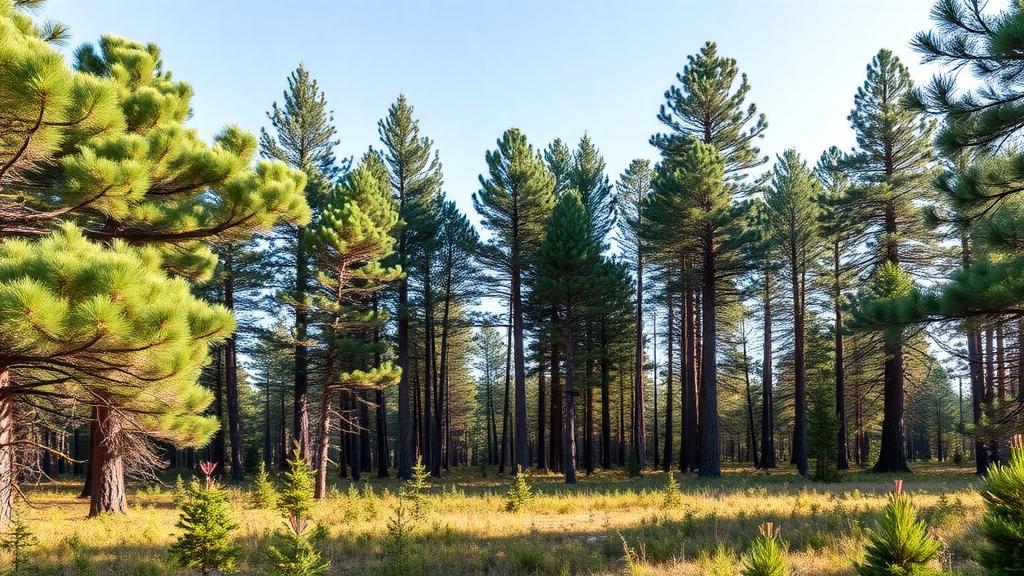
Lodgepole pine (Pinus contorta), one of the most widely planted conifers in the world and a species with a notorious record of invasion in places like New Zealand, Iceland, and Patagonia, appears to be struggling to reproduce on its own in Latvia. A new field survey of nearly all seed-producing lodgepole pine plantations in the country has found that self-regeneration is sparse, seedling dispersal is short-ranged, and heavy browsing by ungulates is clipping back much of what does manage to establish. The findings, published in the journal NeoBiota, suggest that the invasion risk posed by the species in the Baltic region is currently low, though the authors caution that the early phase of conifer invasions is often deceptively quiet.
…
The quiet performance of lodgepole pine in Latvia stands in sharp contrast to the species’ reputation elsewhere, and the reasons for that contrast illuminate how invasion biology actually unfolds on the ground. An invasion is not a property of a species alone; it emerges from the interaction between the species’ traits and the receiving environment. Lodgepole pine carries a formidable suite of traits: it begins producing seed at an early age, its small winged seeds travel readily on wind, it masts frequently, and its juveniles grow quickly. In theory, these are exactly the attributes that allow a tree to colonize open ground rapidly. Yet in Latvia, those attributes appear to be running into a wall of local resistance, and the study’s findings about canopy openings, bare soil, competition, and browsing describe the components of that wall.
The browsing signal deserves particular attention. Nearly a quarter of seedlings taller than 30 centimeters showed high browsing damage, and the authors identified this as a particularly important factor limiting regeneration. Across much of Europe, ungulate populations—roe deer, red deer, and increasingly moose—have reached densities that shape forest regeneration far beyond what would have been typical under historical predation regimes. For a species attempting to establish outside plantation boundaries, where seedlings lack any protection, the first decade of life is a gauntlet. Native Scots pine and Norway spruce seedlings face the same pressure, but they benefit from being recognized targets of active forest management, including protection measures and hunting regimes calibrated to their needs. A scattered, low-density recruit of an introduced species receives no such assistance, making ungulate browsing a disproportionately effective filter on non-native regeneration.
The finding that seedling density within plantations and in their immediate surroundings was essentially identical—roughly 240 versus 234 seedlings per hectare—suggests that once seed disperses beyond the canopy edge, establishment conditions rather than seed availability become the limiting factor. If seed rain were the bottleneck, densities would decline steeply with distance from the parent stand. Instead, the near-uniform density up to 90 meters implies that microsite availability, germination substrate, and post-germination survival are doing the sorting. This pattern is consistent with what invasion ecologists call recruitment limitation: a species may produce abundant seed, but without safe sites—bare mineral soil, gaps in the ground vegetation, appropriate moisture and light—those seeds rarely translate into established juveniles.
The age structure of the Latvian plantations is another crucial piece of context. Most of the studied stands were between 28 and 47 years old, with only a single 87-year-old stand representing the older end of the distribution. The most distant seedling recorded was found at 89 meters, a modest figure compared with the 760-meter spread documented in Iceland over six decades. The Latvian authors themselves note that the young age of the plantations may have contributed to lower propagule pressure on the surrounding landscape. This is a recurring theme in conifer invasion dynamics: the lag phase. In New Zealand, the invasion of lodgepole pine proceeded gradually, with initially low self-regeneration that accelerated as plantations matured and accumulated seed sources. Iceland’s experience followed a similar trajectory, with the first seedlings appearing 26 years after plantation establishment, after which the occupied area expanded thirtyfold over the following decades. The Latvian plantations may simply not yet have reached the stage at which propagule pressure overwhelms local resistance.
This lag-phase dynamic has practical consequences for how the findings should be interpreted. A low invasion risk measured today is not a forecast for 2050. The Latvian plantations established in 1979 to 1981, using seed material from various Canadian and American provenances in cooperation with Sweden, are now entering the age at which seed production becomes substantial and masting events become more consequential. If climate change extends the growing season in the Baltic region—as it already has, by an estimated six to fourteen days over the last century—and if late spring frosts that currently threaten newly germinated seedlings become less reliably lethal, the biotic and abiotic filters constraining regeneration could weaken simultaneously. The authors’ call for continued monitoring of dispersal reflects this understanding: the current snapshot is reassuring, but the trajectory matters more than the snapshot.
The comparison with Sweden is instructive because Sweden represents the closest analogue in both climate and management history. Swedish plantations, covering roughly 520,000 hectares, have been monitored for self-regeneration, and 53 percent of plantations older than 25 years contain lodgepole pine seedlings spreading up to 15 meters outside their boundaries at low densities of 62 to 221 seedlings per hectare. The Latvian figures—45 percent of plantations containing regeneration, densities in the low hundreds per hectare, and dispersal up to 89 meters—are broadly consistent with the Swedish picture, though the Latvian dispersal distances are somewhat greater. Sweden nonetheless lists the species as invasive pre-emptively, a regulatory stance that reflects concern about what might happen as plantations age and propagate rather than what has been observed so far. Latvia’s situation, with only about 40 hectares of lodgepole pine stands in the entire country, is orders of magnitude smaller in scale, which itself constrains the total seed output available for colonization.
The ecological stakes of a potential future invasion are not trivial. Where lodgepole pine has naturalized aggressively, its impacts extend beyond simple displacement of native vegetation. In Patagonia, dense lodgepole pine stands have altered microenvironmental conditions and reduced plant diversity beneath their canopies. In Iceland, the species has displaced native habitat in treeless ecosystems such as steppes and tundra, where no native conifer exists to compete for the same niche. There is also a subtler legacy effect: when invasive pines are removed, the altered chemical composition and biota of the soil they leave behind can facilitate the spread of other non-native species, creating a cascade in which the first invader paves the way for successors. In the hemiboreal forests of Latvia, where conifers and broadleaves already mix at stand and landscape scales, a conifer that regenerates densely in canopy gaps could shift successional pathways in ways that reduce structural diversity and alter vegetation dynamics—effects that remain poorly documented in Northern Europe precisely because large-scale assessments of self-regeneration have been lacking.
The site properties identified as constraining regeneration also offer a window into what a future invasion would require. The absence of large canopy openings and bare soil, together with competition from established ground vegetation, emerged as key factors limiting seedling establishment. This means that the very disturbances that forest managers often create deliberately—clearcuts, soil scarification, thinning—could act as invasion gateways if lodgepole pine seed sources were nearby. Fire, which plays a prominent role in the species’ native ecology and in its invasion history in the Southern Hemisphere, is rare in the Latvian landscape, but windthrow and other abiotic disturbances create comparable opportunities. The interaction between management practice and invasion risk is therefore not hypothetical: decisions about how much bare soil to expose near lodgepole pine plantations will directly influence whether the current low regeneration densities persist.
It is worth noting that the Latvian plantations themselves carry a biological complication. Most consisted of Pinus contorta var. latifolia, likely representing two provenances, but three plantations contained material from 27 provinces across Canada and the United States. Provenance mixing can influence both adaptive capacity and reproductive behavior, and the authors’ hypothesis that biotic constraints would keep natural regeneration slow was framed against this genetic backdrop. The fact that up to 30 percent of canopy trees in six plantations had died from fungal infections adds another layer: disease pressure, presumably from pathogens native to Europe that the introduced pines had not evolved defenses against, is itself a form of biotic resistance operating on the mature trees, reducing both seed production and the aesthetic and economic appeal that motivated the original plantings.
Ultimately, the Latvian study contributes a data point from a region where lodgepole pine’s trajectory remains genuinely uncertain. The species is not yet considered naturalized in Poland despite more than 160 years of presence, and it is not reported as invasive in France despite widespread introduction. Yet it has naturalized in Great Britain, Ireland, and European Russia, and it has transformed landscapes in Iceland. The difference between these outcomes lies in the details of local conditions—disturbance regimes, browsing pressure, climate, soil, and the sheer scale of planting. Latvia’s current picture, with sparse regeneration, short dispersal, and heavy browsing damage, places it closer to the Swedish and Polish end of the spectrum than to the Icelandic one. Whether it stays there will depend on factors that are still in motion: the maturation of existing plantations, the trajectory of ungulate populations, the frequency of canopy-opening disturbances, and the pace of climatic change in the Baltic region. The study’s value lies not in declaring the question settled but in establishing a rigorous baseline against which future monitoring can measure change.
Subject of Research: Self-regeneration and dispersal of the introduced lodgepole pine in Latvian forests
Article Title: Lodgepole pine ( Pinus contorta Doug.) shows low self-regeneration and dispersal in Latvia
Article References: Lodgepole pine ( Pinus contorta Doug.) shows low self-regeneration and dispersal in Latvia. (n.d.). https://doi.org/10.3897/neobiota.108.200368
Image Credits: AI Generated
DOI: 10.3897/neobiota.108.200368
Keywords: lodgepole pine, Pinus contorta, invasive species, Latvia, forest regeneration, seed dispersal, browsing damage, hemiboreal forests, non-native conifers, NeoBiota, Lodgepole, pine
Cite Scienmag News
Patricia Pace. (October 16, 2026). Lodgepole pine shows weak self-regeneration and limited spread in Latvia, study finds. Scienmag. https://scienmag.com/lodgepole-pine-shows-weak-self-regeneration-and-limited-spread-in-latvia-study-finds/
Patricia Pace. "Lodgepole pine shows weak self-regeneration and limited spread in Latvia, study finds." Scienmag, 16 October 2026, https://scienmag.com/lodgepole-pine-shows-weak-self-regeneration-and-limited-spread-in-latvia-study-finds/. Accessed 16 October 2026.
Patricia Pace. "Lodgepole pine shows weak self-regeneration and limited spread in Latvia, study finds." Scienmag. October 16, 2026. https://scienmag.com/lodgepole-pine-shows-weak-self-regeneration-and-limited-spread-in-latvia-study-finds/


