


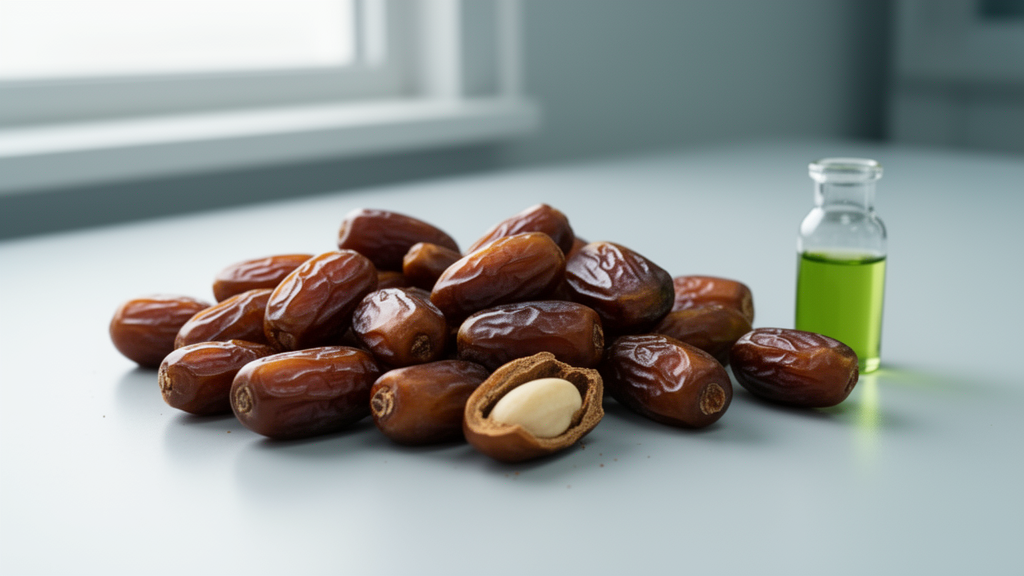
Every year, the global date industry produces mountains of seeds that are mostly discarded, fed to animals, or downgraded into low-value products. A new review published in Frontiers in Soft Matter argues that this overlooked agricultural waste could become a sustainable feedstock for one of medicine’s most demanding frontiers: precision nanomedicine and nanotheranostics, where a single nanoparticle is engineered to diagnose disease, deliver a drug, and monitor treatment all at once. The review, led by biomedical engineers at the University of Ibadan in Nigeria, systematically maps how the humble seed of Phoenix dactylifera could be transformed into carbon-based materials, green-synthesised metal nanoparticles, and hybrid drug-delivery platforms, while also delivering a sober assessment of how far the field actually is from that vision.
The appeal of the date seed lies in its chemistry. It is a lignocellulosic biomass packed with cellulose, hemicellulose, lignin, lipids, proteins, minerals, and a rich arsenal of phytochemicals, including phenolic acids and flavonoids. These components support two distinct nanomaterial routes. The structural polymers serve as precursors for carbon-rich materials: when the seed is heated under oxygen-limited conditions, cellulose provides a carbon framework, hemicellulose drives early char formation, and lignin yields stable aromatic carbon structures. Subsequent activation with steam, carbon dioxide, or chemical agents opens up porosity and surface area, producing activated carbons with tunable pores suitable for adsorption, drug loading, and biosensing electrodes. Meanwhile, the soluble phytochemical fraction plays a completely different role, acting as a natural reducing and capping agent for synthesising metallic nanoparticles.
That second route, green synthesis, is where the seed’s biochemistry becomes genuinely elegant. In conventional nanoparticle production, separate chemical reducing agents and stabilisers are required, often at high temperatures and with toxic solvents. Date seed extracts can do both jobs simultaneously. Phenolic compounds, with their abundant reactive hydroxyl groups, donate electrons to metal ions such as silver, converting them to zero-valent atoms that cluster into nuclei and grow into nanoparticles, while the phenolics themselves oxidise into quinone derivatives. Proteins and polysaccharides then adsorb onto the freshly formed particle surfaces, providing steric and electrostatic stabilisation that prevents aggregation. The resulting organic capping layer shapes the particle’s hydrodynamic size, surface charge, and, crucially, how it interacts with proteins, cells, and tissues, which is the defining question for any biomedical application.
The review details how this mechanism unfolds step by step. Once silver ions receive electrons and dissolve into the reaction, metallic atoms nucleate, and the balance between nucleation and growth determines final particle size: rapid nucleation favours smaller particles, while slower nucleation with prolonged growth produces larger ones. Flavonoids, reducing sugars, and proteins can also contribute to reduction, meaning the overall reducing capacity of the crude extract matters more than any single phytochemical class. This is a point the authors stress repeatedly: attributing nanoparticle formation to a specific compound requires chromatographic profiling and spectroscopic evidence, not just broad colourimetric assays of total phenolic or flavonoid content.
That caveat matters because the field suffers from a reproducibility problem. The chemical composition of date seeds varies with cultivar, geographical origin, maturity, drying temperature, storage conditions, and grinding particle size. Extraction conditions, including solvent polarity, solid-to-liquid ratio, temperature, and time, further reshape which compounds end up in solution. Since these variables influence nucleation, particle growth, aggregation, and surface chemistry, two laboratories using ostensibly the same seed can produce nanoparticles with entirely different sizes, morphologies, and biological behaviours. The review argues that many reported differences between studies reflect the starting biomass and processing rather than the material itself, and it calls for standardised reporting of seed provenance, pretreatment, extraction parameters, and synthesis conditions, ideally supported by design-of-experiments and response surface methodology to map how variables interact.
On the biological side, the evidence is promising but preliminary. Green-synthesised silver and zinc oxide nanoparticles derived from date seed extracts have shown antimicrobial activity, likely through membrane disruption, metal-ion release, and oxidative stress. Antioxidant effects have been measured with DPPH, ABTS, and FRAP assays. But the review draws a sharp line between laboratory assays and clinical relevance. An inhibition zone on an agar plate can be distorted by how nanoparticles diffuse through the gel, and chemical antioxidant activity does not automatically translate to efficacy inside living systems. Similarly, drug loading onto a porous carbon or nanoparticle surface does not guarantee therapeutic delivery without demonstrated cellular uptake, controlled release, and targeting specificity.
Safety assessment emerges as another major hurdle. Antimicrobial potency does not imply compatibility with mammalian cells, since the same oxidative stress mechanisms that kill bacteria can harm healthy tissue. The review highlights the need for concentration-dependent cytotoxicity testing with assays such as MTT and resazurin, haemolysis measurements for any material intended for intravenous use, and evaluation of platelet interaction, coagulation, and complement activation. It also emphasises nano-bio interactions: nanoparticles stable in distilled water may aggregate or acquire a protein corona in serum, changing their cellular uptake, biodistribution, and biological identity entirely. Any serious translational effort must characterise stability under physiologically relevant conditions, not just in the beaker.
The most ambitious applications remain the least developed. True nanotheranostics requires a single platform that combines therapy with imaging or sensing, and the review finds that integrated systems built from date seed materials, combining targeting ligands, imaging agents, and drugs within polymer matrices such as chitosan, alginate, or PLGA, are largely conceptual. Date seed-derived carbons have shown more maturity in biosensing, where their conductivity and surface chemistry support immobilisation of biological recognition molecules on electrodes, and in hybrid scaffolds for tissue engineering, where swelling behaviour, porosity, and mechanical properties must be characterised in the final composite rather than inferred from the individual components. Imaging claims, whether fluorescence or photothermal, need experimental proof through quantum yield, photostability, and cellular imaging studies rather than assumptions based on nanoscale size alone.
The authors’ conclusion is measured rather than hyped. Date palm seed has genuine potential as a renewable, chemically versatile feedstock for multifunctional nanomaterials, and converting waste biomass into value-added medical platforms fits squarely within circular economy thinking. But its biomedical value will depend on transforming green synthesis from an artisanal, variable process into a controlled materials-engineering discipline: chemically standardised extracts, identified reducing compounds, rational surface engineering, rigorous nano-bio evaluation, and validation in appropriate in vitro and in vivo models, followed by the unglamorous work of sterilisation, scale-up, and regulatory compliance. Until then, the date seed remains what it has long been, an abundant agricultural byproduct, albeit one whose next life may be written at the nanoscale.
Subject of Research: Conversion of date palm seed biomass into phytochemical-derived nanomaterials for drug delivery and nanotheranostics
Article Title: Date palm seed (Phoenix dactylifera) as a sustainable platform for precision nanomedicine and nanotheranostics: a review of phytochemical-derived nanomaterials and drug delivery applications
Article References: Ozieme, A. D., Adeleye, A. A., & Ajide, O. O. (2026). Date palm seed (Phoenix dactylifera) as a sustainable platform for precision nanomedicine and nanotheranostics: a review of phytochemical-derived nanomaterials and drug delivery applications. Frontiers in Soft Matter, 6, Article 1976364. https://doi.org/10.3389/frsfm.2026.1976364
Image Credits: AI Generated
DOI: 10.3389/frsfm.2026.1976364
Keywords: date palm seed, Phoenix dactylifera, green synthesis, nanoparticles, nanotheranostics, drug delivery, phytochemicals, activated carbon, biomass valorisation, nanomedicine, biosensing, biocompatibility
Cite Scienmag News
Louis Brooks. (October 16, 2026). Date Palm Seeds, Usually Thrown Away, Could Become Green Nanomedicine Factories. Scienmag. https://scienmag.com/date-palm-seeds-usually-thrown-away-could-become-green-nanomedicine-factories/
Louis Brooks. "Date Palm Seeds, Usually Thrown Away, Could Become Green Nanomedicine Factories." Scienmag, 16 October 2026, https://scienmag.com/date-palm-seeds-usually-thrown-away-could-become-green-nanomedicine-factories/. Accessed 16 October 2026.
Louis Brooks. "Date Palm Seeds, Usually Thrown Away, Could Become Green Nanomedicine Factories." Scienmag. October 16, 2026. https://scienmag.com/date-palm-seeds-usually-thrown-away-could-become-green-nanomedicine-factories/


