


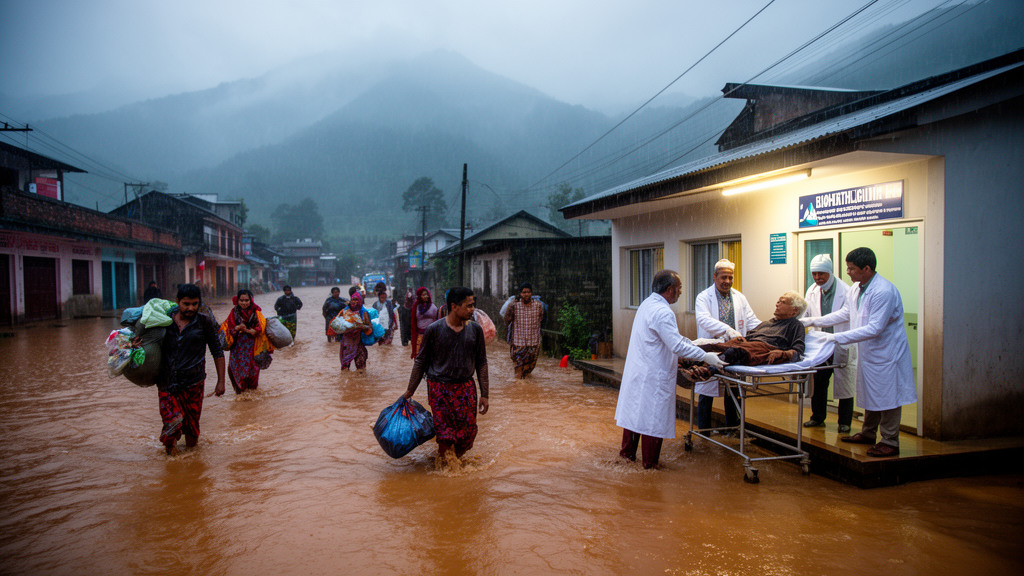
On 26 August 2026, an ice-and-rock avalanche on Nepal’s northern border with China sent a violent flash flood surging down the Bhotekoshi-Trishuli corridor, and the numbers that followed have forced public health experts to rethink what a flood actually is. By 25 September, Nepal’s disaster authority had confirmed 1,453 deaths, recorded 5,285 people as missing, rescued 13,795 survivors, and logged 10,988 people needing medical treatment. Writing in PLOS Global Public Health, Krishna Kumar Aryal of the University of Bergen and colleagues argue that these figures demand a conceptual shift: a flood of this magnitude should be counted as a burden-of-disease event, not merely a rescue operation, and the health system’s performance should be judged across preparedness, response, and long-term resilience rather than by the drama of the emergency alone.
The arithmetic behind that claim is stark. The confirmed deaths alone already outrank seven of the twenty-one causes of death that Nepal routinely tracks. If the missing are eventually confirmed dead, this single event would fall within the top ten leading causes of death in a typical year. To put that in perspective, if everyone missing is confirmed dead, the flood will have killed nearly as many people in Nepal as diabetes does annually, a chronic condition that claimed 7,976 lives in 2023. Burden-of-disease accounting, built on the Global Burden of Disease framework, normally assigns deaths to categories like cardiovascular disease, respiratory infections, or diabetes. Disasters are usually treated as one-off shocks outside that ledger. Aryal and colleagues contend that this accounting habit obscures the true health toll of climate-driven catastrophes and lets health systems escape the scrutiny that a comparable epidemic would trigger.
The health system itself was a casualty of the flood. Four health facilities and two warehouses were destroyed, three more facilities damaged, and 19 health workers went missing. Thirty-five motorable bridges and 45 suspension bridges were washed away, severing access to secondary-level care at Nuwakot and Dhading district hospitals in already hard-to-reach mountain terrain. Within 24 hours, disease surveillance recorded cases of acute gastroenteritis, influenza-like illness, and fever-with-rash at displacement sites, while a third of the water samples tested were contaminated. These are the classic early signatures of outbreak risk when water, sanitation, and referral systems fail together. With thousands of people still living in temporary shelters, the authors warn that the risk of further communicable disease outbreaks remains high, and that the surveillance capacity that caught the first signals must be sustained, not switched off once the headlines fade.
Nepal has faced this test before, four times at major scale in nine years: the 2015 Gorkha earthquake, the 2017 Terai floods, the 2023 Jajarkot earthquake, and the 2024 floods and landslides. Each time, facilities were damaged or cut off, referral routes were lost, and immunisation and maternal services were disrupted. And each time, the country rebuilt to the same standard rather than a higher one. The 2026 flood is the fifth major rapid-onset disaster to strike along the same fault lines in barely a decade, and the authors argue that this repetition is itself the finding: the pattern reveals a system that responds heroically but does not convert experience into standing capability.
That distinction between nominal functioning and genuine resilience is central to the article’s technical argument. Resilience has often been measured simply by whether services continued during a shock. But a 2023 reconceptualization by health policy researcher Sophie Witter and colleagues, published in The Lancet Global Health, reframes the question around equity: not whether the system kept functioning, but who absorbed the strain of it doing so. In this flood, the answer is already visible in the demographic breakdown of who is left to cope. According to United Nations flash appeal figures, 19,284 households and 84,270 people were affected, including 43,085 women, 32,021 children and adolescents, of whom 7,048 were under five, 1,854 people with disabilities, and 8,603 elderly people. Resilience, the authors argue, will be judged less by the emergency response than by what follows: how quickly facilities are rebuilt and routine maternal, newborn, and non-communicable disease care is restored for these populations.
The conceptual benchmark the authors invoke comes from the fourth edition of Disease Control Priorities, or DCP4, a major global priority-setting initiative. DCP4 argues that health systems should be Always On, meaning that standing emergency capability should be built into routine care rather than assembled after the fact, through dual-use infrastructure that scales up during crises rather than switching on. Nepal has been building toward this since 2015. The country established Health Emergency Operation Centres, developed a hub-and-satellite referral system, adopted minimum service standards, expanded oxygen and laboratory capacity during COVID-19, and deployed Emergency Medical Deployment Teams alongside community surveillance and hospital disaster plans. A 2025 assessment of 25 Nepali hub hospitals found that most now hold standing disaster preparedness plans with provisions for surge capacity, coordinating emergency response and referrals across the federal system.
Yet the flood is a live audit of that investment, and so far the answers are discouraging. Did the destroyed health posts have any dual-use or surge design? Did referral protocols anticipate losing 80 bridges at once? The authors conclude that the answer to both questions looks like no. In a federal system, being Always On is as much a governance challenge as a technical one. Sustaining standing capabilities requires clear ownership, reliable financing, and coordinated preparedness across all tiers of government. But research mapping health system resilience at the local level in federal Nepal, published in BMC Health Services Research in 2025, found that legal responsibilities at the local tier still exceed the capacity and resources available to fulfil them. Accountability for rebuilding and maintaining surge readiness remains fragmented, while funds and support often reach the front line slowly. The flood therefore tests not only physical infrastructure but also the effectiveness of intergovernmental fiscal transfers, institutional coordination, and shared responsibility across Nepal’s three tiers of government.
The stakes extend well beyond the injured. After the 2015 earthquake, as the health system prioritised trauma care over routine services, admissions for maternal and other routine conditions at a Kathmandu tertiary hospital fell sharply and stayed low for months, a finding published in Scientific Reports in 2020 that shows a disaster’s harm reaches far beyond the injured. Mental health tells a similar story. Following the 2015 earthquake, psychosocial needs increased sharply, but the response was largely improvised because mental health support had not been adequately integrated into emergency preparedness plans, a gap documented in the WHO South-East Asia Journal of Public Health. The authors argue that a standing system should close both gaps by design. Health workers are among the affected too, with 19 missing in this flood, so safeguarding their wellbeing and swift return to work is itself part of keeping care running. Protecting routine care, they write, is what keeps this flood from adding a second, quieter toll to Nepal’s burden of disease.
Rebuilding to disaster-resilient standards helps, but at this scale it is not enough, because anything fixed in place can be swept away again. What must hold, the authors argue, is the referral network actually activated rather than assumed, with strategic facilities resourced and ready; emergency transport that reaches patients in time to prevent avoidable deaths; and humanitarian aid that reaches frontline health workers so they can return to work quickly. Nepal is now finalising its national health benefits package through a systematic priority-setting exercise toward universal health coverage by 2030, and the authors, several of whom support this work at Nepal’s Ministry of Health and Food Safety, see one concrete avenue: building continuity of basic services, including essential emergency and critical care, into the revised basic health services package as a standing requirement rather than an emergency add-on. Essential emergency and critical care, a concept defined through a global consensus of clinical experts published in BMJ Global Health in 2021, refers to the basic life-saving interventions, triage, oxygen, fluids, and monitoring, that every facility should deliver continuously.
Financing that standing capacity as routine health spending, rather than mobilising it as relief after each disaster, is the policy test this flood now sets. The authors call for funding essential services, including essential emergency and critical care, through recurrent budget lines and regular fiscal transfers to provincial and local governments, ensuring readiness is maintained between disasters rather than rebuilt after each shock. Nepal’s own disaster law already mandates such funds across all three tiers of government, yet local resources and financial flexibility remain limited. Global experience reinforces the point: analysis of the COVID-19 response, published in The Lancet in 2021, found that health security pursued in parallel to universal health coverage, rather than integrated with it, left systems fragmented and exposed, and that building preparedness into the routine systems and budgets that deliver everyday care is a more resilient course for low- and middle-income countries. The authors echo a view published in The Lancet while their paper was being finalised, by Karkey, Adhikari, and Basnyat, that health systems must be ready to absorb shocks of this magnitude while sustaining essential services. Nepal’s flood, they conclude, is the audit: counted properly, it becomes a burden-of-disease event that the health system must answer for, not just a rescue story it can be proud of.
Subject of Research: Public Health
Article Title: Counted, not just rescued: Nepal’s flood, and the test of an ‘Always On’ health system
Article References: Aryal, K. K., Bhattarai, A., Shrestha, A., Adhikari, S., & Johansson, K. A. (2026). Counted, not just rescued: Nepal’s flood, and the test of an ‘Always On’ health system. PLOS Global Public Health, 6(10), e0007486. https://doi.org/10.1371/journal.pgph.0007486
Image Credits: AI Generated
DOI: 10.1371/journal.pgph.0007486
Keywords: Counted, just, rescued, Nepal, flood, test, Always, health, system, scientific research
Cite Scienmag News
Violet Maxwell. (October 16, 2026). Nepal’s Deadly Flood Puts Its Always On Health System to the Test. Scienmag. https://scienmag.com/nepals-deadly-flood-puts-its-always-on-health-system-to-the-test/
Violet Maxwell. "Nepal’s Deadly Flood Puts Its Always On Health System to the Test." Scienmag, 16 October 2026, https://scienmag.com/nepals-deadly-flood-puts-its-always-on-health-system-to-the-test/. Accessed 16 October 2026.
Violet Maxwell. "Nepal’s Deadly Flood Puts Its Always On Health System to the Test." Scienmag. October 16, 2026. https://scienmag.com/nepals-deadly-flood-puts-its-always-on-health-system-to-the-test/


