


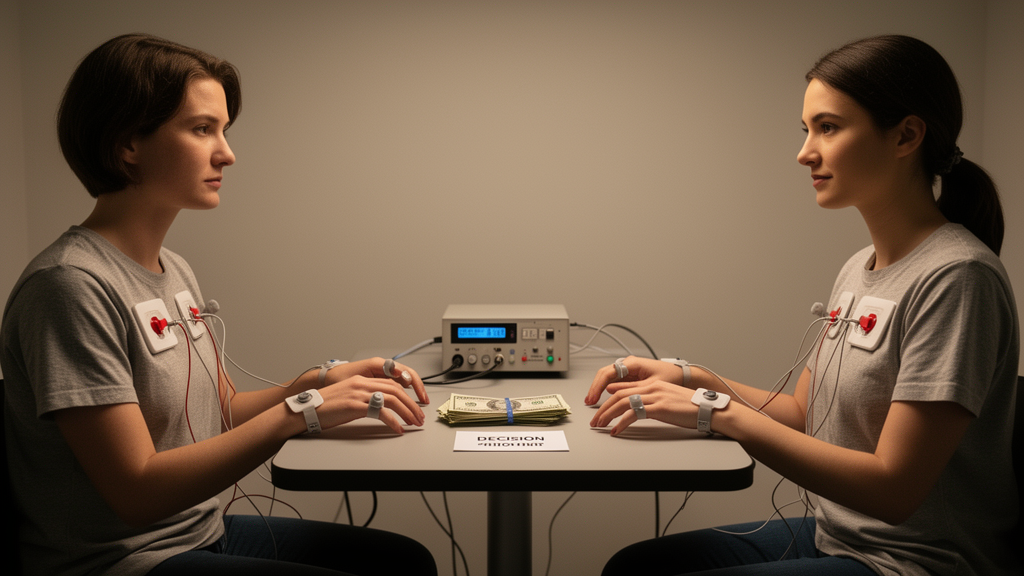
Every day, people hand over money, information, and opportunities to strangers they have known for only minutes. Why they do this, especially when the stakes are meaningful, has long puzzled economists and neuroscientists alike. A new study from the Center for Neuroeconomics Studies at Claremont Graduate University, published in Frontiers in Behavioral Economics, offers a striking answer: the decision to trust a stranger may be written in the synchrony of two nervous systems during a face-to-face conversation, before a single binding promise is made. Using a signal-processing technique borrowed from speech recognition, the researchers showed that physiological synchrony during two minutes of unenforceable talk predicted whether someone would sacrifice real money to trust a stranger with 60 percent accuracy.
The research team, led by Lena Arai, Yi Zeng, and Paul J. Zak, designed their experiment to fix what they see as two chronic artifacts in the classic trust-game literature. Since the pioneering experiments of the 1990s, most laboratory trust studies have disallowed pre-decision communication and used trivially small stakes. The rationale was to strip away confounds such as attractiveness, smiles, touch, or ethnicity that might contaminate a clean measure of trust. Yet the behavioral data show that this unenforceable communication, known in game theory as cheap talk, substantially increases cooperation. Outside the laboratory, trust is nearly always preceded by a conversation in which the terms of exchange are discussed. By removing communication, the authors argue, decades of experiments have ignored the most interesting part of the decision to trust.
The second artifact was the small endowments typical of trust experiments, which usually involve college students, a population the literature describes as WEIRD: Western, Educated, Industrialized, Rich, and Democratic. Low-stakes monetary trust experiments typically yield around 90 percent of individuals trusting strangers, a level of cooperation that may say more about the insignificance of the money than about human trust. The new study recruited 76 employed adults between the ages of 25 and 50 from diverse cultural backgrounds, including participants who self-identified as White, Asian, Latino or Hispanic, and African American or Black, and mixed native and non-native English speakers. Participants could earn up to 530 dollars based on their own decisions and those of their dyadic partner, with 50 dollars guaranteed for showing up and all payments made in cash without deception.
The monetary task itself was a modified version of the sequential trust game. Each participant was endowed with 120 dollars and randomly assigned as the first or second decision-maker. The first decision-maker could send 0, 40, 80, or 120 dollars of that endowment to the second decision-maker. Transfers sent were removed from the first player’s account and multiplied in the second player’s account, with the multiplier varying by amount: 40 dollars became 240, 80 dollars became 360, and the full 120 dollars became 480. The second decision-maker then chose how much to return, without multiplication, from the multiplied stake plus the original endowment. Varying the multiplier was a deliberate departure from the standard design, intended to make the decision process more complicated and to ensure participants understood that the amounts involved were meaningful. In the consensus view of experimental economics, the first transfer measures trust and the return transfer measures reciprocity or trustworthiness.
Before making their private decisions at partitioned computer terminals, each dyad sat facing each other in a private room for exactly two minutes. They were advised to discuss their strategies and make a commitment to a particular choice, but were told clearly that these commitments were not enforceable and that all decisions would be made in private. Throughout this conversation, electrodermal activity, the peripheral signature of centrally mediated arousal, was recorded from disposable electrodes on the index and middle fingers of the non-dominant hand. Electrodermal activity captures increased conductivity from sweat in the eccrine glands, and was chosen because it has previously been shown to predict who reneges on promises to reciprocate trust, and because it is straightforward to obtain without interfering with natural conversation. Each participant’s baseline response, measured while sitting alone with headphones for two minutes, was subtracted from the response during communication to control for individual differences.
The central technical question was how to quantify synchrony between two people’s physiological time series. The researchers evaluated two measures. The first, intersubject correlation, is the traditional benchmark used in neuroimaging and electroencephalogram studies: it calculates Pearson correlations for a physiological measure between participant pairs, often within short overlapping windows and with time lags to account for the dynamics of interpersonal interaction, an approach known as windowed cross-lagged correlation. The second, dynamic time warping, is newer to behavioral neuroscience. Developed to align time series that vary in speed, it was famously applied to speech recognition, which made it an apt candidate for electrodermal signals generated during dyadic conversation. Dynamic time warping builds a cost matrix of pairwise distances between two series and finds the warping path that minimizes cumulative distance, effectively stretching or compressing the time axis of one or both signals to achieve better alignment than simple Euclidean distance. Unlike correlation-based approaches applied to nonstationary data, dynamic time warping does not require stationary time series, a property well suited to physiological signals that drift and surge during live interaction.
The behavioral results were themselves unusual for a trust game. Across 222 usable interactions, maximal trust, in which the first decision-maker sent the entire 120-dollar endowment, occurred in 28 percent of cases. Conversely, in 40 percent of interactions, the first decision-maker sent nothing, revealing complete distrust. That nearly half of participants showed complete distrust and one third displayed maximum trust is a distribution not typically seen in other trust games, and the authors attribute it to the meaningful stakes. Notably, the decision to trust did not vary by race, sex, age, education, or income, nor did it depend on whether dyadic partners were the same or different sexes. The amount transferred was uncorrelated with age, education, or income. Even the raw change in skin conductance level from baseline to communication did not differ between those who trusted and those who did not, underscoring that it was not arousal per se but the relationship between two people’s signals that carried the predictive signal.
When the two synchrony measures were compared, the difference was decisive. Intersubject correlations averaged across four window sizes did not vary between trust and no trust, nor by the degree of trust, and nonparametric Kruskal-Wallis tests found none of the individual window values significantly different across the four trust groups. Dynamic time warping told a different story. While average values were identical for all levels of trust compared to no trust, they were statistically different by the degree of trust, and three of the four window widths, 5, 10, and 15, were significantly different from each other. Consistent with the team’s hypothesis, dynamic time warping synchrony during communication was associated with increased first-decision-maker trust for all four windows tested, with p-values below .01. In practical terms, dyads whose electrodermal signals aligned more tightly during the two-minute conversation were more likely to have the first decision-maker sacrifice money to trust the stranger across the table.
To compare the predictive accuracy of the two measures head to head, the researchers estimated binary logistic regressions predicting trust or no trust. Because the four windows of each measure were highly correlated, with correlations ranging from .49 to .99, they generated principal components separately for each synchrony type, using cross-validation to choose the optimal number. The intersubject correlation analysis produced two components explaining 83 percent of the variation in synchrony, but neither was statistically associated with the decision to trust, and the regression achieved a balanced accuracy of only 52 percent. The dynamic time warping analysis produced three components explaining 99 percent of the variation. None alone was statistically significant, but together they predicted the trust decision with a balanced accuracy of 60 percent, with precision and recall both at .68. That is a 15 percent improvement over intersubject correlation, or eight percentage points in the discussion section, and while modest in absolute terms, the authors emphasize that the correlation measures were largely unrelated to the trust decision while the warping windows were statistically associated with it.
The findings open a window onto mechanisms that operate beneath conscious awareness. Cheap talk reveals information that influences choices, including statements, smiles, word choice, gestures, and signs of physiologic stress that indicate lying, but much of this information is processed unconsciously, which is why asking participants why they trusted a stranger yields so little insight. The authors caution against overgeneralizing: the sample was moderate in size and consisted of educated Western adults, the trust game is a scripted social interaction, and future work should replicate the results in field studies with non-scripted tasks, different populations, and phasic skin conductance responses. Still, they argue that future studies should include meaningful stakes, pre-decision communication, and neurophysiologic signatures. Because electrodermal signals emanate from the brainstem and are conserved across individuals, the approach may hold on average across settings. Part of the research program involves mapping these unconscious physiologic tells into observable movements, statements, and language that negotiators could read without sensors. If two minutes of conversation can align the nervous systems of strangers tightly enough to predict who will risk 480 dollars on them, the warping of time between two bodies may be one of the most consequential signals in economic life.
Subject of Research: Dynamic time warping of interpersonal physiologic synchrony predicts high stakes trust
Article Title: Dynamic time warping of interpersonal physiologic synchrony predicts high stakes trust
Article References: Arai, L., Zeng, Y., & Zak, P. J. (2026). Dynamic time warping of interpersonal physiologic synchrony predicts high stakes trust. Frontiers in Behavioral Economics, 5, Article 1826500. https://doi.org/10.3389/frbhe.2026.1826500
Image Credits: AI Generated
DOI: 10.3389/frbhe.2026.1826500
Keywords: neuroeconomics, trust, physiological synchrony, dynamic time warping, electrodermal activity, behavioral economics, Dynamic, time, warping, interpersonal, physiologic, synchrony
Cite Scienmag News
Cassandra Pierce. (October 16, 2026). Physiological synchrony measured by dynamic time warping predicts trust in strangers with real money at stake. Scienmag. https://scienmag.com/physiological-synchrony-measured-by-dynamic-time-warping-predicts-trust-in-strangers-with-real-money-at-stake/
Cassandra Pierce. "Physiological synchrony measured by dynamic time warping predicts trust in strangers with real money at stake." Scienmag, 16 October 2026, https://scienmag.com/physiological-synchrony-measured-by-dynamic-time-warping-predicts-trust-in-strangers-with-real-money-at-stake/. Accessed 16 October 2026.
Cassandra Pierce. "Physiological synchrony measured by dynamic time warping predicts trust in strangers with real money at stake." Scienmag. October 16, 2026. https://scienmag.com/physiological-synchrony-measured-by-dynamic-time-warping-predicts-trust-in-strangers-with-real-money-at-stake/


