


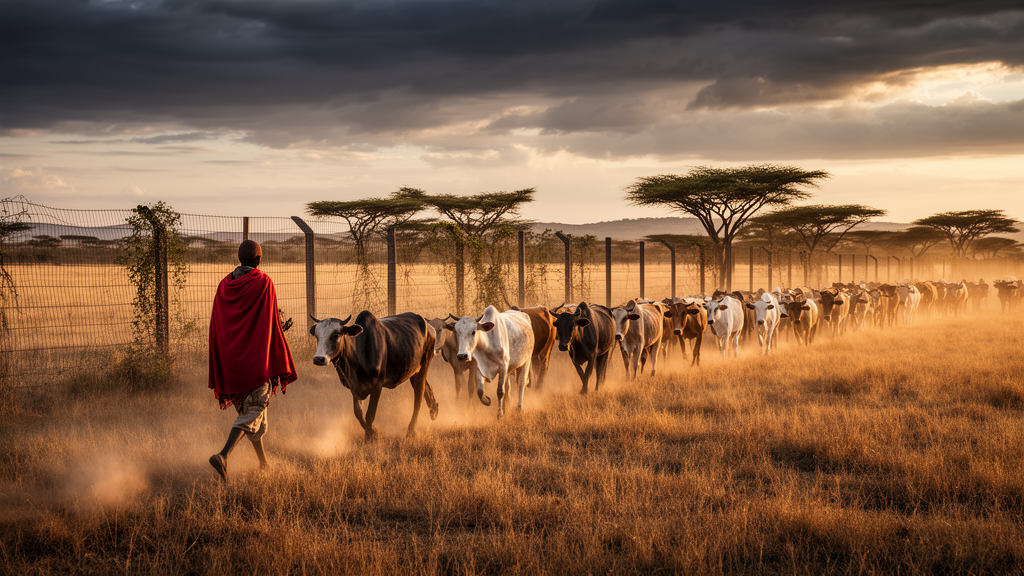
African pastoralists have contributed least to the carbon-intensive political economies that define the Anthropocene, yet they appear disproportionately within climate-policy narratives of vulnerability, degradation and crisis. That paradox sits at the heart of a new comparative study published in Pastoralism: Research, Policy and Practice, which draws on decades of ethnographic, linguistic and historical research among the Maasai of northern Tanzania, the Hamar of southwest Ethiopia and the Fulani of the Sahel. The authors argue that pastoralists’ relational ontologies, encoded in mobility, multispecies cohabitation, ritual, language and moral ecologies, offer alternative socio-ecological knowledge that challenges technocratic and reductionist approaches to climate governance. Recognising pastoralist modes of knowing and being, they contend, is not merely an ethical imperative but foundational for developing more situated, just and pluriversal Anthropocene futures.
The study identifies three interrelated policy paradoxes. First, climate and mobility are often cast as causes of conflict, yet pastoralists frequently employ mobility as a way to avoid violence. Second, development policies have structurally focused on improving pastoralists’ lives, yet have had the opposite effects. Third, pastoralists have always diversified their livelihoods, for example through farming, not as a move away from pastoralism but rather to remain cattle keepers. These paradoxes, the authors argue, trace how pastoralist lifeworlds are repeatedly misrecognised across climate, development and security frameworks, which are often treated in isolation but form part of the same top-down policy-expert nexus.
For over a century, pastoral mobility and livestock-based livelihoods have been framed through colonial imaginaries of disorder, irrationality and backwardness. The desertification myth of the 1930s, when British and French foresters warned of an advancing desert, and the cattle complex thesis, which cast East African pastoralists as irrational keepers maximising herds at the environment’s expense, produced nature narratives of blame. Colonial ecological science relied on equilibrium models positing a fixed carrying capacity beyond which rangelands would collapse, feeding postcolonial narratives of overgrazing and the tragedy of the commons, especially around the droughts of the 1980s. Research shows these misconceptions led to political oppression and catastrophic interventions, including land dispossession.
Since the 1990s, a paradigm shift has recognised that variability, not stability, is the ecological norm in dryland environments. Pastoral mobility, rather than degrading land, has been shown to be a rational adaptation to environmental unpredictability, and grazing does not do irreversible damage to rangelands. Yet evidence such as satellite studies on the regreening of the Sahel continues to be ignored in policy formulation, a form of uncomfortable knowledge strategically excluded because it challenges established power relations. The authors argue that the rise of climate determinism, in which climate is elevated as the single or most important variable determining human life, obscures complex and structural drivers of vulnerability, inequality and long histories of marginalisation, including conservation enclosures, land grabs, sedentarisation schemes and state territorial projects.
The Great Green Wall of Africa, the most ambitious tree-planting project on the continent, stretching some 8,000 kilometres across the Sahel, is presented as iconic for the Anthropocene era. The region’s traditional inhabitants and their resource use have not been considered and were entirely excluded from decision-making, reproducing colonial imaginaries of wastelands as if these landscapes were empty of people. Two decades after its inception, and the takeover by developed nations through billions of euros and dollars of funding, the project has shown disappointing results and is not meeting the expectations of the IPCC and other expert bodies. The authors situate such megaprojects within a governance state, where the boundaries of nation states, multilateral organisations, private companies, donors and NGOs have become blurred, and where the vocabulary of partnerships and participation can create the illusion of equal say while knowledge hierarchies are already established.
National Adaptation Programmes of Action, presented as technical instruments to identify urgent adaptation needs, reveal how climate expertise is constructed and authority assigned. Tanzania’s NAPA embeds pastoralists within a generic livestock sector and presents mobility as a problem to be corrected, proposing land-use change, education of herders, zero grazing and herd reduction while asserting that livestock numbers exceed the land’s carrying capacity, reproducing equilibrium-based ecological reasoning and reviving the colonial trope of the irrational cattle keeper. Ethiopia’s NAPA frames adaptation as a technological project aimed at transforming pastoral livelihoods through improved seeds, irrigation, insurance schemes and early warning systems, with pastoralism rendered viable only insofar as it conforms to expert prescriptions. Mali’s NAPA adopts a more pastoral-friendly tone, recognising mobility, transhumance corridors and local resource governance, yet lacks operational mechanisms and frames mobility as a logistical challenge rather than an adaptive system in its own right. Across the three cases, pastoralist knowledge is acknowledged rhetorically but translated into externally defined interventions.
The authors document how pastoralists’ own forecasting skills, based on detailed observations of cloud and weather patterns, wind direction, insect behaviour, flowers, birds, trees, soil moisture and star constellations, were more meaningful to Maasai communities than abstract medium-range weather forecasts, and were corroborated by national climate scientists and meteorologists. Among the Hamar, relations between people, cattle and the environment cannot be understood without attending to speech. Central to this rhetorical ontology is barjó, often glossed as fate, luck, life, wellbeing or God, referring to the continual creation of harmony among people, cattle and the cosmos. Every living being possesses barjó, and elders call it through stylised chants to ensure rain, fertility and health. The Hamar possess an extraordinarily fine-grained descriptive system for cattle appearance, encompassing terms for colour, pigmentation, patterns and horn shapes, yielding over 150 descriptive expressions. A man’s initiation into adulthood culminates in leaping across a line of cattle, and the colour-pattern of the first heifer calf he steps on generates his calf name, a status marker and ontological link between human persona and bovine phenotype.
Among the Maasai, climate is intricately linked to Eng’ai, the female supreme being, an all-encompassing life force referring simultaneously to rain, sky, heaven and God. Talks about changes in the weather are never about an external atmospheric reality but about changes amongst their culture and society at large, so that climate change becomes a moral meta-commentary upon society. Lack of rain means that society needs to restore societal values, invoking ideas of moral decay and a nostalgia to the universe of love and respect that needs to be revitalised. Women lamented and emphasised their ritual and moral role as guardians of society. Among the Fulani, the institution of habaane, meaning what we give that binds, materialises a relational ontology in which wellbeing is collectively produced: a household that has lost its herd receives cattle from kin or neighbours, which they keep until they are able to rebuild their own herd. Fulani ecological relations further reflect a relational understanding of space, distinguishing between wuro, the camp where cattle and people come together, and ladde, the bush or open pasture conceived as an unbounded domain related to freedom, which has undergone progressive restriction since colonial times as states have sought to territorialise and regulate pastoral mobility.
The authors argue that climate governance must shift fundamentally to recognise mobility as highly adaptive, treat relational ontologies as ecological knowledge, embrace uncertainty as productive, integrate pastoralist institutions into governance, and understand pastoralist linguistic categories as climate theory. A relational approach to more just climate governance requires more than simply adding pastoralist voices to existing frameworks as an afterthought; their expertise should form the backbone of policy discussions as it concerns their lands and lifeworlds. The pastoralist worlds examined here are not remnants of a premodern ecology but active interlocutors in reimagining and anticipating the Anthropocene, offering alternative perspectives on coexistence and care that unsettle the technocratic reductionism of global climate discourse. A just Anthropocene, from a pastoralist point of view, requires a move away from crisis narratives and opening up policy spaces for a multitude of knowledge regimes, appreciating not only epistemic but also ontological justice, fully recognising pastoralists’ lifeworlds as valuable ways of being in the world.
Subject of Research: Pastoralist policy paradoxes in the Anthropocene. Relational ontologies and the marginalisation of lifeways among the Maasai (Tanzania), Hamar (Ethiopia), and the Fulani (the Sahel)
Article Title: Pastoralist policy paradoxes in the Anthropocene. Relational ontologies and the marginalisation of lifeways among the Maasai (Tanzania), Hamar (Ethiopia), and the Fulani (the Sahel)
Article References: de Wit, S., Petrollino, S., van Dijk, H., & de Bruijn, M. (2026). Pastoralist policy paradoxes in the Anthropocene. Relational ontologies and the marginalisation of lifeways among the Maasai (Tanzania), Hamar (Ethiopia), and the Fulani (the Sahel). Pastoralism: Research, Policy and Practice, 16, Article 16130. https://doi.org/10.3389/past.2026.16130
Image Credits: AI Generated
Keywords: pastoralism, Anthropocene, climate policy, relational ontologies, Maasai, Fulani, Hamar, mobility, conservation, securitisation, Pastoralist, policy
Cite Scienmag News
Margaret Porter. (October 16, 2026). Pastoralist policy paradoxes in the Anthropocene. Scienmag. https://scienmag.com/pastoralist-policy-paradoxes-in-the-anthropocene/
Margaret Porter. "Pastoralist policy paradoxes in the Anthropocene." Scienmag, 16 October 2026, https://scienmag.com/pastoralist-policy-paradoxes-in-the-anthropocene/. Accessed 16 October 2026.
Margaret Porter. "Pastoralist policy paradoxes in the Anthropocene." Scienmag. October 16, 2026. https://scienmag.com/pastoralist-policy-paradoxes-in-the-anthropocene/


