


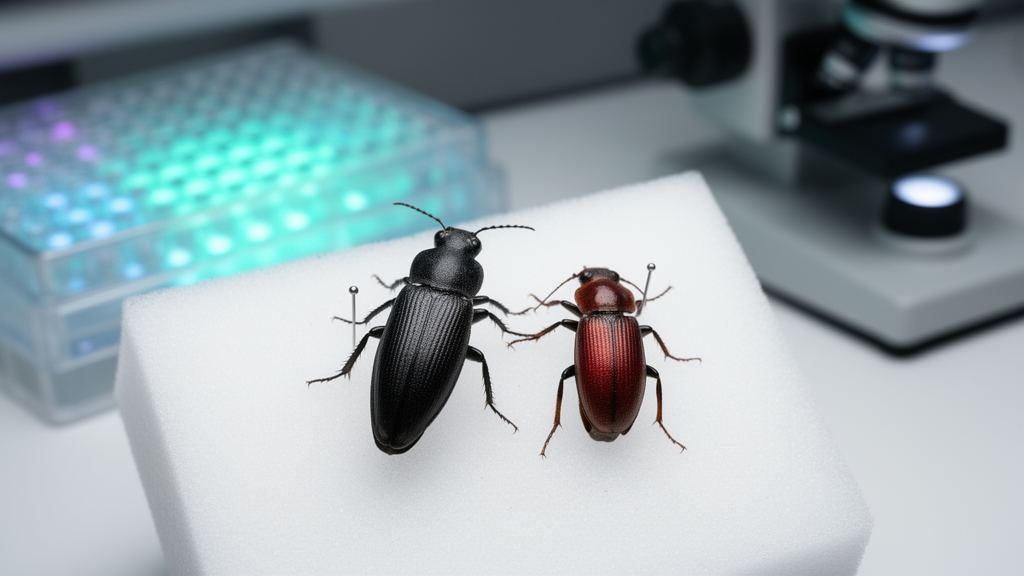
Deep in the high-altitude grasslands of the Tibetan Plateau and the arid slopes of the Helan Mountains, beetles of the genus Blaps have long puzzled taxonomists. These flightless darkling beetles, recognizable by their matte black bodies and fused wing cases, represent the most species-rich genus within the subtribe Blaptina, with 214 described species and subspecies worldwide. Yet despite decades of morphological study, the boundaries between many species remain frustratingly blurred. A new study published in the Deutsche Entomologische Zeitschrift combines DNA barcoding with detailed larval and adult morphology to untangle this diversity, describing two species new to science and adding crucial larval data for a third species newly recorded from China.
The research team, led by X.-M. Li of the Museum of Hebei University in Baoding, China, collected specimens from three of China’s most biologically challenging regions: Xinjiang Uygur Autonomous Region, Inner Mongolia Autonomous Region, and Xizang Autonomous Region. Rather than relying solely on traditional morphological comparisons, the researchers reconstructed a preliminary phylogenetic tree based on cytochrome c oxidase subunit I (COI) sequences from 99 individuals representing 35 species. This mitochondrial gene, often called the
The choice of COI as the workhorse marker reflects a broader trend in animal taxonomy. This mitochondrial gene evolves quickly enough to distinguish closely related species, yet it can be amplified reliably with standard primer pairs such as F 2183 and R 3014, which target a region first popularized in the 1990s. In the new study, the amplified fragment yielded 667 base pairs for the final analysis, a length sufficient to resolve clustering patterns among the 35 sampled species. Because mitochondrial DNA is maternally inherited and does not recombine, each sequence traces a single lineage backward in time, which makes the gene especially convenient for species-delimitation analyses, even though it cannot capture the full picture of species history that nuclear markers would provide.
The study’s analytical design illustrates how modern taxonomists guard against the known pitfalls of single-marker species delimitation. All three methods applied here—ASAP, GMYC, and PTP—operate on distance, ultrametric tree, and maximum-likelihood tree frameworks respectively, so agreement among them provides a measure of confidence that no single methodological artifact is driving the results. ASAP, the newest of the three, assembles species partitions automatically by evaluating asymptotic scores across possible splits in a pairwise distance matrix. GMYC, by contrast, models the transition between branching events within species and between species on an ultrametric tree inferred in BEAST, treating speciation and coalescent processes as distinct rates. PTP takes the maximum-likelihood tree directly and models the number of substitutions expected on branches within versus between species. When all three converge on the same clusters, as they did for the larval and adult samples in this study, the resulting species boundaries gain substantial credibility.
The matching of larvae to adults deserves particular emphasis. In beetle taxonomy, larval associations have historically relied on rearing individuals from egg to adult in the laboratory, a process that can take months or years for species with multi-year life cycles. DNA barcoding short-circuits this bottleneck: because larvae and adults of the same species share identical or near-identical COI haplotypes, a larva collected in the field can be assigned to a species cluster with high confidence. The study’s finding that all larval samples clustered with their associated adults—six larvae matching Blaps lineolata, one matching Blaps ovalis, and one matching Blaps caraboides intermittens—demonstrates the practical power of this approach. The larval descriptions that follow are therefore anchored in molecular evidence rather than circumstantial field association.
Larval morphology itself carries phylogenetic weight that adult characters sometimes lack. Within Blaptini, larval traits such as the shape of the epipharynx, the structure of the urogomphi, and the pattern of setae on the head capsule have been used since the mid-twentieth century to infer relationships among genera. The last-instar larvae described here measure between 24.0 and 32.0 millimeters in length, with subcylindrical bodies and hat-shaped terminal segments. Notably, the larva of Blaps caraboides intermittens lacks urogomphi entirely, retaining only two spines at the apex of the last segment—a feature that may prove diagnostic when compared with larvae of related species. The head is prognathous, slightly narrower than the prothorax, with a Y-shaped epicranial stem and a transverse labrum bearing six discal and eight apical setae. Such details, though seemingly minute, form the basis for comparative larval systematics across the tribe.
The geographic scope of the sampling reflects the center of diversity for the genus. Xinjiang, Inner Mongolia, and Xizang together span deserts, steppe, and alpine grassland—habitats where flightless tenebrionids have diversified extensively. Flightlessness in Blaps is associated with reduced hind wings and fused elytra, traits that restrict dispersal and can promote allopatric speciation across mountain ranges and river valleys. This geographic isolation likely explains why so many species remain morphologically cryptic: populations separated by barriers accumulate genetic differences faster than visible morphological ones, especially in groups where body shape is constrained by a burrowing or nocturnal lifestyle. Molecular delimitation methods are therefore particularly valuable in such radiations, where traditional diagnostic characters may fail to capture true species boundaries.
The phylogenetic reconstruction used four species of Platyscelidini as outgroups, a choice grounded in prior evidence that this tribe is the closest relative of Blaptini. Rooting the tree with these outgroups allowed the researchers to polarize character evolution within Blaps and to test whether the genus is monophyletic. Earlier molecular work had suggested that Blaps is likely paraphyletic—meaning that some species currently placed in the genus are more closely related to other blaptine genera than to their congenerics. The preliminary tree in this study, while based on a single marker, adds further sampling density across the genus and sets the stage for more comprehensive multilocus analyses that could resolve this question definitively.
Specimen preparation followed standard protocols for both morphological and molecular work. Adults and larvae were deposited in the Museum of Hebei University, and DNA was extracted from larval pygopod tissue and adult leg muscle, preserving the rest of each specimen for morphological study. Photographs were taken with a Canon EOS 5D Mark III paired with Laowa macro lenses capable of up to 10× magnification, and multiple focal planes were stacked to produce sharp composite images. This combination of high-resolution imaging and molecular data reflects a growing standard in descriptive taxonomy, where new species are documented with both visual precision and genetic vouchers that future researchers can reanalyze.
The subgeneric structure of Blaps adds another layer of complexity to the taxonomy. Five subgenera are currently recognized: Blaps itself, with 184 species and subspecies, dominates the genus, while Ablapsis contains 24, Nalepa eight, Dineria two, and Arenoblaps just one. The two new species described here fall into different subgenera—Blaps lineolata into Ablapsis and Blaps ovalis into Blaps—highlighting that new diversity is being discovered across the genus rather than within a single lineage. The new record of Blaps caraboides intermittens from Xinjiang extends the known Chinese fauna and underscores how much remains to be documented even in regions that have been sampled repeatedly.
Looking forward, the study’s framework—combining COI barcoding, multiple delimitation methods, and detailed larval descriptions—offers a template for future work on Blaptina. With 350 species across 10 genera in the subtribe, and with immature stages described for only a fraction of Blaps species, the potential for further discoveries is substantial. Larval associations in particular remain a bottleneck for understanding evolutionary relationships, and each newly described larva adds a data point that can be compared across the tribe. As more specimens are collected from underexplored regions of the Palaearctic and adjacent biogeographic realms, the integration of molecular and morphological evidence will continue to refine our understanding of how this remarkable radiation of flightless beetles diversified across the arid and mountainous landscapes of Eurasia.
Subject of Research: Description of two new species and larvae of three species of Blaps Fabricius, 1775 from China ( Coleoptera , Tenebrionidae , Blaptinae ), with molecular species delimitation
Article Title: Description of two new species and larvae of three species of Blaps Fabricius, 1775 from China ( Coleoptera , Tenebrionidae , Blaptinae ), with molecular species delimitation
Article References: Description of two new species and larvae of three species of Blaps Fabricius, 1775 from China ( Coleoptera , Tenebrionidae , Blaptinae ), with molecular species delimitation. (n.d.). https://doi.org/10.3897/dez.73.194205
Image Credits: AI Generated
Keywords: Blaps, Tenebrionidae, darkling beetles, species delimitation, COI barcoding, China, new species, larval morphology, phylogenetics, Blaptina, integrative taxonomy, Description
Cite Scienmag News
Gavin Prescott. (October 16, 2026). DNA Barcodes and Microscopic Details Reveal Two New Darkling Beetle Species from China. Scienmag. https://scienmag.com/dna-barcodes-and-microscopic-details-reveal-two-new-darkling-beetle-species-from-china/
Gavin Prescott. "DNA Barcodes and Microscopic Details Reveal Two New Darkling Beetle Species from China." Scienmag, 16 October 2026, https://scienmag.com/dna-barcodes-and-microscopic-details-reveal-two-new-darkling-beetle-species-from-china/. Accessed 16 October 2026.
Gavin Prescott. "DNA Barcodes and Microscopic Details Reveal Two New Darkling Beetle Species from China." Scienmag. October 16, 2026. https://scienmag.com/dna-barcodes-and-microscopic-details-reveal-two-new-darkling-beetle-species-from-china/


