


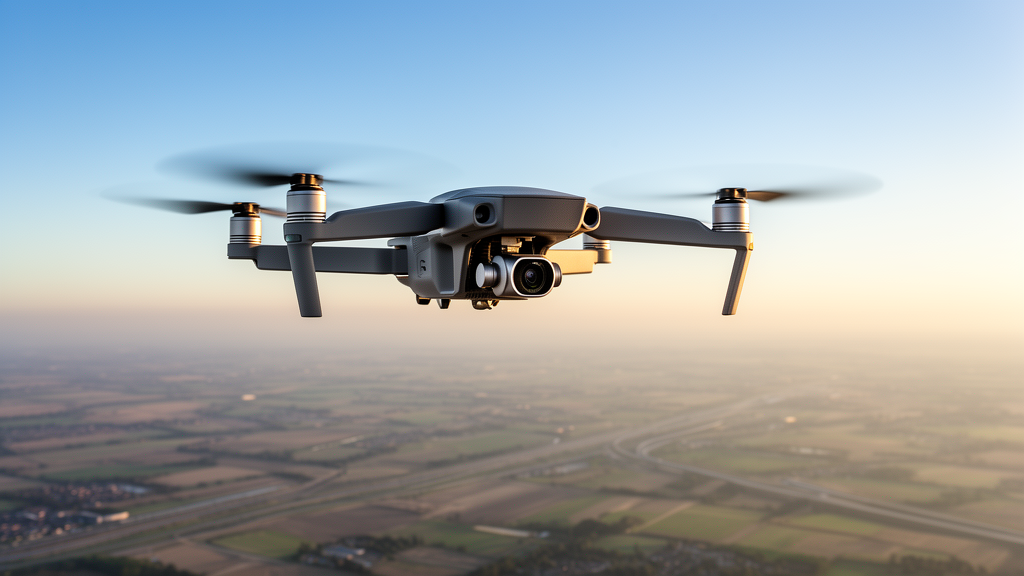
Every autonomous drone lives or dies by what its camera tells it in real time. The onboard perception system sits at the very front of a sensing-decision-control loop: each detection of a vehicle, obstacle, or target feeds directly into navigation, collision avoidance, and tracking decisions made in flight. A missed car at high altitude can delay an avoidance maneuver or produce an unsafe waypoint; a false positive can trigger unnecessary detours and unstable replanning. Yet there is a stubborn, well-known weakness in this loop that has plagued drone engineers for years — detectors trained at one altitude routinely fall apart when the platform is redeployed at another. Now, a new neural network architecture called CADA-Net claims to have cracked this problem by treating altitude not as a nuisance to be removed, but as a powerful geometric clue to be exploited. The results are striking, and they could reshape how we think about label-efficient machine perception on embedded platforms.
The problem is more subtle than it first appears. When a search-and-rescue drone sweeps a corridor at low altitude before climbing for area coverage, or an inspection drone transitions between close hovering and high-altitude transit, each altitude shift changes target scale, viewing perspective, target density, and the effective receptive field of the network in a coupled manner. This is not a simple scale change. The underlying distribution shift is geometric and semantic at the same time. Detectors trained on low-altitude imagery show massive accuracy drops when redeployed at high altitude, and the gap cannot be closed by simply throwing more multi-scale feature pyramids at the problem. The high-altitude regime presents small targets against heterogeneous backgrounds — a regime where an explicit structural or contextual prior outperforms added backbone capacity, as recent work in remote sensing and aerial image analysis has repeatedly demonstrated.
Mainstream domain-adaptive detectors have historically concentrated on weather, illumination, and synthetic-to-real shifts, typically through adversarial feature alignment or self-training with a teacher network. Surveys of unsupervised domain adaptation for detection note that altitude has remained conspicuously outside the canonical list of factors examined in this literature. Earlier UAV-specific work treated altitude, viewpoint, and weather as nuisance attributes to be removed. But here is the insight that drives the new research, published in Frontiers in Neurorobotics: altitude carries an informative geometric prior that can be exploited rather than discarded. Methods that align features without conditioning on altitude tend to collapse heterogeneous high-altitude statistics into a single target manifold, which limits transfer once the gap becomes geometric in nature. The cost of fully annotating a target altitude further compounds the problem, since high-altitude imagery in public benchmarks is markedly scarcer than mid- and low-altitude imagery.
CADA-Net — short for cross-altitude domain-adaptive network — is built on a Faster R-CNN backbone with a ResNet-101 feature extractor and a feature pyramid neck. The architecture runs two parallel learning streams that share a single conditioned encoder. The first stream injects a categorical altitude prior into multi-scale features through feature-wise linear modulation, or FiLM. The altitude tag — mapped to ordinal values 0, 0.5, and 1 for low, medium, and high bands — is fed through a two-layer perceptron that generates channel-wise scale and shift parameters applied to each of the five pyramid levels. This preserves the spatial resolution of the original feature map while letting the network retune its response statistics for the altitude in question. Because the ordinal values feed a nonlinear perceptron rather than acting as direct coefficients on the features, the learned mapping from altitude to modulation parameters is itself nonlinear and does not translate equal scalar spacing into equal feature displacement.
The second stream tackles the scarcity of high-altitude annotations through a weak-to-strong teacher-student self-training schedule. For each unlabelled target image, a weakly augmented view — horizontal flipping and mild colour jitter — is fed to the teacher, whose predictions above a confidence threshold of 0.8 are retained as pseudo-boxes. A strongly augmented view, which inherits the flip of the weak view so that the retained boxes remain spatially valid and adds photometric distortion, Gaussian blurring, and random erasing, is fed to the student and supervised by the retained pseudo-boxes. The teacher is updated through an exponential moving average of the student weights with a coefficient of 0.9996, while the student receives gradients from all three loss terms. A balancing schedule down-weights the unsupervised term during early iterations to prevent pseudo-label noise from dominating the optimisation before the teacher stabilises. Crucially, the altitude prior is supplied to both the teacher and the student alike, so that pseudo-labels are generated under the same feature modulation that the student is trained to use at inference — a consistency that pure self-training pipelines rarely make explicit.
Evaluated on the UAVDT benchmark under a low-to-high adaptation protocol, CADA-Net reaches 46.3 mAP@0.5 on the high-altitude band, surpassing the source-only baseline by 17.9 points and the strongest domain-adaptive competitor by 7.2 points, while leaving only a 6.3-point gap to a fully-supervised upper bound. With just 5 percent of target labels — a mere 17 annotated high-altitude frames — accuracy rises to 48.1 mAP@0.5. The label-efficient curve is roughly logarithmic, with most of the improvement secured by the time the budget reaches 5 percent. The comparison to the adaptive teacher baseline is particularly revealing: the adaptive teacher curve climbs more steeply between 10 and 100 percent because the underlying detector lacks altitude conditioning, so additional target labels mainly help the network resolve appearance ambiguities. The CADA-Net curve is flatter because altitude-conditioned modulation already absorbs a large part of the geometric shift, so the marginal value of each additional label diminishes earlier. From the perspective of mission-time annotation budgets in real drone deployment, this pattern is enormously helpful — a small number of labels at a new altitude is sufficient to recover most of the available accuracy.
But is cross-altitude shift simply a scale problem in disguise? The researchers examined this objection directly. The cumulative distribution of normalised box area shows that high-altitude objects are visibly smaller than low- and medium-altitude objects, but the three distributions overlap substantially between 10⁻³ and 10⁻² of normalised box area. Scale alone therefore does not provide a clean separation. More strikingly, the Jensen-Shannon divergence between the low- and high-altitude marginal distributions on four image-level statistics reveals that aspect ratio carries a divergence of 0.437 — comparable to the 0.413 for box scale — which indicates that the cross-altitude shift involves a viewpoint component that scale-augmentation strategies simply cannot reach. A multi-scale baseline that augments across object sizes but ignores altitude leaves a substantial residual gap on the high-altitude band, which altitude conditioning closes. The evidence shows that the cross-altitude gap is geometric and semantic at the same time, and a detector intended for multi-altitude flight benefits from making altitude a first-class input rather than relying on scale-invariant features alone.
The ablation study isolates the contribution of each component. Removing FiLM modulation reduces the high-altitude mAP by 6.5 points, removing the adversarial discriminator reduces it by 4.8 points, and disabling pseudo-label self-training causes the largest single drop at 9.1 points. The relative magnitudes match the design intent: pseudo-label self-training drives the bulk of the cross-altitude transfer when target annotations are scarce, while altitude-conditioned modulation supplies the geometric prior that keeps the pseudo-labels reliable. The adversarial term contributes a smaller but consistent share by smoothing the feature distribution across altitudes. The pairing of conditioning and self-training behaves less like a sum of independent contributions and more like a feedback loop in which each component improves the other — a mild super-additivity indicating that the two objectives reinforce rather than cancel.
Perhaps the most practically significant finding is that the accuracy gain survives the brutal throughput and power limits of embedded inference. Onboard profiling on an NVIDIA Jetson AGX Orin sustains 42 frames per second at INT8 precision within a 27.4-watt envelope — leaving substantial headroom within the 60-watt platform limit. The TensorRT INT8 build attains this throughput with only a 1.4-point accuracy drop relative to the PyTorch FP32 baseline. This is a precondition for onboard use rather than evidence of closed-loop flight, and the researchers are careful to frame it as such. The profiling exercises the perception module alone, so the figures bound onboard feasibility rather than demonstrate closed-loop operation. Real-platform deployment further introduces motion blur, exposure variation, and communication latencies that an offline Jetson profile does not capture.
The broader implication is that rendering a geometric prior explicit can support label-efficient perception at embedded inference rates for UAV platforms operating across altitude transitions. In downstream autonomy, detector errors are not neutral: missed vehicles can delay avoidance decisions, whereas false positives can cause unnecessary waypoint changes. Future work should therefore embed CADA-Net in closed-loop UAV navigation and avoidance pipelines to evaluate task-level outcomes such as collision rate, unnecessary avoidance manoeuvres, and waypoint tracking error rather than detection accuracy in isolation. The altitude prior could also be generalised from a discrete three-band tag to a continuous reading, the pseudo-label schedule could be made more adaptive to scene dynamics, and the perception backbone could be coupled with downstream navigation and avoidance controllers. But the core message is clear and potentially viral in its simplicity: sometimes the best way to solve a hard domain-shift problem is not to remove the variable causing the shift, but to feed it back into the network as a signal. For drones that must operate across the full vertical envelope of the sky, that single design decision — treating altitude as a clue rather than a confounder — has just narrowed the gap between benchmark performance and real-world reliability.
Subject of Research: CADA-Net: cross-altitude domain-adaptive perception for label-efficient onboard sensing in autonomous UAVs
Article Title: CADA-Net: cross-altitude domain-adaptive perception for label-efficient onboard sensing in autonomous UAVs
Article References: Cai, L. (2026). CADA-Net: cross-altitude domain-adaptive perception for label-efficient onboard sensing in autonomous UAVs. Frontiers in Neurorobotics, 20, Article 1926034. https://doi.org/10.3389/fnbot.2026.1926034
Image Credits: AI Generated
DOI: 10.3389/fnbot.2026.1926034
Keywords: CADA-Net, cross-altitude, domain-adaptive, perception, label-efficient, onboard, sensing, autonomous, UAVs, scientific research
Cite Scienmag News
Blake Davidson. (October 16, 2026). This Tiny Neural Network Could Finally Let Drones See Clearly at Any Altitude. Scienmag. https://scienmag.com/this-tiny-neural-network-could-finally-let-drones-see-clearly-at-any-altitude/
Blake Davidson. "This Tiny Neural Network Could Finally Let Drones See Clearly at Any Altitude." Scienmag, 16 October 2026, https://scienmag.com/this-tiny-neural-network-could-finally-let-drones-see-clearly-at-any-altitude/. Accessed 16 October 2026.
Blake Davidson. "This Tiny Neural Network Could Finally Let Drones See Clearly at Any Altitude." Scienmag. October 16, 2026. https://scienmag.com/this-tiny-neural-network-could-finally-let-drones-see-clearly-at-any-altitude/


