


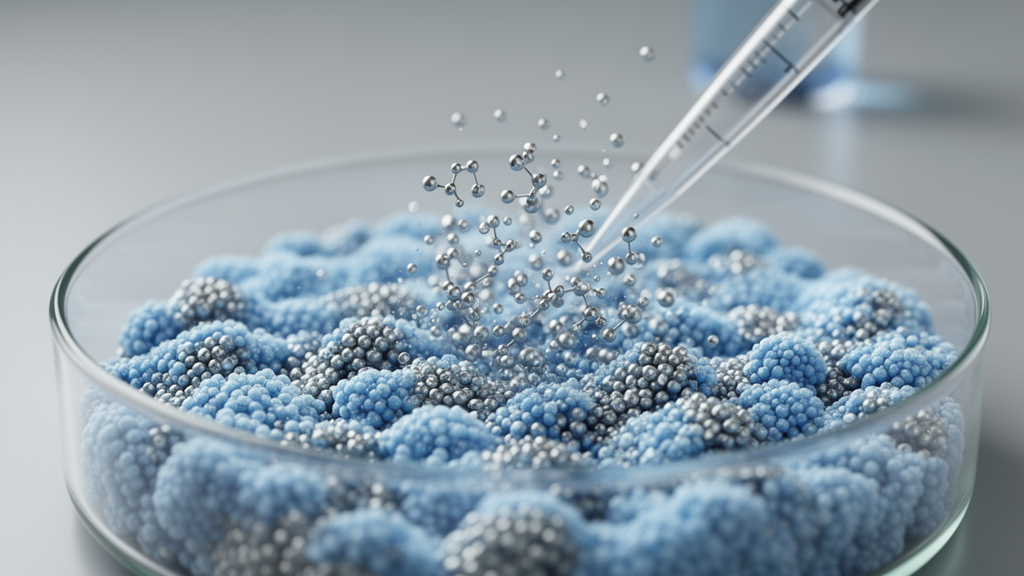
Early childhood caries remains one of the most stubborn chronic diseases of childhood, affecting an estimated 532 million children worldwide with untreated decay in their primary teeth. Because young children are often unable to cooperate with dental treatment, and because dental fear and poor compliance frequently undermine therapy, researchers have long sought non-invasive ways to stop the disease before it starts. A new study from Anhui Medical University and the University of Hong Kong, published in Frontiers in Oral Health, now reports that a nanocomposite combining a quorum-sensing-disrupting enzyme with silver nanoparticles can reshape the bacterial community of caries-derived dental plaque biofilms in the laboratory, weakening the very genera that drive tooth decay.
The material, called Ag-Est816, is a dual-function weapon. One component is Est816, a recently discovered N-acyl-homoserine lactonase, an enzyme that hydrolyzes the signaling molecules Gram-negative bacteria use for quorum sensing, the chemical communication system that coordinates biofilm formation, virulence factor production, and antibiotic resistance. The other component is silver nanoparticles, which kill bacteria through multiple mechanisms at once: disrupting bacterial membranes, generating reactive oxygen species, and interfering with DNA replication. Because the enzyme dismantles communication while the silver delivers direct bactericidal pressure, the composite was designed to attack cariogenic biofilms on two fronts simultaneously.
Silver nanoparticles have shown promise in caries management before, with clinical trials demonstrating that nano-silver fluoride can arrest decay in primary molars. But silver-based approaches face real limitations: the nanoparticles tend to aggregate and lose efficacy, some formulations discolor teeth, and prolonged exposure to silver ions can harm dental pulp stem cells and odontoblasts. The quorum-quenching strategy, by contrast, is non-bactericidal at its core, interfering with collective bacterial behavior without directly affecting growth or metabolism. The Ag-Est816 composite, covalently conjugating the enzyme to silver nanoparticles via branched polyethyleneimine, was engineered to retain more than 90 percent of the enzyme’s quorum-quenching activity while providing excellent cytocompatibility with human gingival fibroblasts.
To test the composite against a realistic microbial community, the team collected supragingival plaque from 30 children younger than six years, 15 males and 15 females, all diagnosed with early childhood caries. The plaque samples were cultured in vitro to form enriched multispecies biofilms, which were then treated with either the Ag-Est816 composite or a phosphate-buffered saline control for two days. The working concentrations, 5 micrograms per milliliter of silver and 6 units per milliliter of enzyme activity, were selected from previous studies as the point where biofilm disruption was achieved while biocompatibility was preserved. The researchers then analyzed the bacterial composition of all 60 samples using high-throughput sequencing of the 16S rRNA gene, examining alpha diversity, beta diversity, taxonomic composition, and predicted microbial functions.
The sequencing results revealed a significant reduction in microbial alpha diversity following treatment. The Chao1 index, Observed species, and Faith’s phylogenetic diversity all decreased significantly, indicating lower species richness and reduced phylogenetic breadth within the treated biofilms. Good’s coverage exceeded 99 percent in both groups, confirming that the sequencing depth was sufficient to capture the communities comprehensively. Pielou’s evenness showed a slight but non-significant decline, suggesting that the treatment primarily reduced the number of detectable taxa rather than redistributing the remaining community uniformly.
Beta diversity analysis, based on weighted UniFrac distances, showed a statistically significant shift in overall community composition between the control and treatment groups. Principal coordinate analysis revealed separation along the first two axes, which together explained nearly 59 percent of the variance. A paired permutational multivariate analysis of variance, accounting for the fact that each child contributed samples to both groups, confirmed the difference with a modest effect size of R-squared equal to 0.0286 and a P value of 0.002. The treatment explained approximately 2.9 percent of the total community variance, a small but detectable shift. A complementary PERMDISP analysis found no significant difference in within-group dispersion, indicating that the observed compositional change was not an artifact of differences in community spread.
At the genus level, the composite produced a clear ecological restructuring. The abundances of Actinomyces, Lactobacillus, and Moryella were markedly decreased, while Haemophilus and Granulicatella were enriched. Actinomyces is considered a pioneer species in caries initiation, adhering to the tooth surface and facilitating colonization by primary cariogenic bacteria such as Streptococcus mutans. Lactobacillus produces lactic acid that promotes enamel demineralization and facilitates caries progression. The reduction of these cariogenic genera suggests the composite may help inhibit early biofilm formation and reduce the risk of further decay. LEfSe analysis identified Actinomyces and Lactobacillus as characteristic taxa of the untreated control group, while Enterococcus and Granulicatella were significantly enriched following treatment, likely reflecting differential susceptibility among taxa and subsequent redistribution of ecological niches within the community.
Functional prediction using PICRUSt2 revealed that the composite influenced several key metabolic pathways. The most statistically significant alteration was observed in starch and sucrose metabolism, indicating a strong influence on carbohydrate processing within the microbial community. Amino acid biosynthesis showed the most substantial enrichment in terms of the number of differentially abundant gene families. Other significantly altered pathways included nucleotide sugar biosynthesis and purine metabolism. Nucleotide sugar biosynthesis is a central precursor process for extracellular polymeric substance formation, a key factor in plaque biofilm development and drug resistance, so changes in this pathway may be relevant to the observed structural disruption of the biofilms.
Scanning electron microscopy and crystal violet biomass quantification confirmed that the composite compromised biofilm structural integrity. Biofilms exposed to Ag-Est816 appeared more dispersed under SEM, with a substantial decrease in extracellular matrix. Quantitative analysis demonstrated a significant reduction in total biofilm biomass in the treatment group compared with the control. Because the two components were not separated in the experimental design, the reduction in biomass is attributed to the composite as a whole, though quorum-quenching remains a plausible contributing mechanism alongside the direct antibacterial effects of the silver nanoparticles.
The authors acknowledge several limitations. The in vitro enrichment step, using brain heart infusion broth, favors fast-growing media-adapted taxa and does not fully preserve the original in vivo community structure. The relatively low abundance of Streptococcus mutans in the model may reflect competitive interactions among Streptococcus species under culture conditions. Functional predictions from 16S rRNA data require validation through metagenomics and metabolomics. The individual contributions of the silver nanoparticles and the enzyme were not separately evaluated, and the efficiency of biofilm detachment was not directly quantified by microscopy, though all samples were processed using an identical standardized protocol. Nevertheless, the findings suggest that this non-invasive nanocomposite has potential as an adjunctive therapy for caries prevention in children, offering a way to modulate the oral microbiome toward a less cariogenic profile while limiting extensive disruption of the microbial community. Further studies in animal models and clinical trials will be needed to validate the ecological effects and assess long-term safety before clinical translation.
Subject of Research: N-acyl-homoserine lactonase–nanosilver composite modulates the bacterial community of an in vitro enriched biofilm model of early childhood caries
Article Title: N-acyl-homoserine lactonase–nanosilver composite modulates the bacterial community of an in vitro enriched biofilm model of early childhood caries
Article References: N-acyl-homoserine lactonase–nanosilver composite modulates the bacterial community of an in vitro enriched biofilm model of early childhood caries. (n.d.). https://doi.org/10.3389/froh.2026.1779148
Image Credits: AI Generated
DOI: 10.3389/froh.2026.1779148
Keywords: early childhood caries, dental biofilms, quorum sensing, silver nanoparticles, AHL lactonase, 16S rRNA sequencing, nanocomposite, preventive dentistry, N-acyl-homoserine, lactonase, nanosilver, composite
Cite Scienmag News
Ophelia Keating. (October 16, 2026). Enzyme-Nanosilver Composite Rewires Cariogenic Dental Biofilms in the Lab. Scienmag. https://scienmag.com/enzyme-nanosilver-composite-rewires-cariogenic-dental-biofilms-in-the-lab/
Ophelia Keating. "Enzyme-Nanosilver Composite Rewires Cariogenic Dental Biofilms in the Lab." Scienmag, 16 October 2026, https://scienmag.com/enzyme-nanosilver-composite-rewires-cariogenic-dental-biofilms-in-the-lab/. Accessed 16 October 2026.
Ophelia Keating. "Enzyme-Nanosilver Composite Rewires Cariogenic Dental Biofilms in the Lab." Scienmag. October 16, 2026. https://scienmag.com/enzyme-nanosilver-composite-rewires-cariogenic-dental-biofilms-in-the-lab/


