


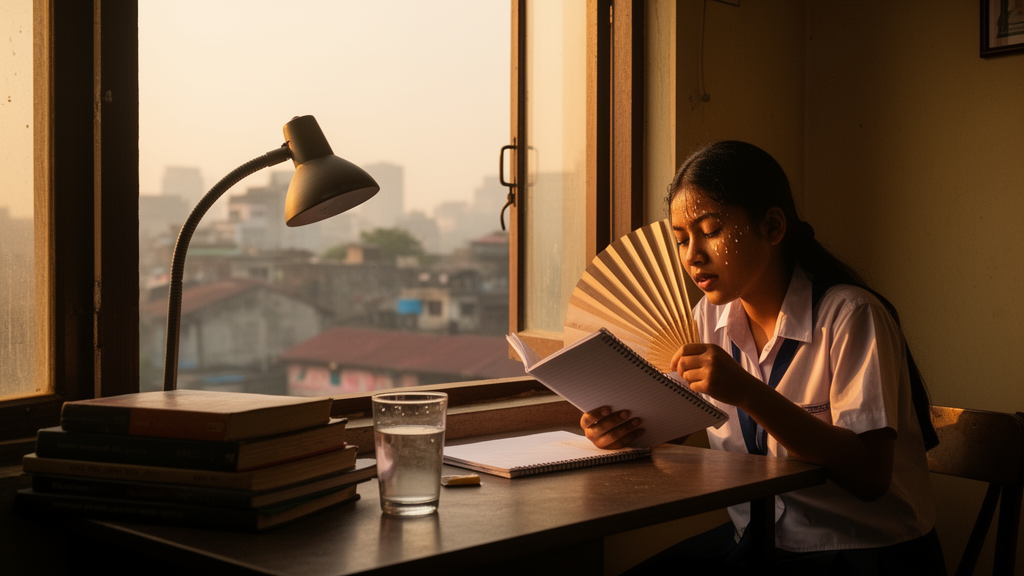
Climate change is usually framed as a story about melting ice sheets, failing crops, and rising seas. A new qualitative study from Bangladesh asks a quieter but equally consequential question: what happens to a student’s ability to learn when the climate turns against the classroom? Published in Environmental Challenges, the research followed students at Jagannath University in Old Dhaka, one of the most densely populated and climate-vulnerable corners of South Asia, and documented in meticulous detail how extreme heat, waterlogging, and erratic rainfall are quietly dismantling study habits, eroding motivation, and undermining academic engagement.
The stakes could hardly be higher. By 2030, the World Bank estimates that nearly 90 percent of South Asia’s population will be exposed to extreme heat, and a quarter will face severe flooding risks, with Bangladesh flagged as among the most endangered nations. The consequences reach far beyond a missed lecture. Research across 29 tropical countries has shown that early-life exposure to extreme temperatures and erratic precipitation measurably reduces the total years of schooling a child completes, meaning that today’s classroom discomforts can calcify into lifelong educational deficits.
The researchers chose Jagannath University deliberately. Old Dhaka, or Puran Dhaka, is a four-century-old district of narrow roads, wholesale markets, and historic buildings packed at a density of roughly 100,000 people per square kilometer, according to the Bangladesh Bureau of Statistics. Decades of breakneck urbanization have consumed green spaces and wetlands, converted floodplains into residential blocks, and disrupted natural drainage. The result is a classic urban heat island: heatwaves here are stronger and longer-lasting than in surrounding rural areas, and waterlogging routinely paralyzes streets, damages infrastructure, and degrades living conditions. Students commuting through this environment absorb the climate’s shocks twice over, first on the road and again in the lecture hall.
Methodologically, the study is a model of qualitative rigor. The team conducted 38 semi-structured, in-depth interviews with students aged 18 to 26, supplemented by two focus group discussions split by gender and five key informant interviews with three faculty advisors, a librarian, and an assistant proctor. Interviews ran 45 to 60 minutes and were translated into Bangla so participants could speak naturally, then transcribed, translated back, and analyzed using Braun and Clarke’s six-phase reflexive thematic analysis. Purposive sampling ensured representation across faculties, years of study, gender, religion, residence type, and socioeconomic background. The analysis was anchored in three theoretical pillars: Bronfenbrenner’s Ecological Systems Theory, which situates learning within nested layers of environment; Lazarus and Folkman’s Stress and Coping Theory, which explains why identical stressors produce different outcomes; and Fredricks’ three-part model of student engagement spanning behavioral, emotional, and cognitive dimensions.
Five themes emerged, and the first is striking in its simplicity: students understand climate change not as an abstract scientific concept but as a lived, bodily experience. One sociology student described winters that are no longer cold, extreme heat, unexpected rainfall, and pollution from brick kilns and filled-in rivers as evidence that climate change is ‘no longer a distant issue but something that is affecting our everyday lives.’ A zoology student who moved from a village to Old Dhaka reported that the heat felt far more intense in the city and that the predictable rhythm of seasons had dissolved. A business student put it bluntly: walking to an 8:30 a.m. class in intense heat leaves him physically exhausted, and climbing to the seventh floor feels harder than it once did.
The second and third themes trace how that lived experience becomes an academic handicap. Extreme heat pushes classes online, but load-shedding and unstable mobile networks then sabotage the digital fallback, so students miss examination topics discussed during chaotic online sessions and cannot reliably recover the material. A fine arts student watched sudden rain destroy fieldwork at Bahadur Shah Park, stretching a two-day project into six or seven. A computer science student reported sitting in overcrowded, humid classrooms where the 50-minute lecture becomes an exercise in endurance: the heat crushes concentration, interest in learning falls, and examination performance follows. Study habits collapse in parallel. A botany student said that heat in his hostel has destroyed the regular study routine he maintained through school, admitting he once sat final examinations underprepared simply because he could not study in the heat. Long commuters describe arriving home too exhausted to study on weekdays, pushing all learning into holidays and stacking pressure onto examination periods.
Engagement itself shows the strain across all three of Fredricks’ dimensions. Behaviorally, waterlogged roads cause lateness and missed attendance, and rain keeps group members from reaching campus for collaborative presentations. Emotionally, students report watching the clock during afternoon lectures, counting down to release from unbearable rooms. A faculty advisor confirmed the pattern, noting that students on back benches without fan access struggle to concentrate and sometimes ask teachers to cancel or shorten classes. Cognitively, the erosion is perhaps most alarming. One philosophy student living on the top floor of a communal mess said the motivation she had during her school-leaving examinations is simply no longer reachable; another student reported that he once studied three to four hours at a stretch but now cannot sustain focus for even 40 to 50 minutes.
The physical and psychological toll threads through every account. A student who wears hijab described how heat triggers severe headaches that developed into migraine, at times so severe she returns to her room in tears. Others report dehydration, heat rash, and skin infections from wading through dirty floodwater. Female students in crowded buses describe sweating, dizziness, and arriving too unwell to concentrate. Sleep is the invisible casualty: a social work student said outages and ambient heat keep him awake until three or four in the morning before 9 a.m. classes, leaving him irritable, dozing through lectures, and performing so poorly on examinations that he feels depressed about his future. In one female dormitory, eight students share a room and two share a single bed, a suffocating arrangement that breeds irritability precisely when examination pressure peaks. The study echoes broader evidence, including findings that Bangladeshi students in disaster-prone regions experience stress that forces survival above study, and that rising classroom temperatures internationally reduce attention and cognitive function.
Yet students are not passive. They carry umbrellas everywhere, share cold drinks that they know are unhealthy, shower two or three times daily, switch off lights to shave a degree off room temperature, and treat sunscreen as a reluctantly absorbed financial burden. Academically, they migrate to the central library, where the librarian reports morning queues during hot weather and seats too scarce to meet demand, and they restructure their days around the climate itself, one computer science student studying immediately after the dawn prayer because morning temperatures are the only tolerable ones. These strategies echo coping patterns documented in Spain, Indonesia, and India, and consistent with evidence that structured schedules and time management are effective problem-focused responses. But the authors stress the obvious: individual improvisation cannot substitute for structural protection. Their recommendations range from improved ventilation, drainage, green space, and reliable electricity on campus to flexible schedules, hybrid learning models, counseling services, climate adaptation committees, and national policy alignment with the Sustainable Development Goals on education, sustainable cities, and climate action.
The study’s limitations are honestly stated: a single institution, a purposive rather than statistically representative sample, and reliance on self-reported experience. But its core insight travels well beyond Old Dhaka. Climate change is not merely damaging infrastructure or agriculture; it is quietly taxing cognition, sleep, motivation, and attendance among the very cohort that South Asia’s future depends upon. As one respondent reflected, seasons are no longer behaving normally, and the balance nature once held is slipping. If universities and policymakers do not build climate-resilient learning environments soon, the region risks raising a generation whose potential was measured not in grades, but in degrees Celsius.
Subject of Research: The effects of climate change on university students' study habits, academic engagement, and coping strategies in climate-vulnerable urban Bangladesh
Article Title: A qualitative exploration of climate change effects on study habits and academic engagement of Jagannath University students
Article References: Bhattacharjee, M., Sheikh, M. K., Sarker, S. S., & Akter, S. (2026). A qualitative exploration of climate change effects on study habits and academic engagement of Jagannath University students. Environmental Challenges, 25, Article 101689. https://doi.org/10.1016/j.envc.2026.101689
Image Credits: AI Generated
DOI: 10.1016/j.envc.2026.101689
Keywords: climate change, higher education, Bangladesh, Old Dhaka, heat stress, academic engagement, study habits, waterlogging, student mental health, qualitative research, urban heat island, climate adaptation
Cite Scienmag News
Sloane Callahan. (October 16, 2026). When Heat Steals the Study Hour: How Climate Change Is Reshaping University Life in Dhaka. Scienmag. https://scienmag.com/when-heat-steals-the-study-hour-how-climate-change-is-reshaping-university-life-in-dhaka/
Sloane Callahan. "When Heat Steals the Study Hour: How Climate Change Is Reshaping University Life in Dhaka." Scienmag, 16 October 2026, https://scienmag.com/when-heat-steals-the-study-hour-how-climate-change-is-reshaping-university-life-in-dhaka/. Accessed 16 October 2026.
Sloane Callahan. "When Heat Steals the Study Hour: How Climate Change Is Reshaping University Life in Dhaka." Scienmag. October 16, 2026. https://scienmag.com/when-heat-steals-the-study-hour-how-climate-change-is-reshaping-university-life-in-dhaka/


