


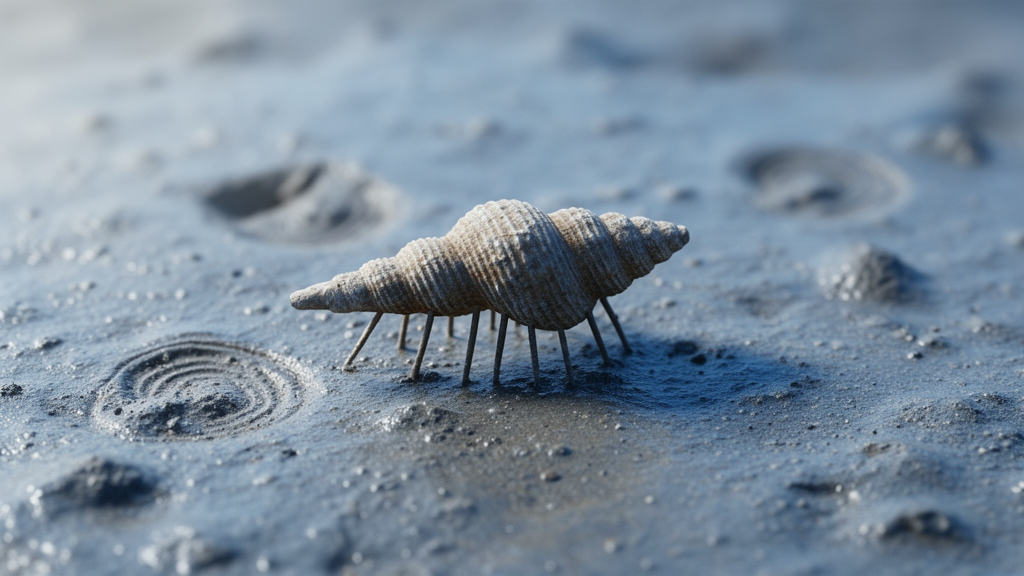
Deep in the blue-green clays of a quarry in the Trans-Ural region of Western Siberia, paleontologists have uncovered a sea snail that walked the seafloor on stilt-like leg projections roughly 37 million years ago. The newly described species, Aporrhais siberica, belongs to the Aporrhaidae, a family of stromboidean gastropods famous for the dramatic, finger-like extensions of their outer lip that transform the shell into something resembling a walking apparatus. The discovery, published in Zitteliana, not only adds a new branch to the family tree of these striking mollusks but also rewrites a long-standing case of mistaken identity that has confused Soviet and Russian paleontologists for more than six decades.
The fossil material comes from the Kyshtyrla quarry, located at 55°55’15″N, 65°49’26″E on the southwestern periphery of Western Siberia. This site, roughly 15 meters deep, exposes polymineralic illite-smectite and montmorillonite blue-green clays laced with pyrite, marcasite, siderite, quartz, and gypsum. These sediments were laid down during the Late Eocene in a shallow-water, semi-isolated epicontinental sea. The deposits belong to the Tavda Formation, which detailed studies of pollen, dinoflagellate cysts, and magnetostratigraphy have dated to the Middle and Upper Eocene. Recent foraminiferal research, combined with geochemical data, confirms that the quarry sediments are Upper Eocene in age and were deposited in a shallow subtidal environment at a stage when the West Siberian Basin was becoming increasingly isolated from the world ocean.
From a paleogeographic perspective, the West Siberian Sea during the Late Eocene was cut off from the Arctic Ocean but connected to the Peri-Tethyan Sea through the Tyrgay Strait. This semi-enclosed setting created a unique ecosystem where sharks cruised above the seafloor, teleost fish darted through the shallows, and aporrhaid gastropods trudged along the bottom. The Kyshtyrla quarry has proven to be an extraordinary window into this vanished world, yielding shark teeth, teleost bone remains, otoliths, mollusks, and trace fossils. It is precisely this rich assemblage that makes the new aporrhaid discovery so significant for understanding the biogeography of the East Peri-Tethys region during the Paleogene.
The new species was previously misidentified as Aporrhais cornuta Korobkov, 1949, an aporrhaid originally described from the Upper Eocene and Lower Oligocene of the North Aral region in what is now Kazakhstan. Turbina, working in 1959 and 1962, attributed the Trans-Ural specimens to “Aporrhais cornutus Alexeiev,” treating them as a subadult of the North Aral species. The new study, led by Wieneke and Trubin, re-examined this material and concluded that the Siberian morph represents a distinct species. The critical difference lies in the digitations: A. siberica lacks the spire-adnate digitation that characterizes A. cornuta, in which a long finger-like projection grows along the entire length of the spire and in some specimens protrudes significantly above it.
Aporrhais siberica is a medium-sized, heavily callused aporrhaid reaching approximately 43 millimeters in height. The shell is high-conical, with a spire of about eight whorls. The aperture bears two digitations rather than three. The first three teleoconch whorls are rounded with numerous opisthocyrt growth lines, while the fourth whorl develops opisthocyrt axial ribs, numbering eleven on the abapertural part. On the penultimate whorl, the ribs strengthen to six on the abapertural side. The last whorl carries three keels, with the adapical keel most prominent, bearing five to six ribs on the abapertural side. The apertural side of the last whorl is completely covered by a thick callus, a feature that occurs only in fully adult specimens and provides strong evidence against the subadult interpretation favored by earlier researchers.
The outer lip of A. siberica is formed by two aperturally canaliculated digitations. The lateral adapical digitation is a spearhead-like elongation of the adapical keel, long and strongly curved adapically. The middle keel runs into the lateral abapical digitation, which is short and abapically directed. The abapical keel ends without building a digitation at all. Both the inner and outer lips of the aperture are thickly callused, the columella is heavily callused, and the callus covers the last whorl aperturally completely. The rostrum is triangular and channeled. These features, especially the thick apertural callus and the absence of a spire-adnate digitation, distinguish A. siberica unambiguously from A. cornuta, which has a long adspiral digitation protruding beyond the spire, a longer and only slightly curved lateral adapical digitation, and only a thin columellar callus.
The research material encompasses six specimens collected from the northeastern wall of the Kyshtyrla quarry. Four shells are stored in the Museum of the Tyumen Industrial University, designated MTIU K6, K7, K8, and K45. The holotype, MTIU K6, is fully preserved at 43 millimeters in height, while K7 and K8 have broken apertural extensions and K45 is a fragment. Two additional shells, SMCT MF33788 and MF33789, are held in the Slovtsov Museum Complex of Tyumen. The paratype MF33788 is fully preserved at 46 millimeters, making it slightly larger than the holotype. The species name honors Siberia, where Anton Maslennikov collected the holotype specimen.
The study also undertakes a comprehensive taxonomic revision of Aporrhais cornuta, untangling a complex chresonymy that spans more than a century of literature. Korobkov originally described the species in 1949 from the Turnagly locality in the northern Aral region of Kazakhstan, based on material from the Upper Eocene Tshegan Formation. The species reaches up to 57 millimeters in height and bears three granulated keels on the last whorl, with a narrow aperture carrying three characteristic finger-like digitations of the outer lip. The adspiral digitation grows along the entire length of the spire, the second curved process is directed laterally and upwards at an angle of 50 to 70 degrees to the first, and the lower rectilinear digitation is directed laterally and downwards at approximately the same angle.
The taxonomic history of A. cornuta is remarkably convoluted. Korobkov and others attributed the name to Alexeev, referring to a manuscript that was only posthumously published in 1963. However, under the International Code of Zoological Nomenclature, Korobkov must be considered the describing author because he gave a different description and used different material than Alexeev’s later publication. Korobkov discovered that the English Eocene species Rostellaria sowerbyi, now correctly named Aporrhais sowerbii, is not conspecific with the Crimean Eocene specimens that had been lumped under that name. Amitrov revised the species in 1994 and attributed it to Korobkov, also finding that the specimen illustrated by Abich in 1858 should be considered the type of Aporrhais aralensis Eichwald, 1868, a much smaller species. Il’ina used the name for a morphologically different, still undescribed species from Kazakhstan that differs from both A. cornuta and A. siberica by its different spire ornamentation and a triangular apertural extension lacking long spines.
The description of Aporrhais siberica resolves a long-standing puzzle in the paleontology of the East Peri-Tethys. By carefully analyzing publications referencing both morphologies and presenting revised synonymies, the researchers have clarified that the Trans-Ural and central Western Siberian aporrhaid faunas were distinct from those of the North Aral and Ustyurt regions. This biogeographic separation reflects the complex paleogeography of the Late Eocene, when the West Siberian Sea was connected to the Peri-Tethyan Sea through the Tyrgay Strait while being isolated from the Arctic Ocean. The new species provides tangible evidence that these semi-isolated basins harbored endemic gastropod lineages, offering a refined picture of how marine faunas evolved and diversified in the epicontinental seas of Eurasia during a critical interval of the Paleogene.
Subject of Research: A new stromboidean gastropod species, Aporrhais siberica sp. nov., from the Upper Eocene Tavda Formation of Western Siberia
Article Title: Description of a new species of Aporrhais ( Gastropoda , Stromboidea ) from the Upper Eocene of Western Siberia
Article References: Description of a new species of Aporrhais ( Gastropoda , Stromboidea ) from the Upper Eocene of Western Siberia. (n.d.). https://doi.org/10.3897/zitteliana.98.129065
Image Credits: AI Generated
DOI: 10.3897/zitteliana.98.129065
Keywords: Aporrhais siberica, Aporrhaidae, Stromboidea, Gastropoda, Paleontology, Eocene, Tavda Formation, Western Siberia, West Siberian Sea, Taxonomy, Description, species
Cite Scienmag News
Gavin Prescott. (October 16, 2026). New Stilt-Walker Sea Snail Species Emerges from Eocene Clays of Western Siberia. Scienmag. https://scienmag.com/new-stilt-walker-sea-snail-species-emerges-from-eocene-clays-of-western-siberia/
Gavin Prescott. "New Stilt-Walker Sea Snail Species Emerges from Eocene Clays of Western Siberia." Scienmag, 16 October 2026, https://scienmag.com/new-stilt-walker-sea-snail-species-emerges-from-eocene-clays-of-western-siberia/. Accessed 16 October 2026.
Gavin Prescott. "New Stilt-Walker Sea Snail Species Emerges from Eocene Clays of Western Siberia." Scienmag. October 16, 2026. https://scienmag.com/new-stilt-walker-sea-snail-species-emerges-from-eocene-clays-of-western-siberia/


