


Liver transplantation has reached a genuine inflection point, according to a comprehensive reflection on the 30th Annual Congress of the International Liver Transplantation Society (ILTS), held in Singapore from 28 to 31 May 2025 under the theme “Advancing Liver Transplantation: Embracing Innovation for the Future.” The meeting was a landmark on several counts: the first ILTS Congress ever staged in Southeast Asia, the largest in the Society’s three-decade history, and a record-setting scientific gathering that drew more than 1,200 delegates and 262 invited speakers from 40 countries across 92 scientific sessions and 7 pre-congress workshops. Writing in Frontiers in Transplantation, Alfred Wei-Chieh Kow of the National University Centre for Organ Transplantation (NUCOT) at the National University Hospital, who served as Local Chair, distils the congress into a portrait of a field where multiple technological revolutions are arriving at clinical maturity simultaneously.
Singapore’s selection as host was substantively apt. The city-state’s transplant programme exemplifies both the achievements and the persistent strains of the Asia-Pacific region: technical excellence spanning deceased and living donor liver transplantation, ABO-incompatible transplantation and increasingly minimally invasive donor surgery, all within a healthcare system confronting an organ shortage common across the region. More than 400 patients remain on Singapore’s national waiting list, with the liver among the most needed organs—a statistic that grounded the congress’s scientific ambition in immediate clinical urgency. In a symbolic tribute, a new orchid hybrid, Vanda Hepatica Nova (Latin for “new liver”), was launched in honour of the meeting, while the legacy “Tree of Life” planting project at Singapore hospitals commemorated organ donors and their families.
The dominant surgical narrative of the congress was robotic donor hepatectomy (RDH), which appears to be moving decisively from pioneering technique toward emerging clinical standard. The LDLTregistry.org Collaborative analysed 2,600 donors at 62 centres and found that RDH achieved the lowest blood loss, the shortest hospital stay and the lowest major complication rate—0.3 percent—compared with 3.7 percent for laparoscopic and 1.9 percent for open approaches. A single-centre analysis of 339 living left-lobe donors reported significantly lower blood loss with RDH (77 versus 316 millilitres) and a lower recipient morbidity rate of 40 percent versus 59 percent. The A2ROBOT study confirmed safety across 88 robotic donor hepatectomies at four US centres, with 5.7 percent major morbidity and no donor mortality.
Risk stratification featured prominently alongside these headline results. Portal vein complications, which occur in roughly 1.9 percent of right-lobe hepatectomies, were predicted by a main-to-left portal vein angle below 60 degrees, variant anatomy, absent falciform fixation and a body mass index above 30. Intraoperative hepatic artery flow below 55 millilitres per minute was strongly associated with small-for-size syndrome, while the FLAME model achieved an area under the curve of 0.81 for predicting early graft failure using four postoperative markers. In an open-label randomised trial of donor regeneration, ursodeoxycholic acid supplementation was found to enhance liver growth velocity by day 14 in right-lobe donors. Minimally invasive transplantation is also extending to recipients: laparoscopic-assisted liver transplantation in 15 patients with hepatocellular carcinoma and severe portal hypertension required no transfusion, and robotic recipient transplantation showed decreased blood loss, fewer infections, shorter intensive care and hospital stays, and 100 percent graft and patient survival at three months.
Machine perfusion emerged as perhaps the most forward-looking theme of the meeting, with normothermic machine perfusion reframed from a preservation tool into an active therapeutic platform. Perfusate flavin mononucleotide (FMN) stood out as a landmark biomarker: De Goeij and colleagues demonstrated that FMN during abdominal normothermic regional perfusion predicted biliary complications with an AUROC of 0.799 in perfusate and 0.732 in bile, while Cleveland Clinic data from more than 1,700 NMP samples validated FMN’s predictive power with an AUROC of 0.94 over the first four hours. Prospective FMN assessment was independently associated with a 44 percent reduction in the 90-day comprehensive complication index. Al-Adra and colleagues applied spatial transcriptomics to donation-after-circulatory-death livers before and after NMP, identifying NF-κB/IL-10 downregulation as a protective signature against ischaemic cholangiopathy, and the Royal Prince Alfred group reported the first transcriptomic analysis of human livers maintained for up to three weeks on long-term NMP, showing functional recovery, stable metabolism and preserved histology. Experts cautioned, however, that severe macrovesicular steatosis exceeding 30 percent remains problematic even after perfusion.
Artificial intelligence is no longer aspirational in this field—it is in clinical use and being rigorously evaluated across every stage of the transplant pathway. Explainable machine learning using LightGBM with SHAP achieved superior discrimination for short-term waitlist mortality compared with MELD, MELD-Na and MELD 3.0, highlighting functional status, bilirubin kinetics and ascites severity as novel predictors. Automated nnU-Net segmentation showed strong accuracy for hepatocellular carcinoma lesions larger than two centimetres, deep-learning intraoperative navigation demonstrated feasibility for real-time avascular-plane segmentation in minimally invasive donor surgery, and an LLM called HCC-LT-ProBot predicted HCC recurrence with high accuracy by integrating literature knowledge with multi-institutional datasets. Smartphone photograph recognition classified donor steatosis at 85 to 90 percent accuracy, and AI auto-segmentation reduced expert operative video review time roughly one hundredfold. In a State-of-the-Art lecture, Professor Dean Ho of the National University of Singapore framed AI as “augmented intelligence”—an adjunct that enhances clinical judgement rather than replacing it—insisting that prospective multi-centre validation remains the essential next step.
Transplant oncology continued to expand its boundaries. Global leaders discussed liver transplantation techniques applied to advanced perihilar cholangiocarcinoma, the RAPIDE procedure for biliary malignancies and ex situ resection of colorectal liver metastases, while Dr Olivier Scatton reviewed transplantation as a gold standard for rare hepatic malignancies, with excellent outcomes in neuroendocrine tumours and hepatic adenomas but poorer results in fibrolamellar carcinoma and sarcomas. Serial circulating tumour DNA testing was shown to effectively identify early HCC recurrence after resection and transplantation. Notably, French national data from 7,981 recipients demonstrated that everolimus exerted a protective effect against de novo malignancies, and the ETELITH study showed that everolimus significantly reduced HCC recurrence within the first five years after transplantation while improving overall survival.
The congress also marked a qualitative shift in xenotransplantation. Building on Tao and colleagues’ 2025 Nature report of gene-modified pig-to-human liver xenotransplantation, Shaked and colleagues demonstrated the feasibility of genetically modified porcine livers as a bridge to transplantation in a brain-dead human decedent model, achieving haemodynamic stability, metabolic function, modulated immune activation and reduced hyperacute rejection. The emerging consensus is that porcine livers as a bridging device, rather than a definitive transplant, represent the most near-term achievable clinical application, pending regulatory pathway development. Complementing this, van der Laan’s group developed macrophage-augmented organoids from pluripotent stem cells, yielding insights into hepatitis E virus replication and SARS-CoV-2 biology, while spatial transcriptomics in paediatric acute liver failure linked impaired T-cell exhaustion and macrophage polarisation to reduced liver regeneration.
Paediatric milestones drew particular attention, including Professor Mohamed Rela’s world-first robotic auxiliary partial orthotopic liver transplantation in a seven-year-old child with a urea cycle defect, which demonstrated precision, faster recovery, reduced scarring and minimised psychological impact. A systematic review of ABO-incompatible paediatric liver transplantation in the rituximab era reported one-year graft survival of 99.3 percent and patient survival of 97 percent, and ROTEM-guided transfusion significantly reduced blood product use. In transplant hepatology, the Toronto group showed that early living donor transplantation for alcohol-associated liver failure without a strict six-month abstinence rule achieves low relapse of 12 percent with no graft loss attributable to alcohol at five years when multidisciplinary evaluation is enforced, while GLP-1 receptor agonists, THR agonists and FGF-21 analogues represent emerging options for MASH, a growing waitlist contributor with roughly 20 percent post-transplant prevalence.
A recurring counterweight throughout the congress was the economics of innovation. The Business Practice Symposium underscored the high costs of combined perfusion strategies, calling for simplification, training and global pricing models to expand access; weighed the startup costs of robotic programmes against long-term efficiencies; and urged that AI undergo prospective validation before deployment at scale. For the Asia-Pacific region, where living donor liver transplantation volumes are the largest globally, HDI-stratified disparities in donor safety, heterogeneous regulatory frameworks for deceased donation and donation after circulatory death, and financial barriers to advanced technologies remain enduring challenges that no single institution can solve alone. The congress’s meta-narrative, Kow concludes, is convergence: robotics, machine perfusion, artificial intelligence and molecular science are no longer isolated innovations but intersecting forces—AI guides robotic navigation, perfusion provides the substrate for biomarker discovery, and organoid models illuminate the immunology that AI tools attempt to predict—leaving the field with a productive scepticism that welcomes transformative technology while demanding sustainable, equitable implementation.
Subject of Research: Emerging research and clinical perspectives in liver transplantation presented at the 30th ILTS Annual Congress 2025 in Singapore
Article Title: Reflections on liver transplantation: emerging research and clinical perspectives in 2025
Article References: Kow, A. W.-C. (2026). Reflections on liver transplantation: emerging research and clinical perspectives in 2025. Frontiers in Transplantation, 5, Article 1923144. https://doi.org/10.3389/frtra.2026.1923144
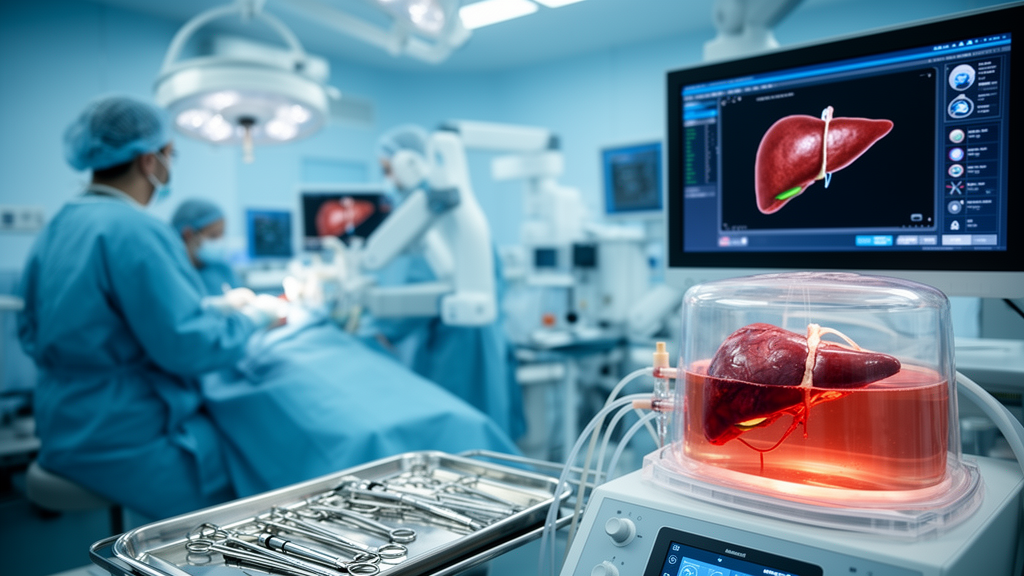
Image Credits: AI Generated
DOI: 10.3389/frtra.2026.1923144
Keywords: liver transplantation, robotic surgery, machine perfusion, artificial intelligence, xenotransplantation, ILTS 2025, transplant oncology, organ donation, Reflections, liver, transplantation, emerging
Cite Scienmag News
Ophelia Keating. (October 16, 2026). Robotic Surgery, Machine Perfusion and AI Converge at Landmark Liver Transplant Congress. Scienmag. https://scienmag.com/robotic-surgery-machine-perfusion-and-ai-converge-at-landmark-liver-transplant-congress/
Ophelia Keating. "Robotic Surgery, Machine Perfusion and AI Converge at Landmark Liver Transplant Congress." Scienmag, 16 October 2026, https://scienmag.com/robotic-surgery-machine-perfusion-and-ai-converge-at-landmark-liver-transplant-congress/. Accessed 16 October 2026.
Ophelia Keating. "Robotic Surgery, Machine Perfusion and AI Converge at Landmark Liver Transplant Congress." Scienmag. October 16, 2026. https://scienmag.com/robotic-surgery-machine-perfusion-and-ai-converge-at-landmark-liver-transplant-congress/


