


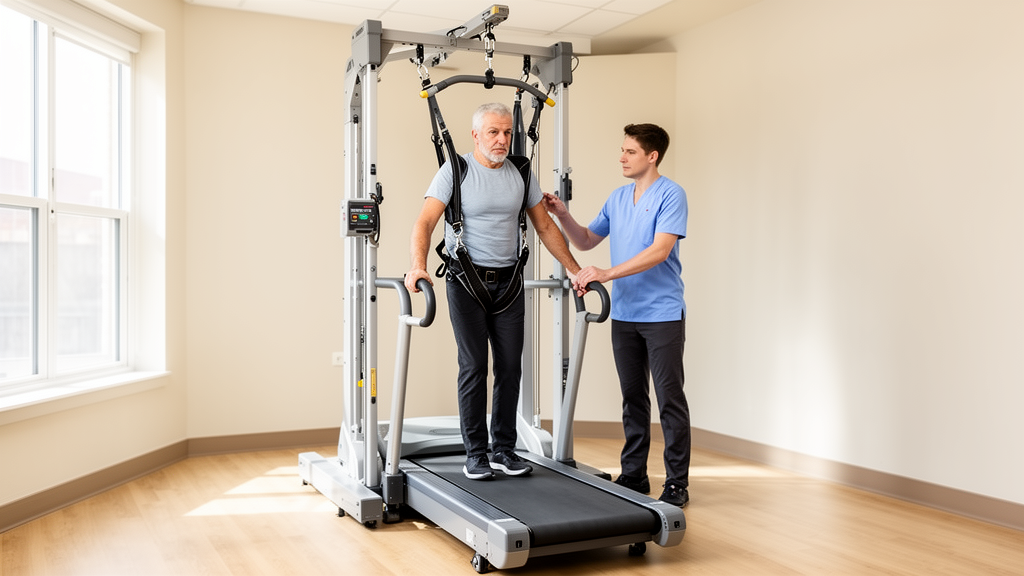
Robotic exoskeletons and gait-training machines have become fixtures of modern stroke rehabilitation, promising thousands of precisely dosed, physiologically informed repetitions that human therapists alone cannot deliver. Yet a sweeping reappraisal of the evidence behind these devices suggests clinicians should temper their enthusiasm: while robot-assisted training appears to genuinely improve balance and lower-limb motor impairment after stroke, the evidence that it helps patients walk farther, faster, or more independently remains surprisingly shaky. The findings, published as an umbrella review in Frontiers in Public Health, offer one of the most rigorous audits to date of what rehabilitation robotics can and cannot claim.
An umbrella review sits at the top of the evidence pyramid: rather than analyzing individual clinical trials, it systematically reappraises existing systematic reviews and meta-analyses, bringing their conclusions into a common framework and grading how much confidence the field can reasonably place in them. A team led by Lei Wang and Ailian Chen at Hunan Provincial People’s Hospital and Hunan Normal University searched seven databases, including PubMed, the Cochrane Library, Embase, Web of Science, and three major Chinese databases, capturing publications up to January 15, 2026. From 405 initially identified articles, only 19 reviews, based exclusively on randomized controlled trials, survived the screening process.
The team then subjected those 19 reviews to three complementary appraisals. Methodological quality was scored with AMSTAR 2, a 16-item instrument whose seven critical items probe issues such as protocol pre-registration, comprehensive searching, and risk-of-bias assessment. Reporting completeness was measured against the 27-item PRISMA 2020 checklist, and the certainty of evidence for each individual outcome was graded with the GRADE framework, which penalizes findings for risk of bias, inconsistency, imprecision, indirectness, and potential publication bias. The review itself was reported under the newer PRIOR guideline for overviews of reviews and prospectively registered on PROSPERO.
The methodological audit revealed a corpus riddled with weaknesses. Only three of the 19 reviews earned a high-quality rating, six were moderate, six were low, and four were critically low, meaning they failed two or more critical AMSTAR 2 criteria. None of the reviews reported the funding sources of the primary studies they synthesized, seven lacked a prespecified registered protocol, and seven disclosed no potential conflicts of interest. Reporting completeness told a similar story: the mean PRISMA 2020 score was 19.1 out of 27, with items on eligibility criteria and the assessment of reporting bias each addressed by barely 5 percent of reviews, and reporting-bias item 21 omitted entirely by every single study.
Primary-study overlap added another layer of complexity. The 19 reviews contained 393 occurrences of primary studies corresponding to just 168 unique trials, yielding a Corrected Coverage Area of 7.44 percent, a moderate degree of overlap. In practical terms, many reviews were re-analyzing substantially the same trial pool, so counts of concordant reviews should not be mistaken for independent replications. Leave-one-review-out analyses confirmed that no single review was driving the overlap estimate.
Against that backdrop, the outcome-level synthesis is revealing. Across 70 extracted outcome measures, not one reached high certainty under GRADE: 20 were moderate, 32 low, and 18 very low, meaning roughly 71 percent of the available outcome evidence was low or very low certainty. The most consistent favorable signals appeared for balance, measured with the Berg Balance Scale, where 17 of 19 reviews reported statistically significant benefits, and for lower-extremity motor function on the Fugl-Meyer Assessment, where 13 of 15 reviews did so. Meta-analyses by Hu and colleagues reported a mean Berg Balance Scale gain of 4.55 points, while Wang and colleagues found a gain of 6.98 points, both statistically robust.
Walking-related outcomes told a far less consistent story. For the Functional Ambulation Category, 10 of 13 reviews reported significant benefits, but the certainty of evidence was mainly low. Walking endurance on the 6-Minute Walk Test was significant in seven of 10 reviews, with some estimates reaching reported minimal clinically important differences of roughly 34 to 71 meters, though certainty ranged from moderate to very low. The Timed Up and Go test was the weakest link: only two of eight reviews found significant improvement, with most reporting no additional benefit over conventional therapy. Gait speed on the 10-Meter Walk Test was favorable in four of five reviews but supported almost entirely by low-certainty evidence.
The authors also emphasize that statistical significance does not automatically translate into clinical importance. Reported benchmarks include Berg Balance Scale minimal clinically important differences of roughly 6.5 to 12.5 points in acute stroke and Fugl-Meyer lower-extremity thresholds of about 3.3 to 4.3 points acutely and about 6 points chronically. Some review-level effect estimates reached these values while others fell short, and confidence intervals sometimes encompassed clinically trivial effects. The dispersion of estimates was striking: for the Berg Balance Scale, one meta-analysis reported an effect of 10.64 points while another reported just 0.05, differences the authors attribute to variation in stroke phase, device class, training dose, comparator intensity, and the composition of included trials.
Technological heterogeneity further complicates generalization. The included reviews spanned mixed robot-assisted gait-training platforms, treadmill-mounted exoskeletons such as the Lokomat, overground exoskeletons, end-effector devices, and even flexible soft exoskeletons, with substantial variation in assistance mode, dose, and comparators. Current evidence does not establish the superiority of any device class, and outcomes most relevant to older adults, such as quality of life, long-term disability, caregiver burden, and sustained community mobility, were not consistently reported. Real-world adoption also hinges on cost, infrastructure, staff training, and equitable access, areas where economic and implementation evidence remains thin.
The authors conclude that robot-assisted training should be regarded as an adjunct whose value depends on patient goals, device characteristics, and local implementation context, rather than a definitively superior therapy. They call for adequately powered, prospectively registered randomized trials with transparent allocation methods and consistent reporting of adverse events, adherence, and longer-term outcomes, alongside standardized documentation of robot type, assistance mode, treatment dose, and stroke stage. A core outcome set spanning motor impairment, walking, activities of daily living, participation, quality of life, and falls, benchmarked against phase-appropriate minimal clinically important differences, would help clarify not only whether robotic rehabilitation works, but which patients benefit most and whether early gains endure.
Subject of Research: An umbrella review of 19 systematic reviews finds robot-assisted training after stroke most consistently improves balance and lower-limb motor function, while walking-related outcomes rest on low-certainty evidence.
Article Title: Robot-assisted training for post-stroke lower-limb dysfunction: an umbrella review
Article References: Wang, L., Wang, C., Cao, Q., Yin, K., Ding, L., & Chen, A. (2026). Robot-assisted training for post-stroke lower-limb dysfunction: an umbrella review. Frontiers in Public Health, 14, Article 1969488. https://doi.org/10.3389/fpubh.2026.1969488
Image Credits: AI Generated
DOI: 10.3389/fpubh.2026.1969488
Keywords: stroke rehabilitation, robot-assisted gait training, umbrella review, AMSTAR 2, GRADE, PRISMA 2020, balance, lower-limb motor function, walking outcomes, exoskeleton, evidence certainty, randomized controlled trials
Cite Scienmag News
Denise Maddox. (October 16, 2026). Robot-assisted training shows promise for post-stroke balance and motor recovery, but walking gains remain uncertain. Scienmag. https://scienmag.com/robot-assisted-training-shows-promise-for-post-stroke-balance-and-motor-recovery-but-walking-gains-remain-uncertain/
Denise Maddox. "Robot-assisted training shows promise for post-stroke balance and motor recovery, but walking gains remain uncertain." Scienmag, 16 October 2026, https://scienmag.com/robot-assisted-training-shows-promise-for-post-stroke-balance-and-motor-recovery-but-walking-gains-remain-uncertain/. Accessed 16 October 2026.
Denise Maddox. "Robot-assisted training shows promise for post-stroke balance and motor recovery, but walking gains remain uncertain." Scienmag. October 16, 2026. https://scienmag.com/robot-assisted-training-shows-promise-for-post-stroke-balance-and-motor-recovery-but-walking-gains-remain-uncertain/


