


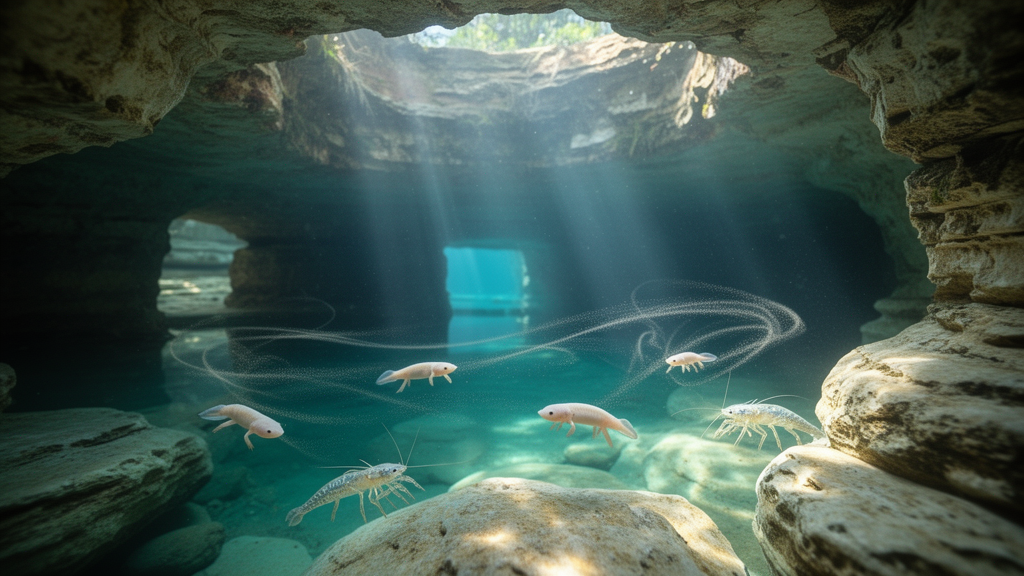
Beneath the surface of the San Marcos River in central Texas, a hidden community of blind, colorless creatures is quietly mapping the boundaries of one of North America’s most remarkable underground ecosystems. A new study published in Subterranean Biology reveals that groundwater-obligate animals, known as stygobionts, do not simply vanish where the limestone karst of the Edwards Aquifer gives way to ordinary riverbed sediments. Instead, they persist in the hyporheic zone, the saturated layer of sand and gravel beneath and alongside the river, with their abundance and diversity shifting in measurable patterns along the river’s length.
The research, led by Kenneth Sparks and Benjamin F. Schwartz of Texas State University, together with colleagues including Safra Altman, Kathryn E. Perez, Zoey B. Chanin, Caroline Mierzejewski, and Benjamin T. Hutchins, set out to answer two deceptively simple questions. First, can the hyporheic zone downstream of karst springs serve as genuine habitat for species typically associated with the Edwards Aquifer itself? Second, how do the richness, diversity, and abundance of these subterranean animals change as one moves away from the spring sources that feed the river?
To address these questions, the team collected 55 samples from 11 sites distributed between 3 and 140 river kilometers downstream of the river’s spring source. At each site, they enumerated the stygobionts present and quantified key environmental characteristics of the hyporheic zone, including water temperature, dissolved oxygen, and hydraulic conductivity, a measure of how easily water moves through the sediment. This combination of biological counts and physical measurements allowed the researchers to test which factors best explain the distribution of life beneath the riverbed.
The Edwards Aquifer is widely recognized as the most biodiverse and intensively studied groundwater habitat in the continental United States, harboring an array of endemic salamanders, fishes, crustaceans, and snails found nowhere else on Earth. Yet the new findings underscore that some Edwards Aquifer-associated species are not confined to the aquifer’s limestone voids. They also occupy the interstitial spaces of river sediments far from the karst margin, blurring the line between groundwater habitat and surface-water ecosystem.
Using linear mixed effects models and variance partitioning, the researchers disentangled the relative influence of environmental filtering and spatial position on stygobiont assemblages. The results were striking. Distance from karst emerged as a significant predictor of both stygobiont richness and diversity, indicating that proximity to the aquifer, and by extension to source populations of subterranean species, shapes the composition of hyporheic communities along the river’s course.
Hydraulic conductivity, meanwhile, proved to be a significant driver of both richness and abundance. This physical parameter reflects the permeability of the riverbed sediments and, by extension, the degree of connectivity between surface water and groundwater. Where water moves freely through the substrate, stygobionts appear to find more favorable conditions, likely because greater exchange brings food, oxygen, and dispersal pathways into the interstitial realm. Conversely, where sediments are tightly packed or dominated by fine particles, the habitat becomes less hospitable to groundwater-adapted fauna.
Despite these significant relationships, the predictive power of the models was low, and additional environmental variables beyond the four focal parameters proved significant in all models. This suggests that the structure of hyporheic stygobiont communities is governed by a complex interplay of factors that current sampling and modeling approaches have not fully captured. The authors note that the study demonstrates stygobiont communities in the hyporheic zone can be structured both by local environmental conditions, through habitat filtering, and to a lesser extent by spatial effects, namely proximity to source populations in adjacent aquifers.
One of the most consequential findings of the study concerns conservation. The authors highlight that habitat specificity is poorly characterized for many stygobiont taxa, which inhibits effective conservation planning and implementation. Without a clear understanding of which microhabitats particular species require, and whether those habitats exist outside the aquifer proper, managers may underestimate the full extent of habitat available to endangered groundwater species or, conversely, fail to protect critical hyporheic refugia that sustain populations during periods of aquifer stress.
The San Marcos River, fed by artesian springs rising from the Edwards Aquifer, offers an ideal natural laboratory for this kind of investigation. Its spring-dominated hydrology means that groundwater discharge continuously influences the river’s chemistry and temperature along its entire length, creating a gradient of conditions that the researchers could sample systematically. The longitudinal design, spanning nearly the full extent of the river from its spring source to points far downstream, allowed the team to detect patterns that would be invisible in isolated spot surveys.
As climate change and increasing groundwater extraction place mounting pressure on the Edwards Aquifer and its dependent ecosystems, studies like this one carry practical urgency. The finding that hyporheic zones can harbor karst-associated stygobionts well beyond the aquifer’s boundaries expands the conceptual map of where these species live and where conservation efforts might need to focus. It also raises new questions about how subsurface communities will respond as spring flows diminish and river sediments are altered by human activity, questions that the authors argue can only be answered with better characterization of stygobiont habitat requirements across the full spectrum of groundwater-influenced environments.
Subject of Research: Longitudinal distribution of stygobiont communities in the hyporheic zone of the karst spring-fed San Marcos River, Texas
Article Title: Longitudinal patterns in stygobiont distribution in the hyporheic zone of the karst spring-fed San Marcos River, Texas, USA
Article References: Longitudinal patterns in stygobiont distribution in the hyporheic zone of the karst spring-fed San Marcos River, Texas, USA. (n.d.). Original publication
Image Credits: AI Generated
DOI: Not provided
Keywords: stygobionts, hyporheic zone, Edwards Aquifer, San Marcos River, karst hydrogeology, groundwater biodiversity, Subterranean Biology, habitat filtering, Longitudinal, patterns, stygobiont, distribution
Cite Scienmag News
Gavin Prescott. (October 16, 2026). Hidden River Life: Groundwater Creatures Trace a Fading Trail From Texas Karst Springs. Scienmag. https://scienmag.com/hidden-river-life-groundwater-creatures-trace-a-fading-trail-from-texas-karst-springs/
Gavin Prescott. "Hidden River Life: Groundwater Creatures Trace a Fading Trail From Texas Karst Springs." Scienmag, 16 October 2026, https://scienmag.com/hidden-river-life-groundwater-creatures-trace-a-fading-trail-from-texas-karst-springs/. Accessed 16 October 2026.
Gavin Prescott. "Hidden River Life: Groundwater Creatures Trace a Fading Trail From Texas Karst Springs." Scienmag. October 16, 2026. https://scienmag.com/hidden-river-life-groundwater-creatures-trace-a-fading-trail-from-texas-karst-springs/


