


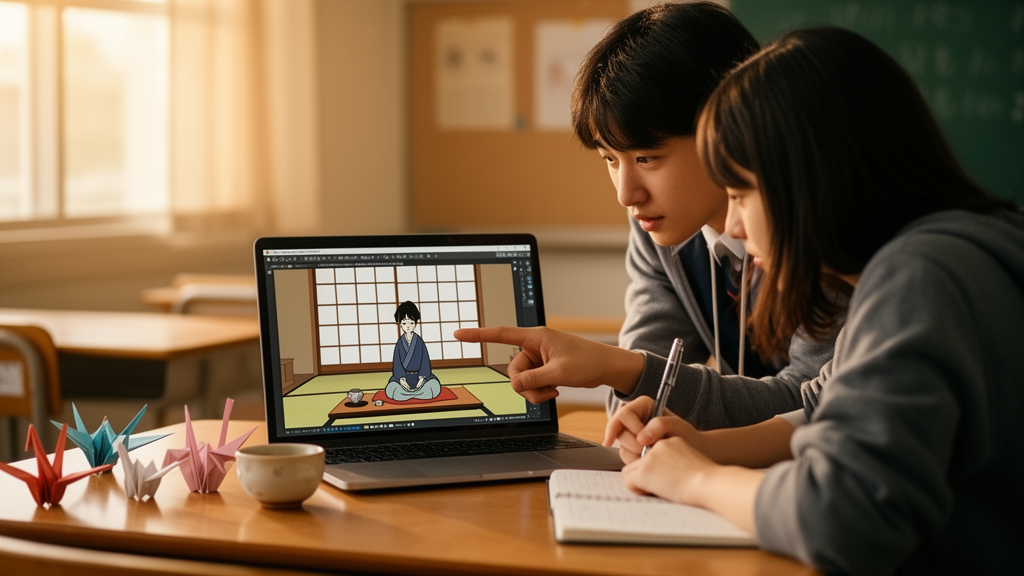
Greetings seem like the simplest part of any language. A quick hello, a handshake, a nod. But a new study argues that some of the world’s greetings carry entire worldviews that English simply cannot carry—and that the tool students use to explore them, whether an AI animation studio or a plain shared document, changes how deeply they come to understand them. The research, published in Frontiers in Computer Science, brought together university students from Norway, India, and Indonesia to exchange three culturally loaded greetings on what the authors call a 3R-Virtual Intercultural Stage.
The three greetings were chosen for their translational stubbornness. The Norwegian Det er hyggelig å møte deg maps relatively neatly onto “nice to meet you,” reflecting an egalitarian culture where pleasantness and social symmetry dominate. The Mising greeting kumríksudung, from a Tibeto-Burman language of Northeast India, is built from kum (pray), ríksu (meet), and dung (a progressive marker), conveying something like “I pray to welcome you into my life”—meeting as a sacred act. The Javanese sugeng, spoken in the high honorific register krama inggil, encodes a wish for the other’s health and aliveness, communal harmony (rukun), and the social rank of the person being addressed. Rendered as “good morning” or “nice to meet you,” the prayer, the hierarchy, and the harmony largely evaporate.
The study’s theoretical backbone is the Dynamic Constructivist Approach, which treats culture not as a fixed identity but as a network of schemas—implicit theories, social scripts, cultural categories—that are selectively triggered by contextual cues. If cultural schemas are activated rather than inherited, the authors reasoned, then a well-designed virtual environment should be able to trigger and re-shape them deliberately. Their 3R-Virtual Intercultural Stage operationalizes this with three dimensions borrowed from social psychology: Role (social positioning, with students acting as both teachers and learners), Rank (hierarchical distance, equalized by treating each greeting as equal linguistic currency in English), and Room (a digitally mediated “Virtual 3rd Space” built on Zoom or Microsoft Teams, designed to neutralize initial social biases).
Thirty-one students from UiT The Arctic University of Norway in Tromsø, Jawaharlal Nehru University in New Delhi, and Universitas Kristen Satya Wacana in Salatiga, Indonesia, formed six mixed cohorts for a two-week exchange. Three cohorts were randomly assigned to an AI-animation group of sixteen students; three to a writing group of fifteen. Both groups met twice online for sessions of sixty to ninety minutes, discussed the same three greetings, and answered the same reflective prompts. The only difference was the medium: the animation group scripted social scenarios for Vyond, a cloud-based animation platform, using ChatGPT-5 to draft scripts that students then revised, while the writing group worked collaboratively in Google Docs.
The Vyond task was deliberately demanding. To animate a greeting, students had to specify a Rank relationship (employer and employee, say), a Role for each avatar (teacher, student, manager), and a Room (a conference hall, a street encounter), then choose gestures, postures, attire, accents, and settings. The authors call this requirement a “Pedagogical Speed Bump”: a structured creative task that intentionally slows learners at the moment of first cultural contact, forcing implicit, embodied knowledge—how close to stand, how low to bow, what to wear—into explicit, decidable parameters. Crucially, the authors attribute the effect to this scaffolding requirement rather than to the software itself, acknowledging that a text task with equivalent parameter demands could in principle produce a similar result.
The reflective data suggest the two media produced genuinely different pathways. Animation-group participants tended to enter the analysis through the body. Confronted with AI-generated avatars that got things wrong, they corrected them using insider knowledge that a written description had never asked for. One Mising participant objected that the animation gave their character a darker skin tone than reality, calling it a generalization toward tribal and minority appearance. A Javanese participant noted the accent “didn’t really feel Javanese” and that the gestures seemed “more Japanese than Javanese,” adding that Javanese speakers typically move little while talking—an implicit social script articulated only because the animation violated it. A Norwegian participant observed that all the characters sounded like they had “kind of an Indian accent,” an outsider’s realization that phonological specificity exists and matters.
Writing-group participants traveled a different route. Without multimodal demands, they entered through the verbal level—pragmatic or semantic—and built toward depth through sustained explanation. One Javanese student mapped which honorific register she used with parents versus grandparents, then admitted the hierarchy was “not totally visible,” before contrasting it with Norwegian egalitarianism. A Mising student described struggling to translate kumríksudung because it carries “a deeper cultural meaning than just hello,” ultimately explaining it through examples instead. A Norwegian participant reported watching partners wrestle with greetings that had “many layers, different levels of respect and a warmth that perhaps is difficult to describe”—a second-hand, intuitive awareness of depth arrived at by witnessing translation fail.
The authors analyzed the reflections through their Equivalent Indigenous Concept Model, which tracks movement across four knowledge dimensions: semantic (dictionary meaning), etic (outsider comparison), pragmatic (context-dependent rules of use), and emic (insider cultural knowledge). Strikingly, participants did not move linearly from surface to depth. Some started with equivalence and worked toward difference; others began with insider experience and moved outward. Both conditions produced self-reports of achieved intercultural understanding, and both produced reflections reaching the emic dimension. The medium, the authors conclude, shaped the process of understanding rather than whether understanding was achieved—functioning not as a delivery method but as a cognitive mediator in its own right.
The study also documents a sobering pattern in generative AI itself. When rendering the three communities, the animation tool defaulted toward dominant cultural referents: Western dress, native-English accents, East Asian gestural conventions. The Mising participant’s skin-tone objection went unraised by Javanese peers about their own depiction, suggesting the bias fell hardest on the least digitally represented community. The authors argue these errors should be treated as a designed-for pedagogical resource—each cohort’s deepest engagement came from correcting the AI—while calling for representational auditing with members of underrepresented linguistic groups in any educational deployment of generative animation.
The authors are candid about limitations. The sample was small, with roughly five participants per language-by-condition cluster, so individual personalities could drive some patterns. The Vyond task took longer than the Google Docs task, facilitators differed between conditions, and coding was done individually by each facilitator without cross-checking. The findings are therefore context-specific to short-term virtual exchanges among university students. Still, the implications reach beyond the classroom. For intercultural pedagogy, the choice of collaborative medium is a cognitive architecture decision, not a logistical one. For indigenous language preservation—UNESCO warns that losing indigenous languages means losing cultural knowledge—the study suggests AI-assisted multimodal environments could keep concepts like kumríksudung alive not as archived artifacts but as living invitations, encountered, puzzled over, and genuinely understood by outsiders on a virtual stage built for exactly that purpose.
Subject of Research: AI-assisted animation versus text-based collaboration in virtual intercultural learning of indigenous greetings
Article Title: AI-assisted animation versus text-based description: divergent pathways to intercultural understanding of Norwegian, Mising, and Javanese greetings on a 3R-virtual intercultural stage
Article References: AI-assisted animation versus text-based description: divergent pathways to intercultural understanding of Norwegian, Mising, and Javanese greetings on a 3R-virtual intercultural stage. (n.d.). https://doi.org/10.3389/fcomp.2026.1939596
Image Credits: AI Generated
DOI: 10.3389/fcomp.2026.1939596
Keywords: intercultural understanding, virtual exchange, COIL, AI animation, indigenous languages, greetings, Mising, Javanese, Norwegian, pedagogy, cultural schemas, Vyond
Cite Scienmag News
Denise Maddox. (October 16, 2026). AI Animation Slows Students Down—and That’s Exactly How They Learn Other Cultures. Scienmag. https://scienmag.com/ai-animation-slows-students-down-and-thats-exactly-how-they-learn-other-cultures/
Denise Maddox. "AI Animation Slows Students Down—and That’s Exactly How They Learn Other Cultures." Scienmag, 16 October 2026, https://scienmag.com/ai-animation-slows-students-down-and-thats-exactly-how-they-learn-other-cultures/. Accessed 16 October 2026.
Denise Maddox. "AI Animation Slows Students Down—and That’s Exactly How They Learn Other Cultures." Scienmag. October 16, 2026. https://scienmag.com/ai-animation-slows-students-down-and-thats-exactly-how-they-learn-other-cultures/


