


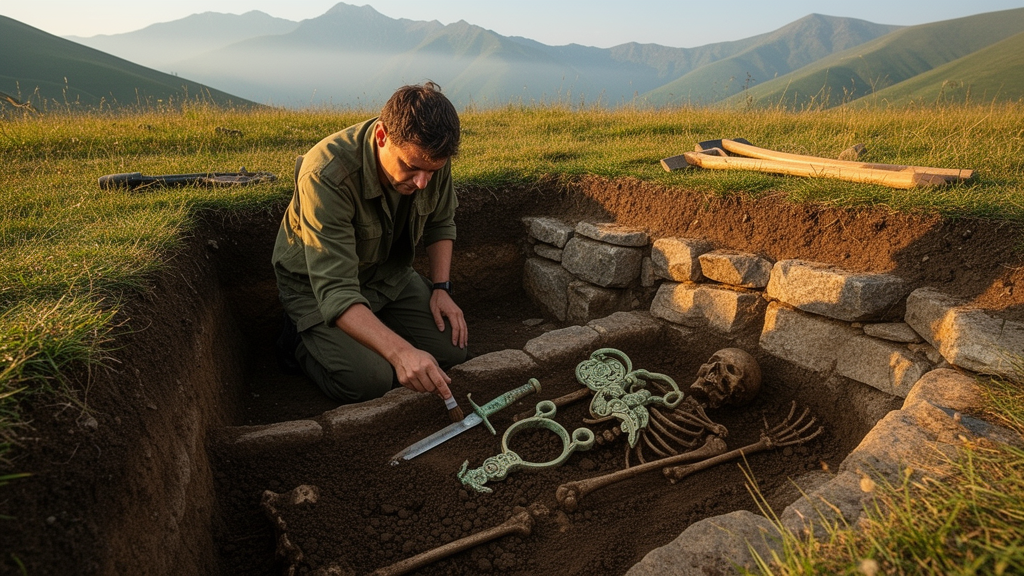
Deep in the Gizeldon gorge of North Ossetia, a burial ground first disturbed by a flood in 1869 has yielded one of its most revealing secrets — not from a new excavation, but from a museum drawer in Vienna. Researchers at the Natural History Museum Vienna have published a detailed analysis of Burial 5 from the famous Koban cemetery, a grave assemblage acquired in the nineteenth century and never before presented to the scientific community. Their typo-chronological study, published in the Annals of the Natural History Museum Vienna, dates the burial to the first half of the seventh century BCE, placing it precisely at the moment when the pre-Scythian world of the Central Caucasus collided with the emerging culture of the early Scythians.
The Koban Culture, flourishing between roughly 1200 and 400 BCE on both sides of the Greater Caucasus Range, is one of the most significant archaeological phenomena of the Late Bronze and Early Iron Ages in the region. Its eponymous cemetery, located about 32 kilometers southwest of Vladikavkaz, gave its name to a culture defined in the nineteenth century through spectacular bronzes adorned with zoomorphic and geometric ornamentation. After the initial discovery by the local landowner Khabosh Kanukov, excavations between 1877 and 1881 by Russian and European scholars — including the renowned Rudolf Virchow and Ernest Chantre — examined more than 25 burials and scattered the finds to museums in Moscow, St. Petersburg, Berlin, Saint-Germain-en-Laye, Lyon, and Vienna.
The Vienna collection owes its existence to Franz Heger, director of the museum’s anthropological and ethnographical department, who undertook scientific missions to the Caucasus in 1881, 1890, and 1891. With the assistance of Vasilij Dolbezhev, a local expert who participated in the Koban excavations for over a decade, Heger assembled more than 30 grave assemblages of extraordinary scientific interest. Many of these burials most probably belonged to elite members of prehistoric society, containing valuable grave goods and costume elements that make the Vienna holdings a key resource for studying the material culture and history of the Caucasus between the twelfth and fourth centuries BCE.
Burial 5 itself was inventoried in 1883 and described by Heger as a male grave. The assemblage contains weapons — a bronze dagger blade, a Scythian-type arrowhead, a richly decorated axe, and a stone mace — alongside tools, jewellery, and pottery. The researchers acknowledge that, without modern documentation, the unity of the inventory must be treated with caution, yet the composition of the finds is consistent with well-documented Koban burials and offers chronological markers of exceptional value.
The weaponry tells a story of technological transition. The bronze dagger belongs to the so-called flame-shaped group with a narrowed middle section, and its features — horizontal shoulders at the transition to the handle, a wide relief rib, and two holes for hilt attachment — mark it as the latest Central Caucasian modification of this type, in use up to the eighth and seventh centuries BCE. The authors also engage critically with existing typologies, noting that Sabine Reinhold’s variant DoC2 bundles daggers ranging from 13.2 to 28 centimeters in length with differing blade shapes, and that errors in her catalogue listings undermine the seriation and chronology built upon them.
The most spectacular object is the bronze axe with a twice-curved body, richly engraved with zoomorphic and geometric imagery. One blade bears two symmetrically arranged predators — presumably dog-wolves — depicted in dynamic running poses with open mouths and bodies filled with chased dots and herringbone patterns. The reverse displays a so-called Maltese cross, a rhombus with nine circles and nested triangles, while the shaft-hole faces carry fish, snakes, and a solar sign of a seven-pointed star within a circle. Such double-curved axes are considered status symbols of the classical Koban Culture, and their latest occurrences coincide with the emergence of early Scythian elements in the Caucasus.
The bronze two-bladed socketed arrowhead of Scythian type is among the rarest finds in the Koban sites of the Central Caucasus, with only two other specimens known from the cemetery. Its closest parallels come from early Scythian sites of the Northern Caucasus, such as Krasnoe Znamya and the Alekseevsky hamlet, dated to the first half through the middle of the seventh century BCE. Together with a fibula bearing two knot-like protrusions and a pendant-amulet in the form of a mountain goat’s head — a motif that replaced the earlier ram-head pendants with the onset of the Scythian period — these artefacts anchor the burial firmly in the first half of the seventh century BCE.
Beyond chronology, the assemblage illuminates far-reaching cultural networks. The Maltese cross motif, the authors argue, spread from the Near East and Transcaucasia into the Central Caucasus and onward to the forest-steppe of the left-bank Dnieper in present-day Ukraine, where it appears on clay ladle handles of the seventh century BCE — a Caucasian route of distribution rather than one via the Basarabi Culture of southeastern Europe. Supporting this hypothesis, bronze pins with heads rolled into tubes of proper Caucasian origin have been found at the same Ukrainian sites as ceramics bearing the cross motif.
The grave goods also speak to social hierarchy. A richly decorated axe and a spherical stone mace — a prestige weapon combining sacred and combat functions, known from only two examples among the several hundred burials of the Tli cemetery — emphasize the high status of the buried person, perhaps a member of the elite. The bronze knife, typologically alien to the Caucasus and tracing its origins to the Northern Pontic and Carpathian-Danubian regions, further testifies to the wide horizons of contact maintained by the mountain communities.
This study opens a planned series of publications on the unpublished Koban materials in Vienna, which will apply interdisciplinary methods including metallographic and XRF analyses, micro-CT scanning of composite objects, radiocarbon dating, and statistical seriation using the Montelius image database and WinSerion software. In the second half of the seventh century BCE, Scythian influence in the Central Caucasus intensified markedly, and local Koban material culture shifted toward increased use of iron. Burial 5, frozen at the threshold of that transformation, offers researchers a rare, precisely datable window into a society on the eve of profound change — and demonstrates that collections assembled more than a century ago can still rewrite the story of the ancient Caucasus.
Subject of Research: Typo-chronological analysis of Burial 5 from the Koban cemetery and the transition from the late pre-Scythian to the early Scythian period in the Central Caucasus
Article Title: Burial 5 of the Koban Necropolis in the Context of the Transition from the late pre-Scythian to the early Scythian Period
Article References: Burial 5 of the Koban Necropolis in the Context of the Transition from the late pre-Scythian to the early Scythian Period. (n.d.). https://doi.org/10.3897/anhmw.169446
Image Credits: AI Generated
DOI: 10.3897/anhmw.169446
Keywords: Koban Culture, Caucasus archaeology, Scythians, Early Iron Age, Bronze Age, Natural History Museum Vienna, burial assemblage, typo-chronology, Franz Heger, North Ossetia, cultural contacts, bronze axe
Cite Scienmag News
Courtney Benton. (October 16, 2026). A 2,700-Year-Old Warrior’s Grave from the Caucasus Reveals the Dawn of the Scythian Age. Scienmag. https://scienmag.com/a-2700-year-old-warriors-grave-from-the-caucasus-reveals-the-dawn-of-the-scythian-age/
Courtney Benton. "A 2,700-Year-Old Warrior’s Grave from the Caucasus Reveals the Dawn of the Scythian Age." Scienmag, 16 October 2026, https://scienmag.com/a-2700-year-old-warriors-grave-from-the-caucasus-reveals-the-dawn-of-the-scythian-age/. Accessed 16 October 2026.
Courtney Benton. "A 2,700-Year-Old Warrior’s Grave from the Caucasus Reveals the Dawn of the Scythian Age." Scienmag. October 16, 2026. https://scienmag.com/a-2700-year-old-warriors-grave-from-the-caucasus-reveals-the-dawn-of-the-scythian-age/


