


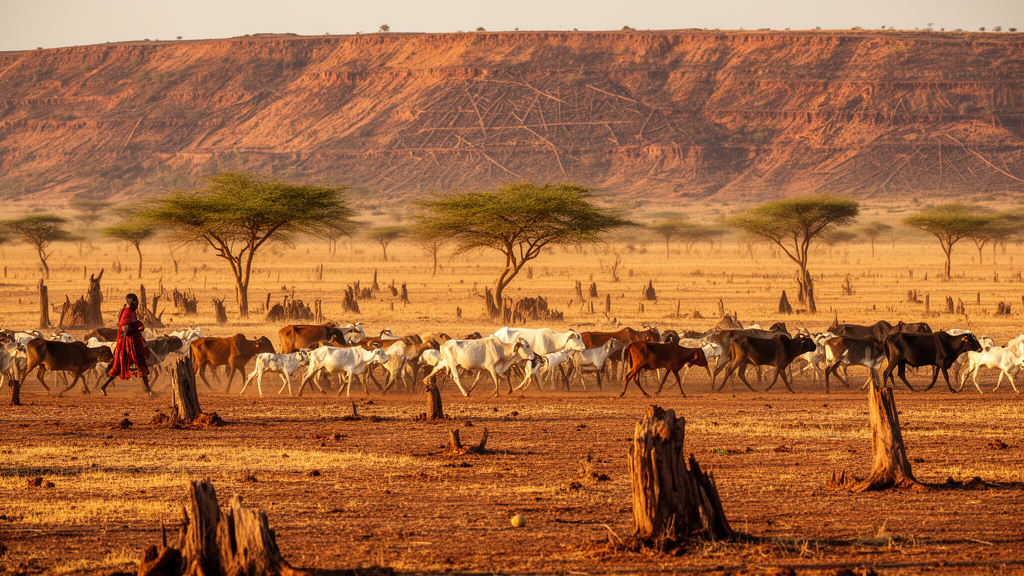
In the arid lowlands of South Omo, Ethiopia, the wildlife that shares the landscape with the Hamer people is quietly disappearing. A new study conducted between January and February 2022 in Hamer District has documented, in unusually detailed statistical terms, how local communities perceive the threats pressing down on wild animal populations outside formal protected areas. The findings, published in the journal BioRisk, reveal a striking paradox: residents overwhelmingly report that wildlife is vanishing around them, yet more than nine in ten say they are willing to join conservation efforts if given the chance.
The research team surveyed 96 households across four kebeles, the lowest administrative units in the district, chosen in consultation with biodiversity experts for accessibility and security. Respondents were interviewed at home using a pre-tested, semi-structured questionnaire translated into the local language, Hameregna, with a native-speaking interpreter present. The survey was complemented by three focus group discussions involving community leaders, youths, women, administrators, and agricultural experts, as well as direct field observations by the researchers. Sample size was calculated with the Yamane formula at a 95 percent confidence level, and the data were analyzed with descriptive statistics, Pearson chi-squared tests, and multiple linear regression using SPSS version 25.
The demographic profile of the respondents underscores how closely tied the district’s fortunes are to traditional livelihoods. Nearly 88.5 percent of those interviewed were pastoralists or agro-pastoralists, herding cattle, goats, and sheep while cultivating sorghum and selling honey. Almost 91 percent had no formal education, and most were married and between 40 and 60 years old. Every respondent was a native of the area, many with decades of residence, giving them a long-term view of ecological change that few external observers could match.
That view is bleak. About 82.3 percent of respondents said wildlife populations in their vicinity are decreasing, and only 1.1 percent reported any increase. These perceptions differed significantly across the four sampled kebeles, with a chi-squared statistic of 44.152 on three degrees of freedom and a p-value below 0.001, suggesting that the intensity of pressure varies locally even within a single district. The remaining respondents either saw no change or were uncertain, but the overall signal of decline was unmistakable.
When asked to rank ten principal threats, respondents placed deforestation, driven by settlement expansion and charcoal production, at the top: 63.5 percent named it the primary threat. Overgrazing came second, ranked first by 30.2 percent and second by 50 percent. Agricultural land expansion and illegal hunting followed in the middle tiers, while human-wildlife conflict was ranked only seventh by most respondents, at 65.6 percent. Human-induced fire, observed directly by the researchers during field visits, also emerged as a significant pressure, with communities deliberately burning habitat to clear land for farming, settlement, and honey collection.
The ecological logic behind these rankings is well supported by broader research. Agriculture is responsible for roughly 96 percent of deforestation in Ethiopia, and long-term data from western Ethiopian agroecosystems show forest cover shrinking at an annual rate of 2.05 percent. In pastoralist regions, the problem intensifies during drought, when herders may travel more than 45 kilometers in search of fodder and water, pushing livestock deep into wildlife habitat. In Hamer District, grazing lands are not allocated seasonally and enclosures are not established for dry periods, so competition between cattle and wild herbivores for forage and water becomes acute precisely when animals are most vulnerable.
Hunting for bush meat, traditional medicine, ivory, and decorative materials adds a further layer of pressure. Respondents listed a range of species used by local communities, including buffalo, warthog, dik-dik, elephant, leopard, lesser kudu, guinea fowl, and francolins, with colobus monkey skins used for decoration and python parts for traditional medicine. Alarmingly, the local existence of giraffes and ostriches is now uncertain. The pattern mirrors national and regional trends: Ethiopia has lost an estimated 90 percent of its elephants since the 1980s, largely to ivory poaching, while the illegal trade in live cheetah cubs remains a major threat across the Horn of Africa. Notably, no respondent identified zoonotic diseases as a threat, despite earlier studies documenting bovine tuberculosis and trypanosomiasis in the area, a gap the authors attribute to distance from the Murule Controlled Hunting Area or limited local awareness.
Against this backdrop of decline, the willingness of the community to act is the study’s most hopeful finding. Fully 90.6 percent of respondents said they would participate in wildlife conservation activities, and 99 percent agreed that conservation work in the district is urgent. Nearly 97 percent said local communities themselves bear responsibility for protecting wildlife, with only a handful pointing to NGOs or broader coalitions of stakeholders. The regression models revealed that willingness was significantly predicted by kebele of residence, sex, marital status, and years of residency, with standardized coefficients of -0.102, -0.544, -0.378, and 0.324 respectively. Education and occupation, by contrast, were not significant predictors, suggesting that long attachment to the land and lived experience of ecological change matter more than formal schooling in shaping conservation attitudes.
The authors attribute this goodwill to the tangible benefits communities derive from the landscape. The Buska Forest, one of the last substantial forest patches in the district, serves as a drought refuge for livestock and supplies medicinal, cultural, and economic resources, from honey to materials used in ceremonies such as bull jumping and the Ivangadi dance. Comparable studies around Awash National Park in Ethiopia and Kruger National Park in South Africa have found similar positive attitudes where protected habitats provide dry-season grazing, water, and non-consumptive value. Retaining that goodwill, the researchers argue, depends on delivering practical alternatives: managed livestock husbandry, alternative grazing lands, and artificial water ponds that can serve both cattle and wildlife during droughts.
The study’s recommendations extend to community-based conservation, ecotourism development, and stronger law enforcement to halt illegal hunting and habitat clearing. The authors also call for additional seasonal research to document the district’s wildlife diversity and assess its ecotourism potential, noting that most biodiversity exists outside protected areas where conservation attention is thinnest. With extinction rates currently estimated at a thousand times the background rate recorded in the fossil record, the Hamer District offers a case study in both the scale of the challenge and the potential of community-led solutions. If the pastoralists who share this landscape with its last giraffes, kudu, and colobus monkeys are equipped to manage grazing and benefit from standing wildlife, the survey suggests they are ready to become its most committed guardians.
Subject of Research: Anthropogenic threats to wildlife and community conservation willingness in Hamer District, South Omo, Ethiopia
Article Title: Anthropogenic threats and challenges of wildlife conservation in Hamer District, South Omo, Ethiopia
Article References: Anthropogenic threats and challenges of wildlife conservation in Hamer District, South Omo, Ethiopia. (n.d.). https://doi.org/10.3897/biorisk.24.175449
Image Credits: AI Generated
DOI: 10.3897/biorisk.24.175449
Keywords: Ethiopia, wildlife conservation, deforestation, overgrazing, pastoralism, South Omo, bushmeat, human-wildlife conflict, community conservation, Buska Forest, ecotourism, habitat loss
Cite Scienmag News
Margaret Porter. (October 16, 2026). Deforestation and Overgrazing Drive Wildlife Decline in Ethiopia’s Hamer District, Survey Finds. Scienmag. https://scienmag.com/deforestation-and-overgrazing-drive-wildlife-decline-in-ethiopias-hamer-district-survey-finds/
Margaret Porter. "Deforestation and Overgrazing Drive Wildlife Decline in Ethiopia’s Hamer District, Survey Finds." Scienmag, 16 October 2026, https://scienmag.com/deforestation-and-overgrazing-drive-wildlife-decline-in-ethiopias-hamer-district-survey-finds/. Accessed 16 October 2026.
Margaret Porter. "Deforestation and Overgrazing Drive Wildlife Decline in Ethiopia’s Hamer District, Survey Finds." Scienmag. October 16, 2026. https://scienmag.com/deforestation-and-overgrazing-drive-wildlife-decline-in-ethiopias-hamer-district-survey-finds/


