


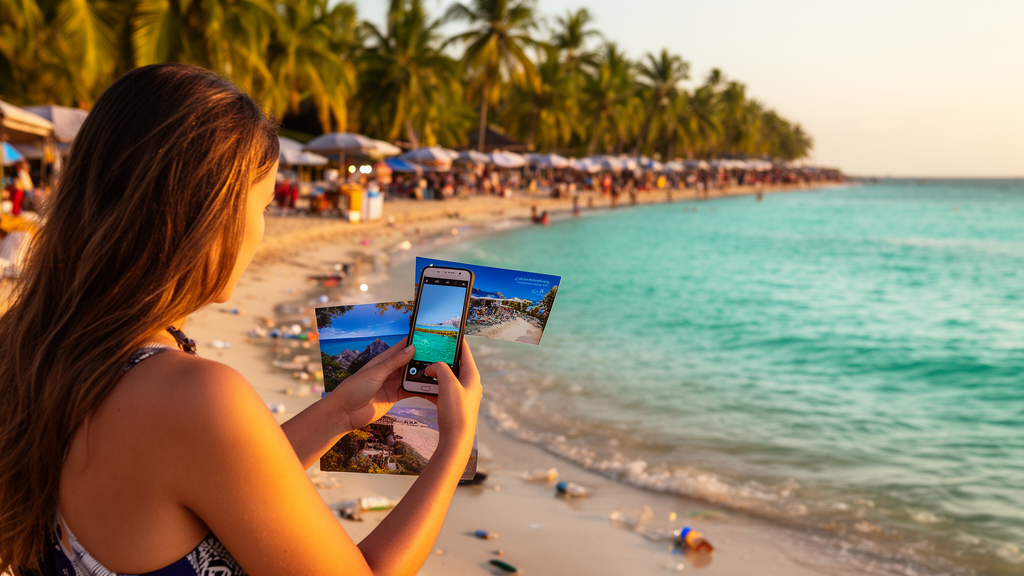
Sanya, the tropical resort city on China’s southernmost island of Hainan, has spent more than a decade cultivating a carefully polished image: turquoise bays, luxury resorts, and a coastline marketed as the country’s answer to Hawaii. But a new study published in PLOS ONE suggests that the picture promoted by official tourism channels and the picture painted by tourists themselves have been drifting apart, and that the gap widened dramatically during the COVID-19 pandemic. Using a statistical framework borrowed from compositional data analysis, researchers Xueli Li, Jianlan Ding, Yina Zhang, and Tao Hu quantified just how far apart these competing narratives really are, and their numbers reveal a structural dissonance that grew by more than a factor of two between the pre-pandemic and pandemic years.
The research tackles a problem that has long frustrated destination marketers: different groups tell different stories about the same place. Press Generated Content, or PGC, includes the travel journalism and professional media coverage that shapes how potential visitors imagine a destination. Tourist Generated Content, or TGC, captures what actual visitors post on social platforms after their trips, reflecting lived experience rather than marketing intent. Official Generated Content, or OGC, represents the messaging produced by government and institutional bodies responsible for promoting the city. When these three narrative systems align, a destination’s image is coherent and persuasive. When they diverge, tourists may arrive with expectations that the reality on the ground cannot meet, a phenomenon the researchers call destination image dissonance.
To measure this dissonance rigorously, the team analyzed content produced between 2013 and 2022, splitting the decade into a pre-pandemic phase from 2013 to 2019 and a pandemic-affected phase from 2020 to 2022. The methodological centerpiece is the Aitchison distance, a metric designed for compositional data, where values are expressed as proportions of a whole and must be interpreted relative to one another rather than in absolute terms. Ordinary distance measures can mislead when applied to such data, but the Aitchison distance respects the geometry of the simplex, the mathematical space in which compositional vectors live. This allowed the researchers to compute a single number that captures how structurally different the official narrative is from the tourist narrative in any given period.
The results are striking. In the pre-pandemic years, the Aitchison distance between official and tourist narratives stood at 19.574. During the pandemic-impacted phase, it jumped to 40.648, more than doubling. This means that the structural gap between what institutions were saying about Sanya and what tourists were actually experiencing and sharing became far more pronounced amid the disruption of COVID-19. The finding suggests that public health crises do not merely reduce tourism volumes; they can fundamentally reshape the relationship between institutional promotion and on-the-ground practice, pushing the two narrative systems further apart precisely when coordinated communication matters most.
The researchers examined the divergence across three dimensions: cognitive, spatial, and affective. On the cognitive dimension, they found notable consistency in one area, tourism and hotels, where all three content types converged on similar themes. But beyond that shared ground, the narratives split. Tourist Generated Content gravitated toward coastal scenery and food, the sensory and experiential elements that dominate personal travel storytelling. Press Generated Content and Official Generated Content, by contrast, emphasized policy elements, reflecting the priorities of institutions that frame tourism in terms of governance, planning, and economic strategy. This split reveals a fundamental difference in what each narrative system considers worth talking about when describing the same city.
The spatial dimension produced perhaps the most consequential finding. The study documented a misalignment between policy-driven spaces, the areas and developments that official narratives highlight, and the spaces tourists actually prefer and write about. This is not a trivial mismatch of emphasis but a systematic dissonance between institutional promotion and on-the-ground practices. When the places being marketed diverge from the places visitors actually value and occupy, the resulting experience can feel like a bait-and-switch, eroding trust and dampening the likelihood of return visits or positive word-of-mouth recommendations.
On the affective dimension, the study found that the emotion of enjoyment and romance dominated across content types, reinforcing Sanya’s positioning as a honeymoon and leisure paradise. Yet beneath this shared emotional vocabulary, the researchers identified a deeper asymmetry. Tourist Generated Content expressed unmet needs, surfacing complaints and disappointments that the glossy promotional picture does not accommodate. Official Generated Content, meanwhile, tended to suppress negative elements, presenting a curated emotional landscape that filters out friction. This dynamic means that the affective gap is not merely a difference in tone but a difference in what is permitted to exist within each narrative system at all.
The implications extend well beyond Sanya. Destination image research has long recognized that images are constructed through multiple channels, but quantifying the divergence between those channels has been methodologically difficult. By applying compositional data analysis and the Aitchison distance to cross-media representations, the study offers a template that other destinations could adopt to diagnose their own narrative health. A city that discovers its official and tourist narratives are drifting apart has an early-warning signal, one that can trigger targeted interventions before the gap translates into reputational damage or declining visitor satisfaction.
The researchers propose targeted strategies to narrow the discrepancies they measured. While the specifics of those strategies are grounded in the Sanya case, the underlying logic is broadly applicable: institutions need to listen to what tourists actually say, not just broadcast what they want tourists to hear. Closing the gap requires incorporating tourist-generated insights into official messaging, aligning promoted spaces with the places visitors genuinely value, and allowing official narratives to acknowledge imperfections rather than suppressing them. In an era where a single viral post can reshape perceptions faster than any advertising campaign, the cost of narrative dissonance has never been higher.
The pandemic years serve as a natural experiment in how crises stress-test the relationship between institutions and the publics they serve. That the Aitchison distance more than doubled during COVID-19 suggests that disruption amplifies pre-existing fractures rather than creating new ones. For Sanya, the findings arrive at a pivotal moment as the city works to rebuild its tourism economy. For destination researchers and marketers everywhere, the study demonstrates that the health of a destination’s image can be measured, monitored, and managed, provided the right mathematical tools are pointed at the right streams of content. The postcard, it turns out, is only as strong as the distance between it and reality.
Subject of Research: Measuring divergence between official, press, and tourist narratives of Sanya's tourism image using compositional data analysis
Article Title: Measuring destination image dissonance: A compositional data analysis of cross-media representations in Sanya’s Tourism
Article References: Li, X., Ding, J., Zhang, Y., & Hu, T. (2026). Measuring destination image dissonance: A compositional data analysis of cross-media representations in Sanya’s Tourism. PLOS One, 21(10), e0360383. https://doi.org/10.1371/journal.pone.0360383
Image Credits: AI Generated
DOI: 10.1371/journal.pone.0360383
Keywords: destination image, compositional data analysis, Aitchison distance, Sanya, tourism marketing, COVID-19, social media, tourist generated content, official generated content, narrative dissonance, Hainan, PLOS ONE
Cite Scienmag News
Kristina Jarvis. (October 16, 2026). How Sanya’s Postcard Image Diverges From What Tourists Actually Say Online. Scienmag. https://scienmag.com/how-sanyas-postcard-image-diverges-from-what-tourists-actually-say-online/
Kristina Jarvis. "How Sanya’s Postcard Image Diverges From What Tourists Actually Say Online." Scienmag, 16 October 2026, https://scienmag.com/how-sanyas-postcard-image-diverges-from-what-tourists-actually-say-online/. Accessed 16 October 2026.
Kristina Jarvis. "How Sanya’s Postcard Image Diverges From What Tourists Actually Say Online." Scienmag. October 16, 2026. https://scienmag.com/how-sanyas-postcard-image-diverges-from-what-tourists-actually-say-online/


