


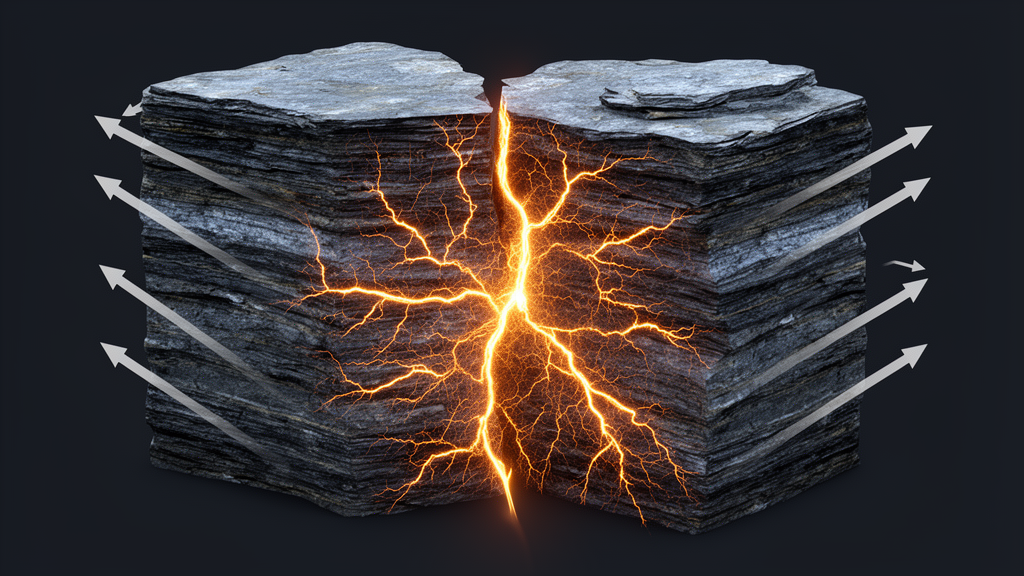
Beneath the rolling hills of the Yongchuan area in southern China’s Sichuan Basin, a remarkable natural experiment has been running for hundreds of millions of years. The same layer of black shale, deposited in a deep-water ocean during the transition from the Ordovician to the Silurian period, has been bent, folded, and fractured by tectonic forces to very different degrees depending on where you look. A new study published in Frontiers in Earth Science shows that these differences in structural deformation are not merely cosmetic. They fundamentally reorganize the microscopic pore networks that store shale gas, changing everything from pore geometry to the fractal complexity of the entire reservoir, and in doing so they control where gas accumulates and how easily it can escape.
The research, led by Xiaoxia Dong and Nanxi Zhang of Sinopec Southwest Oil & Gas Company together with colleagues at Chengdu University of Technology, focused on the first member of the Lower Silurian Longmaxi Formation, one of China’s most important shale gas targets. The team collected 27 shale samples from seven core drilling wells that span a striking range of structural settings: quiet, gently folded synclines; fault-bounded uplifted blocks; clamped fault blocks squeezed between reverse faults; low-amplitude anticlines; and intensely deformed anticlines. Because the samples come from the same stratigraphic interval, differences in their microscopic fabric can be attributed largely to deformation intensity rather than to original depositional variation, making the dataset an unusually clean test of how tectonics sculpts a reservoir.
The analytical toolkit combined several complementary techniques. X-ray diffraction quantified the mineral composition of each sample, petrographic thin sections and field-emission scanning electron microscopy revealed pore types at scales down to a few nanometers, overburden porosity and permeability measurements characterized the bulk flow properties, and low-temperature nitrogen adsorption experiments mapped the distribution of pore sizes. On top of these measurements, the researchers applied the Frenkel-Halsey-Hill fractal model to the adsorption data, extracting two fractal dimensions that describe, respectively, the roughness of pore surfaces at low relative pressure and the complexity of the pore network at high relative pressure. Fractal dimensions near 2 indicate smooth, regular pore systems, while values approaching 3 signal rough, tortuous, highly heterogeneous networks.
The geochemical results confirm that the Yongchuan shale is a genuinely world-class source rock. Total organic carbon content ranges from 2.8 to 6.2 percent, averaging 4.9 percent, and vitrinite reflectance values between 2.65 and 3.02 percent place the organic matter firmly in the over-mature dry gas window. The rock is dominated by quartz, with contents spanning 29.0 to 72.8 percent, and contains relatively modest amounts of clay minerals, between 7.8 and 37.0 percent. Brittle minerals such as quartz and feldspar average 60.5 percent of the whole rock, yielding a brittleness index that ranges from 55.4 to 89.0 percent. In practical terms, this is a stiff, glassy shale that fractures readily under stress, which is precisely the property that allows tectonic forces to leave such a deep imprint on its internal architecture.
Under the scanning electron microscope, the contrast between weakly and strongly deformed areas is dramatic. In the syncline areas, where deformation is minimal, the pore system is dominated by honeycomb-like organic matter pores, typically a few nanometers to tens of nanometers across, with spherical and elliptical shapes and only sparse, small laminar cracks along bedding planes. In the anticlines, fault uplift areas, and clamped fault blocks, the picture changes completely. Organic pores are less abundant and often deformed or compacted, while inorganic pores, clay-mineral interlayer pores, dissolution pores, and a rich suite of microfractures take center stage. Three crack types appear: laminar cracks along bedding, abnormally high-pressure cracks opened by overpressured fluids, and tectonic cracks generated directly by structural stress. The abundance of tectonic cracks rises in step with deformation intensity, mirroring the fractures visible in the drill cores.
Quantitative measurements reinforce the visual story. Overall porosity ranges from 2.13 to 5.28 percent and permeability from 0.0002 to 0.4209 millidarcys, marking a classic low-porosity, low-permeability reservoir. Yet the ranking of structural units is revealing: the clamped fault block area shows the highest average porosity and by far the highest permeability, while the gently deformed synclines sit at the opposite end of the permeability spectrum. Nitrogen adsorption curves are type II with H3 and H4 hysteresis loops, indicating wedge-shaped, slit-like, and parallel-plate pores. Pore size distributions are double-peaked, with a dominant peak in the micropore range around 1 to 2 nanometers. In the synclines, micropores average 28.7 percent of the pore volume and macropores a mere 2.9 percent; in the anticlines, macropores balloon to an average of 17.4 percent while micropores shrink to 12.9 percent, clear evidence that compression has squeezed small pores into larger ones.
The fractal analysis delivers the study’s most elegant insight. Across all samples, the surface fractal dimension D1 ranges from 2.5528 to 2.7158 and the structural fractal dimension D2 from 2.8219 to 2.9285, with D2 consistently higher, meaning the larger seepage pores are more structurally complex than the tiny adsorption pores. The fault uplift area records the roughest surfaces and the most intricate pore networks, while the low-amplitude anticline area is the most homogeneous. Crucially, the factors controlling fractal dimension shift with deformation style. In synclines, pore complexity is largely decoupled from organic carbon and clay content, whereas in anticlines it correlates positively with both, and in fault blocks the relationships invert again. Structural deformation, in other words, does not just damage pores one by one; it rewrites the statistical rules governing the whole pore system.
These microscopic differences translate directly into gas behavior. Total gas content across the study area spans 2.57 to 7.86 cubic centimeters per gram, and the ranking by unit is striking: the low-amplitude anticline area averages 7.2 cubic centimeters per gram, more than double the syncline average of 3.51. Correlation analysis shows that gas content tracks organic carbon positively in the synclines, fault blocks, and low-amplitude anticlines, but negatively in the intense anticlines, where the authors infer that free gas escapes along open fractures. The balance between adsorbed gas held on pore surfaces and free gas stored in larger voids also flips with deformation: free gas fractions rise steadily from syncline to anticline as fractures and macropores proliferate, while adsorbed gas declines. Moderate deformation therefore boosts storage and flow, but excessive deformation opens escape routes that drain the reservoir, which the authors suggest may explain disappointing production from some anticlinal wells.
Synthesizing these observations, the team proposes a differential evolution model that reads almost like a metamorphic pathway for pore systems. As deformation intensity increases, the dominant pore type shifts from organic matter pores to an organic-clay composite pore-fracture system; macropore proportions climb, micropore proportions fall, and the gas phase migrates from adsorbed to free. The authors argue that this coupling between deformation intensity and pore evolution is not a local curiosity but a general principle, citing consistent patterns from the Qiongzhusi Formation in Yunnan, the Permian Basin in India, and the Newark Basin in the United States. For explorers, the practical message is to map deformation intensity as a primary reservoir variable and to target the sweet spot where deformation is strong enough to enhance permeability and free gas storage, but not so strong that the gas has already slipped away through fractures.
Subject of Research: Effects of differential structural deformation on pore structure, fractal characteristics, and gas enrichment in Longmaxi Formation shale reservoirs
Article Title: Influence of differential structural deformation on pore structure and fractal characteristics of shale reservoirs: a case study of the Longmaxi Formation in the Yongchuan area, South Sichuan Basin
Article References: Influence of differential structural deformation on pore structure and fractal characteristics of shale reservoirs: a case study of the Longmaxi Formation in the Yongchuan area, South Sichuan Basin. (n.d.). https://doi.org/10.3389/feart.2026.1901814
Image Credits: AI Generated
DOI: 10.3389/feart.2026.1901814
Keywords: shale gas, Longmaxi Formation, Sichuan Basin, structural deformation, pore structure, fractal dimension, nitrogen adsorption, scanning electron microscopy, organic matter pores, microfractures, gas content, reservoir characterization
Cite Scienmag News
Violet Maxwell. (October 16, 2026). Squeezed, Fractured, and Fractal: How Tectonic Stress Reshapes Shale Gas Reservoirs. Scienmag. https://scienmag.com/squeezed-fractured-and-fractal-how-tectonic-stress-reshapes-shale-gas-reservoirs/
Violet Maxwell. "Squeezed, Fractured, and Fractal: How Tectonic Stress Reshapes Shale Gas Reservoirs." Scienmag, 16 October 2026, https://scienmag.com/squeezed-fractured-and-fractal-how-tectonic-stress-reshapes-shale-gas-reservoirs/. Accessed 16 October 2026.
Violet Maxwell. "Squeezed, Fractured, and Fractal: How Tectonic Stress Reshapes Shale Gas Reservoirs." Scienmag. October 16, 2026. https://scienmag.com/squeezed-fractured-and-fractal-how-tectonic-stress-reshapes-shale-gas-reservoirs/


