


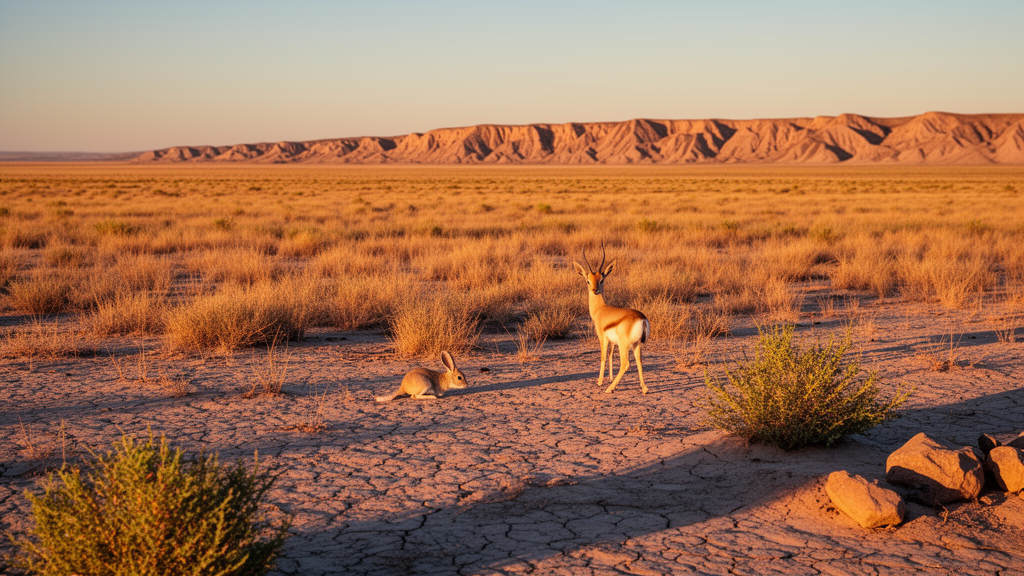
China’s vast arid and semi-arid belt, stretching from the deserts of Xinjiang across the Mongolian steppe to the fringes of the Tibetan Plateau, has long been treated as a biodiversity afterthought compared with the species-rich forests of the south. A new study published in Frontiers of Biogeography upends that assumption. Although the country’s drylands contain only about one-third of its mammal species, they hold 52 percent of China’s mammal phylogenetic diversity—the accumulated branch length of the mammal tree of life—and a remarkable 85 percent of its functional diversity, the variety of ecological roles that mammals perform. The findings suggest that conservation maps drawn from species counts alone may be protecting the wrong places.
The research team, working at the scale of 96 prefecture-level cities that overlap China’s drylands, compiled distribution records for 249 terrestrial mammal species from regional faunas and expert surveys, yielding more than 3,000 presence records. Rather than stopping at species richness, the researchers quantified three distinct dimensions of biodiversity for every prefecture: taxonomic diversity, phylogenetic diversity measured as the total evolutionary branch length connecting the species present, and functional diversity measured from a dendrogram built on five key traits—body mass, diet, litter size, habitat breadth, and activity time. They then linked each metric to modern climate, climate change since the Last Glacial Maximum roughly 21,000 years ago, elevation range, land-use change, and plant species richness.
The spatial results were striking. Taxonomic diversity peaked in the northwest of the study region, phylogenetic diversity in the southeast, and functional diversity in the southwest. Meanwhile, assemblages in the northeast showed the most clustered phylogenetic and functional structures, a statistical signature of strong environmental filtering that limits the range of lineages and traits able to persist there. These mismatches mean that a prefecture teeming with species is not necessarily a reservoir of evolutionary history or ecological function, and vice versa—a conclusion with direct consequences for where reserves should be placed.
To untangle the drivers behind these patterns, the team used spatial autoregressive models that account for the geographic autocorrelation inherent in ecological data, comparing all candidate subsets of eight explanatory variables and averaging the best-supported models by Akaike’s information criterion. Plant species richness emerged as the single most important predictor of taxonomic diversity, consistent with the food resource diversity hypothesis: richer plant communities support more herbivores directly and, indirectly, more insects and prey for insectivores and carnivores, allowing mammals with different feeding niches to coexist.
Climate left its mark in more subtle and sometimes counterintuitive ways. Annual precipitation was significantly negatively correlated with species richness, an unexpected result the authors attribute partly to the coarse administrative grain of the analysis and partly to the fact that low-precipitation deserts harbor specialized arid-adapted species such as the wild camel, Yarkand hare, goitered gazelle, and long-eared jerboa. More intriguingly, taxonomic diversity increased with glacial–interglacial precipitation change: places that became wetter since the Last Glacial Maximum now support more species, likely because historical moisture gains boosted primary productivity and expanded suitable habitat, enabling persistence, range expansion, and postglacial recolonization.
Phylogenetic diversity told a different story. Its two leading predictors were land-use change between 1900 and 1950 and mean annual temperature. The positive association with early twentieth-century land-use change surprised the researchers, but the explanation is plausible: before mechanized agriculture transformed the region, land conversion consisted of small-scale cultivation, seasonal grazing, and traditional agropastoral mosaics that diversified habitat types, echoing the intermediate disturbance hypothesis. Warmer modern temperatures, meanwhile, align with the tropical niche conservatism hypothesis—most mammal lineages evolved in warm climates, and warmer conditions relax the cold filter that excludes evolutionarily distinct lineages from drylands.
Functional diversity, the dimension in which China’s drylands are most disproportionately rich, was shaped by glacial–interglacial precipitation change, elevation range, and annual precipitation. Larger elevation ranges provide more niches and habitat types, while greater water availability supports more food resources and shelters. Functional structure was also positively correlated with precipitation and elevation range, indicating that drier, more homogeneous environments filter assemblages toward functionally clustered communities dominated by drought-tolerant strategies. Phylogenetic structure, by contrast, was most strongly associated with early land-use change, suggesting that historically heterogeneous landscapes allowed distantly related species to partition resources and reduce competition.
The conservation implications are urgent. Of the 249 species recorded, 14 are critically endangered, 17 endangered, 20 vulnerable, and 48 near-threatened according to the Red List of Chinese Vertebrates. Yet the current national nature reserve network appears poorly aligned with multidimensional diversity: among prefectures in the top 20 percent for phylogenetic diversity, every single one had less than 10 percent of its area covered by national nature reserves, and 74 of the 96 prefectures overall fell below that threshold. Hotspots of species richness, evolutionary history, and ecological function barely overlap, so reserves sited on species counts alone systematically miss the drylands’ greatest evolutionary and functional assets.
The authors acknowledge limitations, including reliance on regional faunal records rather than recent monitoring data and the use of administrative units rather than ecological grid cells, but they argue that expert-compiled prefecture-level data remain more reliable than coarse global range maps, which can overestimate distributions substantially. The study provides fresh empirical support for classical biodiversity hypotheses—tropical niche conservatism, environmental heterogeneity, and food resource diversity—while pointing toward practical solutions: restoring native vegetation to buffer climate impacts, and recognizing that moderate, traditional land-use mosaics can sustain phylogenetic diversity in ways that intensive modern conversion cannot. As climate change intensifies across Central Asia’s drylands, protecting the full spectrum of mammal diversity, not just its species tally, may determine whether these fragile ecosystems retain the evolutionary and functional machinery that keeps them alive.
Subject of Research: Climatic, ecological, and anthropogenic drivers of mammal diversity in arid and semi-arid regions of China
Article Title: Climatic, ecological, and anthropogenic drivers of mammal diversity in arid and semi-arid regions of China
Article References: Climatic, ecological, and anthropogenic drivers of mammal diversity in arid and semi-arid regions of China. (n.d.). https://doi.org/10.21425/fob.19.187583
Image Credits: AI Generated
Keywords: Climatic, ecological, anthropogenic, drivers, mammal, diversity, arid, semi-arid, regions, China, scientific research
Cite Scienmag News
Gavin Prescott. (October 16, 2026). China’s drylands hide most of the nation’s mammal evolutionary and functional diversity. Scienmag. https://scienmag.com/chinas-drylands-hide-most-of-the-nations-mammal-evolutionary-and-functional-diversity/
Gavin Prescott. "China’s drylands hide most of the nation’s mammal evolutionary and functional diversity." Scienmag, 16 October 2026, https://scienmag.com/chinas-drylands-hide-most-of-the-nations-mammal-evolutionary-and-functional-diversity/. Accessed 16 October 2026.
Gavin Prescott. "China’s drylands hide most of the nation’s mammal evolutionary and functional diversity." Scienmag. October 16, 2026. https://scienmag.com/chinas-drylands-hide-most-of-the-nations-mammal-evolutionary-and-functional-diversity/


