


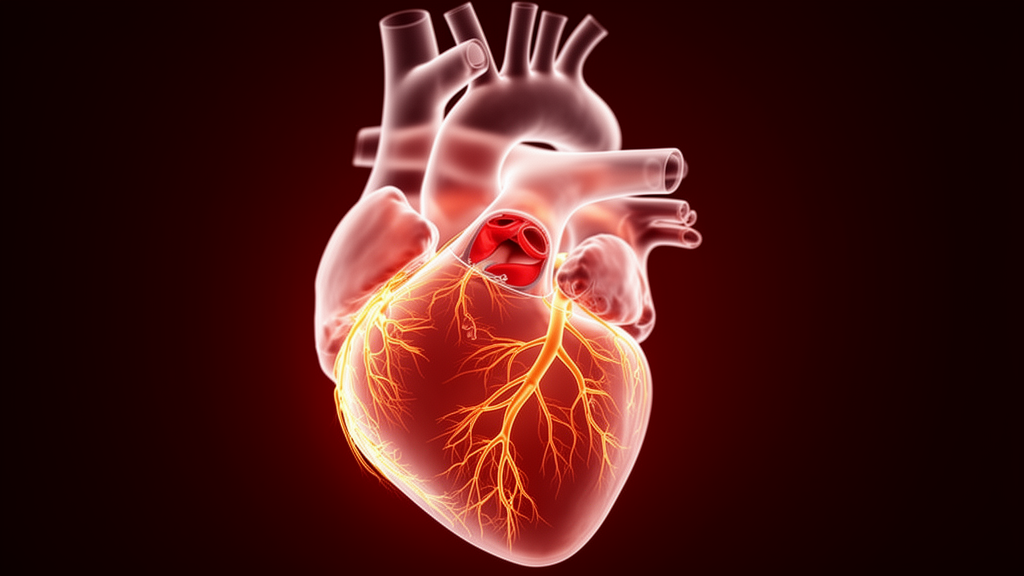
For patients with severe aortic stenosis, transcatheter aortic valve implantation, or TAVI, has become a routine and often lifesaving procedure. The narrowed aortic valve is replaced through a small incision, usually in the groin, without opening the chest. Yet a new systematic review and meta-analysis published in PLOS One suggests that fixing the valve may not fix everything. Even after the mechanical obstruction is relieved, a subtler form of heart disease may persist in the microscopic vessels that nourish the heart muscle itself, and its true extent depends heavily on how doctors look for it.
The condition in question is coronary microvascular dysfunction, or CMD, a disorder of the tiny arteries and arterioles that branch off the main coronary arteries. While major coronary blockages are easy to spot on an angiogram, the microvasculature operates at a scale beyond direct imaging. When these small vessels fail to dilate properly, the heart muscle cannot increase its blood supply during stress, even when the large arteries look clean. In aortic stenosis, the thickened heart muscle wall demands more oxygen while the high pressure inside the heart chamber compresses the microcirculation, creating a perfect storm for microvascular impairment.
A team of researchers from Thailand, led by Maethas Panyawongkhanti and colleagues, systematically searched five databases for studies published between January 2010 and December 2025 that assessed CMD in adults with severe aortic stenosis undergoing TAVI. The team accepted only rigorous measurement techniques: wire-based thermodilution, which threads a pressure-temperature sensor into the coronary artery; angiography-derived indices calculated from routine catheterization images; Doppler ultrasound measurements of coronary flow; and stress cardiac magnetic resonance imaging. The protocol was prospectively registered and the analysis followed PRISMA 2020 reporting standards, with study quality graded using the Newcastle-Ottawa Scale and the certainty of evidence evaluated under the GRADE framework.
Eleven primary studies made the final cut. Ten of them, encompassing 1,212 patients, contributed to the prevalence analyses, while an additional study of 126 patients entered only the sensitivity analyses. The headline finding was striking: the pooled prevalence of CMD before TAVI was 46.8 percent. But that number came with a caveat that turned out to be the study’s most important message. When CMD was measured with wire-based thermodilution, the gold standard involving direct intracoronary sensors, prevalence was 46.8 percent across six studies and 324 patients. When angiography-derived indices were used instead, across four studies and 888 patients, prevalence dropped to 38.4 percent, with essentially no statistical heterogeneity between those studies.
The discrepancy between modalities is not merely academic. Wire-based thermodilution measures the minimal microvascular resistance directly, an absolute physiological quantity expressed in units of pressure times time divided by flow. Angiographic indices, by contrast, are relative ratios that compare resting and hyperemic states and can be influenced by factors such as resting flow velocity, heart rate, and the pressure gradient across the stenotic valve itself. Because the two approaches define CMD differently, they cannot be assumed to identify the same patients. The high heterogeneity statistic of 72 percent in the thermodilution group reflected non-equivalent CMD definitions across studies, meaning that the pooled figure should be interpreted as a range rather than a precise point estimate.
The researchers also tracked what happens to the microcirculation after the valve is replaced. Coronary flow reserve, or CFR, the ratio of hyperemic to resting coronary blood flow, increased after TAVI by a pooled mean difference of 0.49, with a 95 percent confidence interval of 0.27 to 0.71, across five studies and 103 paired observations. On the surface, this looks like good news: the microvasculature appears to recover once the valve obstruction is gone. But the authors caution that the improvement may be deceptive. CFR is a ratio, and when resting blood flow demand falls after valve replacement, the denominator of the ratio shrinks, mechanically inflating the reserve even if the absolute capacity of the microcirculation is unchanged.
The narrative synthesis of microvascular resistance data supported exactly that interpretation. Reductions in microvascular resistance were confined to pressure-to-velocity and reserve ratio indices, which are relative measures sensitive to changes in resting conditions. In contrast, absolute minimal microvascular resistance, the most direct measure of the microcirculation’s structural capacity, showed no significant change after TAVI across four studies and 85 patients. In other words, the heart’s resting oxygen demand drops after valve replacement, which makes the reserve ratios look better, but the underlying architecture of the microvasculature may remain impaired. This distinction matters because structural microvascular damage, such as fibrosis and capillary rarefaction in the chronically hypertrophied heart muscle, is unlikely to reverse simply by removing the valve obstruction.
The prognostic question, whether CMD before TAVI predicts major adverse cardiovascular events, or MACE, after the procedure, yielded a hypothesis-generating rather than definitive answer. Across two studies and 585 patients, the hazard ratio for MACE associated with baseline CMD was 3.22, with a 95 percent confidence interval of 0.98 to 10.60 and substantial heterogeneity of 78 percent. The confidence interval crosses unity, meaning the association is not statistically significant at the conventional threshold, and the wide range reflects the small number of contributing studies and the incompatible hazard ratio calculations used in the original research. The authors explicitly state that the CMD-MACE association should be viewed as hypothesis-generating due to limited studies, varied CMD definitions, and incompatible statistical approaches.
What emerges from this review is a nuanced picture of a common but underrecognized complication. Coronary microvascular dysfunction affects a substantial proportion, plausibly between one-third and one-half, of patients with severe aortic stenosis before valve replacement, and the diagnostic method fundamentally shapes the estimated burden. TAVI improves coronary flow reserve, but likely by reducing resting demand rather than by repairing the microcirculation itself. Whether CMD independently predicts poor outcomes after TAVI remains an open question that the current evidence cannot settle.
The authors call for prospective multicenter studies with standardized CMD definitions to resolve these uncertainties. Such studies would need to agree on diagnostic thresholds, follow patients over meaningful time horizons, and use compatible statistical methods for prognostic modeling. Until then, the message for clinicians is clear: a successful valve replacement does not guarantee a fully healthy microcirculation, and the tools used to assess it are not interchangeable. For the growing population of elderly patients undergoing TAVI worldwide, the microscopic vessels of the heart may represent the next frontier in structural heart disease care.
Subject of Research: Coronary microvascular dysfunction prevalence, post-TAVI coronary flow reserve changes, and prognostic significance in severe aortic stenosis patients undergoing transcatheter aortic valve implantation
Article Title: Coronary microvascular dysfunction in patients undergoing transcatheter aortic valve implantation: A systematic review and meta-analysis
Article References: Panyawongkhanti, M., Chintrakulchai, P., Tanking, C., & Luangphiphat, W. (2026). Coronary microvascular dysfunction in patients undergoing transcatheter aortic valve implantation: A systematic review and meta-analysis. PLOS One, 21(10), e0360374. https://doi.org/10.1371/journal.pone.0360374
Image Credits: AI Generated
DOI: 10.1371/journal.pone.0360374
Keywords: coronary microvascular dysfunction, TAVI, aortic stenosis, coronary flow reserve, meta-analysis, PLOS One, cardiology, heart disease, Coronary, microvascular, dysfunction, patients
Cite Scienmag News
Frances Kline. (October 16, 2026). Hidden Heart Damage: Nearly Half of Aortic Stenosis Patients Show Microvascular Disease Before Valve Replacement. Scienmag. https://scienmag.com/hidden-heart-damage-nearly-half-of-aortic-stenosis-patients-show-microvascular-disease-before-valve-replacement/
Frances Kline. "Hidden Heart Damage: Nearly Half of Aortic Stenosis Patients Show Microvascular Disease Before Valve Replacement." Scienmag, 16 October 2026, https://scienmag.com/hidden-heart-damage-nearly-half-of-aortic-stenosis-patients-show-microvascular-disease-before-valve-replacement/. Accessed 16 October 2026.
Frances Kline. "Hidden Heart Damage: Nearly Half of Aortic Stenosis Patients Show Microvascular Disease Before Valve Replacement." Scienmag. October 16, 2026. https://scienmag.com/hidden-heart-damage-nearly-half-of-aortic-stenosis-patients-show-microvascular-disease-before-valve-replacement/


