


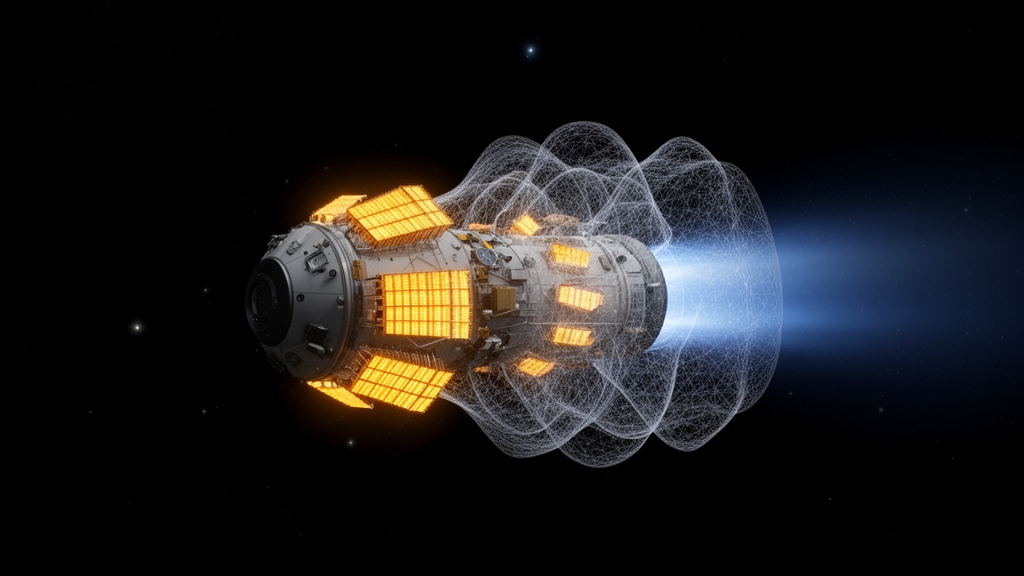
A concept study published in Frontiers in Space Technologies proposes an unusual marriage of quantum physics and rocket engineering: a mechanical see-saw, no wider than a human hair, that is slammed shut by the Casimir force, strikes a piezoelectric crystal, and converts the impact into electrical current to feed a magnetoplasmadynamic thruster aimed at interstellar flight. The authors, Neil R. Nagalkar and Pramod Shukla, are careful to stress that their Casimir Piezoelectric Drive, or CPD, does not conjure free energy from the quantum vacuum. Instead, it is a waste-heat engine that uses the Casimir effect purely as a closing mechanism, much like a spring in a conventional engine, while the true energy input is heat that the spacecraft would radiate away anyway.
The Casimir effect arises from quantum vacuum fluctuations of the electromagnetic field between two closely spaced conducting plates. For ideal parallel plates, the attractive pressure scales inversely with the fourth power of the separation, which means the force grows explosively as the gap narrows. At nanoscale distances of roughly ten to a hundred nanometers, this force becomes mechanically significant enough to deflect micro- and nano-scale structures. That steep distance dependence is the engine of the proposed architecture: as a see-saw arm brings a conducting plate toward its opposing surface, the accelerating attraction delivers a sharp mechanical impact to the piezoelectric element beneath.
The central obstacle the authors set out to solve is a subtle one. The piezoelectric effect generates current only in response to changing mechanical strain, not static stress. A constant Casimir force squeezing two plates together produces a single transient charge displacement and then nothing. Any harvesting scheme must therefore create a repeatable mechanical cycle. The proposed see-saw does exactly that. A metal plate pivots at its center, with piezoelectric crystals and Casimir-active surfaces at each end. When one side collapses under Casimir attraction and strikes its crystal, generating a pulse of current, the see-saw geometry lifts the opposite side, opening its gap to the maximum. The Casimir force then pulls that side down, delivering the next impact and reopening the first gap. Each closure necessarily reopens its partner, creating a self-resetting oscillator.
But a conservative force cannot yield net energy from a closed cycle. The energy gained from closing one gap equals the energy required to reopen it, and the see-saw coupling does not evade that bookkeeping. The authors calculate that at the moment of reset, the Casimir force holding the closed side at ten nanometers exceeds the force pulling the open side from a hundred nanometers by a factor of ten thousand. Net-positive operation therefore demands an external energy input, and the study identifies it in an unexpected place: the waste heat of the spacecraft’s own power supply. A radioisotope thermoelectric generator producing 250 watts of electricity simultaneously generates roughly 3,750 watts of heat that is conventionally dumped into space. The CPD would conduct some of that heat into the see-saw beam, whose thermal expansion reopens the Casimir gaps after each impact. For an aluminum beam about 80 micrometers long with a thermal expansion coefficient of 23 parts per million per kelvin, a 50-kelvin temperature swing produces roughly 90 nanometers of displacement, enough to reopen the gap from contact to maximum separation. As the beam cools toward the 2.7-kelvin background of deep space, the Casimir force closes the gap again and drives the next impact.
The timing of this cycle is governed by two competing timescales. Numerical integration of the see-saw’s nonlinear equation of motion shows that Casimir-driven collapse takes one to four microseconds, with the terminal impact velocity converging to about 0.35 meters per second regardless of the initial perturbation, because the kinetic energy is dominated by the steeply scaling force in the final nanometers of closure. The rate-limiting step is thermal: conductive equilibration through the aluminum beam takes about 1.7 microseconds, while radiative cooling to deep space is three orders of magnitude slower. High-frequency operation therefore requires the array substrate to be thermally coupled to both the RTG waste heat and a heat sink, cycling the beam temperature conductively. The resulting full-cycle period of roughly seven to eleven microseconds corresponds to an operating frequency near one hundred kilohertz, about an order of magnitude below the authors’ preliminary estimates, with array power scaling down proportionally.
The scaling analysis is candid about the numbers. At a plate separation of ten nanometers with one-square-micrometer plates, each impact harvests on the order of a few times ten to the minus twenty joules, and a million-unit array at one hundred kilohertz delivers roughly 0.87 watts of gross mechanical power, falling about two orders of magnitude below the 100-watt minimum for micro-MPD thrusters. The answer is burst mode, a well-established pattern in electric propulsion: pulsed plasma thrusters already accumulate capacitor energy over milliseconds to seconds and discharge in microseconds. Here, the capacitive bank would accumulate energy for roughly 115 seconds and then fire a one-second burst at the 100-watt threshold, a duty cycle of about 0.87 percent. In the zero-drag environment of interstellar space, every velocity increment is permanently retained, so the spacecraft’s velocity climbs monotonically over years to decades.
The electrical side of the chain leans on well-characterized materials. The reference design uses PZT-5A lead zirconate titanate, chosen for its high electromechanical coupling coefficient of about 0.6 and its extensive use in MEMS energy harvesting. A single impact on a thin PZT film produces an open-circuit voltage in the tens of millivolts, far below the 40-volt cathode threshold for MPD operation, but units wired in series sum their voltages. Depending on film thickness, between roughly 530 and 2,400 series-connected units reach the threshold, and with a million total units the array can be arranged as parallel strings of series elements with ample design flexibility. Accounting for piezoelectric conversion efficiency, the net electrical output supports a burst duty cycle of about 0.42 percent, accumulating for roughly 236 seconds per one-second thruster pulse.
The thermal economics are deliberately framed as scavenging rather than generation. The ratio of thermal input to harvested energy per cycle is very low, with conversion efficiency on the order of one part in a hundred thousand, but the authors argue this is acceptable because the thermal input is a byproduct that would otherwise be lost. At a million units, the required thermal input is about one watt, less than 0.03 percent of a single 250-watt-class RTG’s waste heat budget. At a billion units, the requirement climbs to roughly one megawatt, still within the capacity of a compact nuclear reactor but beyond any RTG. The architecture also exploits temperature as a control variable: thermal Lifshitz corrections to the Casimir force allow the oscillation characteristics to be tuned for optimal harvesting, and plutonium-238’s 87.7-year half-life means the thrust decays gradually rather than failing abruptly.
The experimental foundation, while thin, is real. Ludwig’s 2012 work on a quantum field energy sensor demonstrated that piezoelectric quartz tuning forks can make precision measurements of Casimir-scale forces, with spring constants from 1,200 newtons per meter to 42 kilonewtons per meter and sub-millihertz frequency stability over twelve-hour periods. Those parameters were optimized for measurement rather than harvesting, but they establish that piezoelectric elements respond to forces in this regime. On the thruster side, NASA’s Jet Propulsion Laboratory tested a lithium-fed MPD thruster at 120 kilowatts in February 2026, more than twenty-five times the power of current flight electric propulsion systems, with near-term targets of 500 kilowatts to one megawatt per thruster, although no MPD thruster has yet flown.
The study is equally frank about the open questions that separate concept from hardware. Stiction, the permanent adhesion of plates at nanoscale contact, is a well-known failure mode in nano-electromechanical systems, and the authors survey mitigations including self-assembled monolayer coatings, dimpled contact surfaces, and hard materials, noting that the thermal reset force exceeds the Casimir contact force by a large margin. Fabricating millions of nanoscale see-saws with the required pivot precision, validating piezoelectric response under the specific impact conditions, assessing array packing density against aft-surface area, and accounting for the mass of propellant, magnets, and power electronics all remain unresolved. The authors position the CPD strictly as a supplementary system: continuous extra thrust for the lifetime of the onboard reactor, limited only by propellant supply, layered on top of a primary propulsion system during the long coast beyond the heliopause and into the Oort Cloud. Whether the delicate nanoscale ballet of quantum vacuum attraction and thermal reset can survive launch, radiation, and decades of deep-space operation is precisely the kind of question the concept study is designed to provoke.
Subject of Research: A theoretical Casimir-piezoelectric energy harvesting architecture for supplementary magnetoplasmadynamic propulsion on interstellar spacecraft
Article Title: A casimir piezoelectric drive (CPD) architecture for supplementary MPD propulsion: a concept study
Article References: Nagalkar, N. R., & Shukla, P. (2026). A casimir piezoelectric drive (CPD) architecture for supplementary MPD propulsion: a concept study. Frontiers in Space Technologies, 7, Article 1975023. https://doi.org/10.3389/frspt.2026.1975023
Image Credits: AI Generated
DOI: 10.3389/frspt.2026.1975023
Keywords: Casimir effect, piezoelectric energy harvesting, magnetoplasmadynamic thruster, interstellar propulsion, waste heat recovery, quantum vacuum, space propulsion, nanoscale oscillators, RTG, PZT-5A, NEMS, burst-mode operation
Cite Scienmag News
Katie Riggs. (October 16, 2026). Quantum Vacuum See-Saw Could Scavenge Waste Heat for Interstellar Thrust. Scienmag. https://scienmag.com/quantum-vacuum-see-saw-could-scavenge-waste-heat-for-interstellar-thrust/
Katie Riggs. "Quantum Vacuum See-Saw Could Scavenge Waste Heat for Interstellar Thrust." Scienmag, 16 October 2026, https://scienmag.com/quantum-vacuum-see-saw-could-scavenge-waste-heat-for-interstellar-thrust/. Accessed 16 October 2026.
Katie Riggs. "Quantum Vacuum See-Saw Could Scavenge Waste Heat for Interstellar Thrust." Scienmag. October 16, 2026. https://scienmag.com/quantum-vacuum-see-saw-could-scavenge-waste-heat-for-interstellar-thrust/


