


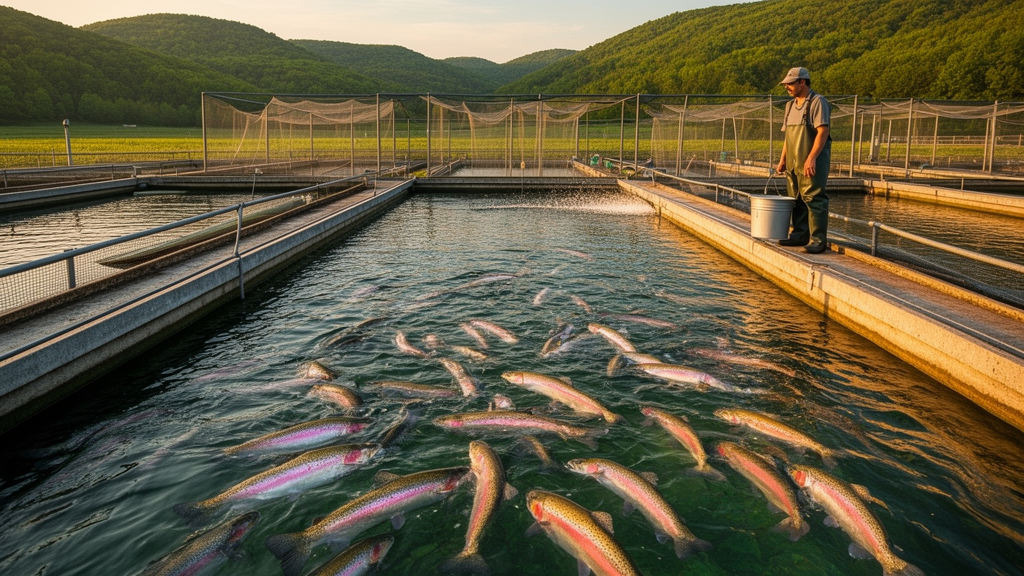
Rainbow trout, one of the world’s most widely farmed cold-water fish, grow best when warm water and long days act together, according to a new study conducted in the high-altitude environment of the Kashmir Valley. Researchers at Sher-e-Kashmir University of Agricultural Sciences and Technology of Kashmir systematically varied both temperature and day length in juvenile trout and found that the combination of 15 degrees Celsius and a 16-hour light, 8-hour dark photoperiod produced the fastest growth and the most efficient feed use of any treatment tested. The work, published in Frontiers in Aquaculture, offers hatchery managers in temperate highland regions a practical, biologically grounded recipe for squeezing more productivity out of their operations while also illuminating how two fundamental environmental signals jointly steer fish physiology.
For ectothermic animals such as fish, water temperature is often described as the abiotic master factor, because it sets the pace of nearly every biochemical reaction in the body. Photoperiod, by contrast, acts as a zeitgeber, a timing cue that synchronizes internal neuroendocrine rhythms with the external world. In nature, these two signals rise and fall together across the seasons, and the new study set out to disentangle how they interact rather than simply asking what each does alone. The researchers hypothesized that growth performance and physiological status in rainbow trout fingerlings would be shaped significantly by temperature, photoperiod, and crucially, their interaction, and that seasonal environmental change would leave a molecular fingerprint in growth-related genes.
The experimental design was straightforward but demanding. Fingerlings weighing about two grams were stocked into 60-liter tubs at a density of roughly 0.167 fish per liter, with ten fish per replicate and three replicates per treatment. Twelve combinations were tested: four thermal regimes at 5, 10, 15, and 20 degrees Celsius, crossed with three photoperiods of 8L:16D, 12L:12D, and 16L:8D, all maintained for 45 days. Light came from 16-watt LED bulbs, and submersible thermostats held water temperature steady within half a degree. Fish were fed a commercial diet at 4 percent of body weight per day, split into two feedings, and were weighed individually at the start, at fortnightly intervals, and at the end of the trial so that rations could be adjusted as the animals grew.
The results were unambiguous. Two-way analysis of variance revealed highly significant effects of temperature, photoperiod, and their interaction on every major growth index measured: final weight, live weight gain, specific growth rate, feed conversion ratio, and gross conversion efficiency, all at p < 0.001. The winning combination was 15 degrees Celsius under the 16L:8D photoperiod, where live weight gain reached 5.14 grams, specific growth rate hit 3.12 percent of body weight per day, gross conversion efficiency climbed to 1.54, and feed conversion ratio dropped to a best-in-trial 0.65. The 20-degree group under the same long photoperiod performed nearly as well, with a live weight gain of 4.49 grams and a feed conversion ratio of 0.74, but it could not match the 15-degree fish, suggesting that extended daylight supports growth under favorable thermal conditions yet cannot fully compensate for a less suitable temperature.
At the other end of the spectrum, fish held at 5 degrees Celsius under the shortest photoperiod fared worst, posting the lowest growth and the highest feed conversion ratio at 1.59. This pattern fits the known physiology of cold-water salmonids: low temperature slows metabolic and digestive rates, limiting how efficiently ingested feed can be converted into tissue. The steep, near-linear growth trajectories recorded for the two long-photoperiod warm treatments, with regression slopes of about 0.11 and 0.10 grams per day and R-squared values above 0.99, underscore how consistently these fish grew once both environmental levers were set favorably. Importantly, the significant interaction terms mean that the response to photoperiod depended on the prevailing temperature, so neither factor can be optimized in isolation.
Blood chemistry told a parallel story. Serum albumin, total protein, globulin, cholesterol, creatinine, glucose, and the transaminases SGOT and SGPT all responded significantly to temperature, photoperiod, or both, while bilirubin remained stubbornly stable across all treatments. The 15-degree, long-photoperiod group, the same one that grew fastest, also showed a favorable biochemical profile: comparatively high albumin and total protein, indicating robust protein metabolism and nutritional status, alongside the lowest cholesterol at 107.19 milligrams per deciliter, low creatinine at 0.25 milligrams per deciliter, and the lowest glucose at 94.71 milligrams per deciliter. The authors interpret these patterns cautiously, noting that serum biochemistry serves as an indicator of physiological condition rather than proof of specific metabolic pathways, and that measurements of cortisol, feed intake, or glycogen reserves would be needed to pin down mechanisms.
Some of the biochemical shifts align neatly with established trout biology. Cholesterol varied with temperature and its interaction with photoperiod but not with photoperiod alone, a pattern consistent with the well-documented tendency of trout to remodel membrane lipid composition, including cholesterol-to-phospholipid ratios, during thermal acclimation. Rising SGOT activity at warmer temperatures likely reflects heightened tissue metabolism across liver and muscle rather than hepatic damage, especially given the limited SGPT response and unchanged bilirubin. Creatinine, a marker tied to creatine turnover and metabolic rate, was lowest in the best-growing treatment, hinting at differences in how energy and nutrients were being deployed, though the data cannot assign a precise mechanism.
The second phase of the study moved from the tank to the seasons. The researchers sampled larger trout, 200 to 250 grams, during peak summer in May and June 2024 and in winter in November and December 2024, extracting RNA from skeletal muscle and quantifying messenger RNA levels of two growth-associated genes: growth hormone 1, or gh1, a core component of the GH-IGF endocrine axis that drives somatic growth, and ghrelin, or ghrl, a hormone involved in energy balance that crosstalks with growth pathways. Using quantitative real-time PCR normalized to the GAPDH housekeeping gene and the 2-delta-delta-Ct method with winter as the calibrator, they found that gh1 expression was 2.33-fold higher in summer and ghrelin was 3.03-fold higher.
Here the story becomes a lesson in statistical humility. Despite these sizable fold changes, neither difference reached statistical significance, with p-values of 0.16 for gh1 and 0.09 for ghrl, likely because only three biological replicates per season were available and the delta-Ct values varied considerably. The authors are careful to frame the molecular results as a directional seasonal tendency rather than demonstrated endocrine activation, and they note that transcript abundance does not necessarily translate into protein levels or circulating hormone activity. Ghrelin’s effects, in particular, are known to differ across fish species and developmental stages, so higher summer transcript levels cannot simply be read as increased appetite or growth hormone secretion. Direct measurements of circulating growth hormone, IGF-I, and ghrelin, along with more replicates, would be required to confirm the seasonal signal.
Taken together, the study delivers a clear practical message wrapped in an important scientific caveat. For aquaculture, the evidence supports manipulating temperature and photoperiod in combination, rather than one at a time, to boost growth and feed efficiency in rainbow trout rearing, with 15 degrees Celsius and a 16-hour day emerging as the optimal pairing within the tested range. The authors stress that this optimum reflects a 45-day trial on fingerlings and should be validated over longer production cycles and commercial hatchery conditions before generalization. For climate science, the work contributes a piece of the puzzle in predicting how cold-adapted species will fare as highland waters warm and seasonal cues shift. And for anyone who assumed that fish growth is a simple function of warmth, the significant interaction terms offer a corrective: in trout, as in much of biology, context is everything, and the calendar written in light matters as much as the thermometer.
Subject of Research: Photothermal regulation of growth, blood biochemistry, and seasonal gh1 and ghrl gene expression in farmed rainbow trout
Article Title: Seasonal photothermal regulation of growth, physiology, and endocrine gene expression in rainbow trout (Oncorhynchus mykiss)
Article References: Dhillon, O., Rather, M. A., Bhat, I. A., & Khan, I. A. (2026). Seasonal photothermal regulation of growth, physiology, and endocrine gene expression in rainbow trout (Oncorhynchus mykiss). Frontiers in Aquaculture, 5, Article 1946093. https://doi.org/10.3389/faquc.2026.1946093
Image Credits: AI Generated
DOI: 10.3389/faquc.2026.1946093
Keywords: rainbow trout, Oncorhynchus mykiss, photoperiod, temperature, aquaculture, growth performance, feed conversion ratio, serum biochemistry, growth hormone, ghrelin, gene expression, Kashmir Valley
Cite Scienmag News
Juliet Wilcox. (October 16, 2026). Long Days and Warm Water Unlock Faster Growth in Farmed Rainbow Trout. Scienmag. https://scienmag.com/long-days-and-warm-water-unlock-faster-growth-in-farmed-rainbow-trout/
Juliet Wilcox. "Long Days and Warm Water Unlock Faster Growth in Farmed Rainbow Trout." Scienmag, 16 October 2026, https://scienmag.com/long-days-and-warm-water-unlock-faster-growth-in-farmed-rainbow-trout/. Accessed 16 October 2026.
Juliet Wilcox. "Long Days and Warm Water Unlock Faster Growth in Farmed Rainbow Trout." Scienmag. October 16, 2026. https://scienmag.com/long-days-and-warm-water-unlock-faster-growth-in-farmed-rainbow-trout/


