


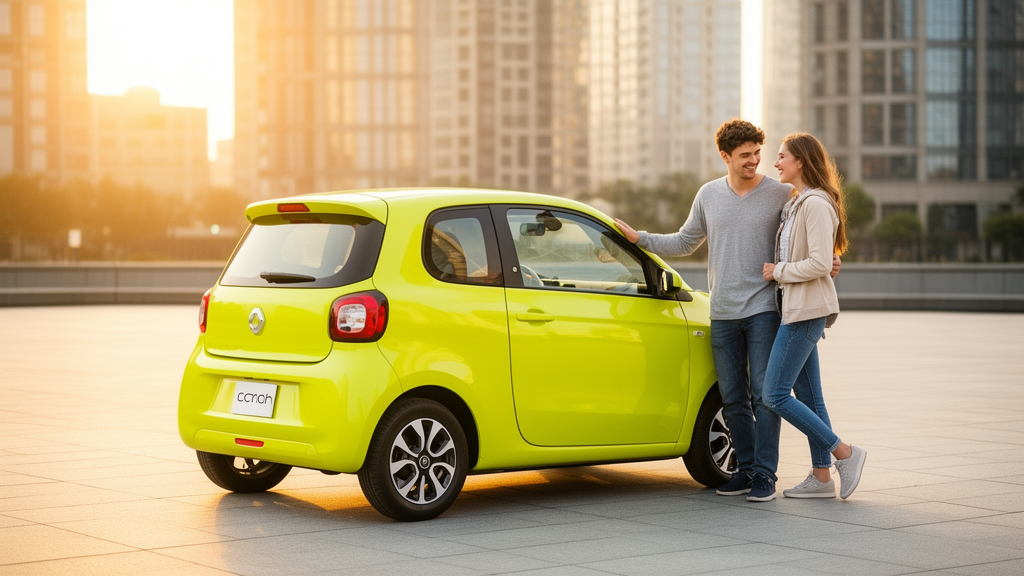
In the southern Chinese city of Liuzhou, a boxy, cheerful little electric car has quietly become a phenomenon. The Wuling Hongguang Mini EV, a low-cost micro vehicle that has sold more than 1.85 million units and become the top-selling single model among Chinese brands in China’s electric vehicle market, is now the subject of a study that dissects exactly why people decide to buy it. Published in Frontiers in Sustainable Cities, the research combines two behavioral theories into a single model and tests it with survey data from 308 respondents in a third-tier Chinese city, a market segment that electric vehicle scholarship has largely ignored.
The study, led by Jialin Li of Universiti Utara Malaysia together with Fowokemi Ogedengbe of the University of Johannesburg and Ammar Bani Doumi of Universiti Kebangsaan Malaysia, is grounded in the Stimulus-Organism-Response framework, a classic model of consumer psychology first developed in environmental psychology. In this structure, external cues act as stimuli that trigger internal cognitive or emotional processing, which in turn produces a behavioral response. The researchers positioned two product attributes as stimuli: perceived price value, the customer’s judgment of whether a vehicle’s benefits justify its monetary cost, and design aesthetics, the subjective evaluation of a car’s appearance, proportions, interior layout and controls. The organism, or internal processing state, was represented by task-technology fit, a construct borrowed from information systems research that measures how well a technology’s capabilities match the tasks a user actually needs to perform. The response was purchase intention.
That integration is the study’s central theoretical move. Previous Chinese electric vehicle studies have typically relied on the technology acceptance model or the unified theory of acceptance and use of technology, emphasizing direct links between perceived usefulness, ease of use and behavioral intention. What those models often overlook, the authors argue, is the matching mechanism between product characteristics and customers’ real usage needs. By fusing task-technology fit into the organism layer of the SOR model, the study asks whether consumers judge a Mini EV not merely as useful or easy, but as functionally adequate for their specific mobility tasks, such as daily commuting, short urban trips and economical travel. The framework generated seven hypotheses, including two mediation hypotheses in which task-technology fit transmits the effects of price value and design aesthetics onto purchase intention.
The logic behind the hypotheses is intuitive but psychologically precise. When consumers perceive strong value for money, the argument runs, they adjust their task expectations. For the Wuling Hongguang, whose target task is short-distance, low-cost commuting, extremely low acquisition and maintenance costs relieve financial pressure and lead buyers to scale back their demand for premium features, coming to view the minimalist configuration as a perfect fit for the specific job of affordable transportation. Design works differently but converges on the same mechanism: clean lines, coordinated proportions and an intuitive control layout reduce cognitive burden, help customers quickly grasp how the vehicle functions, and make the car seem compatible with their identity, lifestyle and expected usage context. Both pathways, the model predicts, should strengthen the perception that the vehicle fits the user’s travel tasks, and that perception should drive the intention to buy.
To test these predictions, the team surveyed Wuling Hongguang customers in Liuzhou, a third-tier city where electric vehicle market penetration exceeded 60 percent in 2025 and Mini EVs are growing rapidly. The researchers distributed 384 questionnaires calculated using Cochran’s formula at a 95 percent confidence level, and after screening out 76 responses with more than 20 percent missing data or careless responding, retained 308 valid questionnaires, a usable rate of 80.2 percent. An a priori power analysis in G*Power 3.1, assuming a medium effect size of f² = 0.15, a significance level of 0.05 and statistical power of 0.80, indicated a minimum required sample of just 77 respondents, which the final sample substantially exceeded. Data were collected electronically between March and May 2026, with ethical clearance from Universiti Utara Malaysia and informed consent from all participants, who were all aged 18 or above.
The sample profile is telling. Nearly two-thirds of respondents, 64.9 percent, were aged 21 to 30, and 55.8 percent held bachelor’s degrees. The largest income group earned RMB 3,001 to 5,000 per month, and students made up 35.1 percent of the sample while employed respondents accounted for 39.0 percent. In other words, the Mini EV’s customer base in Liuzhou skews young, relatively well educated and low to middle income, precisely the demographic for whom the cost-benefit trade-off of a micro electric car is most salient. The researchers measured all constructs on seven-point Likert scales adapted from previously published instruments, including the UTAUT2 price-value measure for perceived price value and a task-technology fit scale transferred from a food-delivery application context, with items reworded to assess whether the vehicle’s capabilities suit daily commuting and short-distance travel.
The analysis used partial least squares structural equation modeling in SmartPLS 4.0, with SPSS 25 for data screening and validation. The measurement model performed strongly: all factor loadings exceeded 0.7, composite reliability values surpassed 0.6, average variance extracted exceeded the 0.5 cutoff for every construct, and both the Fornell-Larcker criterion and the heterotrait-monotrait ratio, with all HTMT values below the 0.90 threshold, confirmed discriminant validity. Harman’s single-factor test suggested common method bias was not a serious concern, as the largest factor explained 42.376 percent of the variance, below the 50 percent warning line. Collinearity diagnostics showed inner variance inflation factors ranging from 2.754 to 3.961, all below the critical value of 5.00, though some slightly exceeded the more conservative 3.3 threshold and were interpreted with caution.
The structural results validated all seven hypotheses, and the effect sizes reveal a hierarchy of influence. Design aesthetics emerged as the strongest predictor in the model, exerting a powerful direct effect on task-technology fit with a path coefficient of β = 0.591 (t = 7.961, p < 0.001) and an F² of 0.438, indicating a strong contribution, while its direct effect on purchase intention was β = 0.359 (t = 4.595, p < 0.001). Perceived price value significantly influenced task-technology fit (β = 0.292, t = 3.799, p < 0.001) and purchase intention (β = 0.241, t = 2.961, p = 0.003), though with smaller effect sizes of F² = 0.107 and 0.068 respectively. Task-technology fit itself significantly predicted purchase intention (β = 0.312, t = 3.849, p < 0.001). Crucially, both mediation hypotheses held: task-technology fit significantly mediated the relationship between perceived price value and purchase intention (β = 0.091, t = 2.563, p = 0.010) and between design aesthetics and purchase intention (β = 0.184, t = 3.437, p = 0.001), confirming that the internal cognitive mechanism of task fit transmits part of the effect of both stimuli onto the behavioral response.
The explanatory power of the model is remarkable for consumer research. The three predictors accounted for 72.2 percent of the variance in purchase intention, an R² of 0.722 that falls in the strong range, and 71.1 percent of the variance in task-technology fit. Predictive relevance was equally high, with Q² values of 0.705 for task-technology fit and 0.687 for purchase intention, both close to one, and the standardized root mean square residual was 0.065 for both saturated and estimated models, below the 0.08 threshold for acceptable fit. In plain terms, the model does not just find statistically significant paths; it explains most of what drives the intention to buy this particular car in this particular city, and it predicts observed values with high accuracy.
The authors are careful about what these findings do and do not prove. Because data were collected at a single point in time, the results are interpreted as associations rather than causal effects, and because the study focused on one city and one vehicle, the findings should not be generalized to all third-tier Chinese cities or all Mini EV consumers. The study did not test task-technology fit as a moderator, did not compare city tiers directly, and measured intention rather than actual purchase behavior. Still, the implications are concrete: manufacturers should communicate value as a complete use proposition connecting price and operating costs with commuting, charging convenience and necessary functions, rather than assuming price cuts alone will drive sales, and product development should link visual appeal with functional clarity, demonstrating how the vehicle performs in realistic use scenarios. The study also extends task-technology fit theory into pre-purchase evaluation, showing that consumers judge fit before they ever adopt a technology, and broadens the SOR organism component beyond affective reactions to include cognitive judgments of task compatibility. Whether the same pattern holds in other cities, vehicle classes and consumer segments remains an empirical question, but for now the science says the world’s best-selling micro electric car wins not because it is cheap or cute, but because buyers conclude it is exactly the right tool for the job.
Subject of Research: Modeling mini electric vehicle purchase using SOR and task technology fit: evidence from the third-tier city of Liuzhou, China
Article Title: Modeling mini electric vehicle purchase using SOR and task technology fit: evidence from the third-tier city of Liuzhou, China
Article References: Modeling mini electric vehicle purchase using SOR and task technology fit: evidence from the third-tier city of Liuzhou, China. (n.d.). https://doi.org/10.3389/frsc.2026.1953189
Image Credits: AI Generated
DOI: 10.3389/frsc.2026.1953189
Keywords: Modeling, mini, electric, vehicle, purchase, task, technology, evidence, third-tier, city, Liuzhou, China
Cite Scienmag News
Glenn Wilkins. (October 16, 2026). Why China’s cheapest electric car wins hearts: price, looks and the science of fit. Scienmag. https://scienmag.com/why-chinas-cheapest-electric-car-wins-hearts-price-looks-and-the-science-of-fit/
Glenn Wilkins. "Why China’s cheapest electric car wins hearts: price, looks and the science of fit." Scienmag, 16 October 2026, https://scienmag.com/why-chinas-cheapest-electric-car-wins-hearts-price-looks-and-the-science-of-fit/. Accessed 16 October 2026.
Glenn Wilkins. "Why China’s cheapest electric car wins hearts: price, looks and the science of fit." Scienmag. October 16, 2026. https://scienmag.com/why-chinas-cheapest-electric-car-wins-hearts-price-looks-and-the-science-of-fit/


