


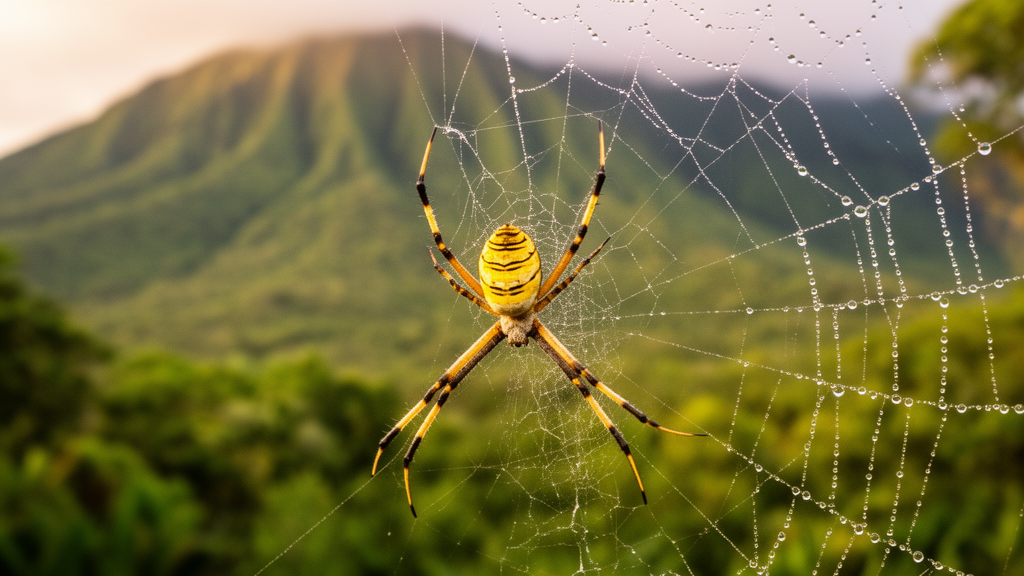
Silk is one of nature’s most versatile materials, and nowhere is its evolutionary story more remarkable than among the arachnids. While the orb webs of spiders have long captured human imagination, silk has independently evolved multiple times across arthropods, and only spiders and spider mites deploy it throughout every stage and aspect of their lives. A new collection of studies published in Frontiers in Arachnid Science now offers a sweeping snapshot of how arachnids—from spiders to mites and pseudoscorpions—build, weave, and engineer with silk in ways that continue to surprise researchers.
The editorial, compiled by Matjaž Gregorič of the Research Centre of the Slovenian Academy of Sciences and Arts, Dinesh Rao of Universidad Veracruzana in Mexico, and André Walter of Aarhus University in Denmark, brings together original research and reviews that showcase the most dynamic areas of current silk research. The functional diversity of silk use among arachnids is staggering: silk structures serve as retreats, nests, and egg sacs; they immobilize prey; they produce ballooning threads for aerial dispersal; they bridge habitat obstacles during relocation; and they function as signal and safety lines. This versatility has enabled arachnids to thrive in environments ranging from dry terrestrial habitats to aquatic ecosystems, and it likely contributed to the ecological and taxonomic diversification of the arachnids themselves.
Among the most iconic silk structures are the prey-capture webs of spiders, but even within this familiar category, mysteries abound. Walter’s review article, titled “The function of web decorations in orb web spiders,” delves into the various hypotheses surrounding conspicuous silk structures known as “web decorations” or “stabilimenta” that certain orb-weaving spiders incorporate into their webs. These striking patterns have puzzled researchers for decades, with proposed functions ranging from attracting prey through visual signals to offering protection from predators or providing mechanical reinforcement to the web itself.
By synthesizing findings from numerous studies spanning decades of research, Walter highlights not only the complexity of decoration function but also the experimental and conceptual shortcomings of past studies. Crucially, the review offers a new hypothesis: that web decorations evolved from ancestral silken retreats as specialized, predator-protective structures. This reframing suggests that what appears to be an ornamental flourish may in fact be a defensive adaptation refined over evolutionary time, shifting the debate from why spiders decorate their webs to how ancestral structures were co-opted for protection.
Equally striking is the case of the water spider, Argyroneta aquatica, the only spider species known to live almost entirely underwater. Shatrov and Soldatenko examined the silk threads produced by this remarkable animal using light, electron, and atomic force microscopy. Their ultrastructural analysis identified five distinct types of silk threads in A. aquatica, revealing a level of material specialization that rivals anything found in terrestrial spiders.
What makes this study particularly compelling is its comparative dimension. The authors compared the water spider’s silks with silk-like secretions from certain mite species and found that some silk types resemble those of water mites, while others resemble those of terrestrial tetranychid mites. This comparative analysis offers insights into the evolutionary adaptations of silk production in aquatic environments and broadens our understanding of silk diversity across arachnids, suggesting convergent solutions to the challenges of living underwater.
On the other side of the planet, a different silk story is unfolding. Alicea-Serrano and colleagues investigated the webs of Tetragnatha spiders on Hawaii, where closely related species on the same island often exhibit markedly different web architectures. Remarkably, these designs converge with those of more distantly related species on other islands—a classic signature of adaptive radiation. The researchers asked whether such ecological divergence is also reflected in the mechanical properties of the silk itself.
The answer is nuanced. Although interspecific variation in silk properties turned out to be relatively modest, the study provides the first evidence that ecological specialization can lead to diversification of silk properties over short evolutionary timescales. These findings contribute to our understanding of how ecological adaptation influences the evolution of functional biomaterials in arachnids, and they suggest that even modest mechanical shifts in silk may track the dramatic behavioral and architectural divergence seen in Hawaiian spider lineages.
Silk properties are not fixed even within a single species, as Wharton and colleagues demonstrated in their study of linyphiid spiders, a comparatively little-explored family that ranks among the most species-rich and abundant spiders in the northern hemisphere. These spiders are renowned for their long-distance aerial dispersal using silken “sails,” a phenomenon known as ballooning. The researchers investigated how environmental factors—humidity, temperature, and exposure to ultraviolet light—affect the physical structure and properties of linyphiid silk.
Their findings indicate that increased humidity and UV light exposure, but not temperature fluctuations, lead to decreased tensile strength. This research highlights the complex interplay between silks and their ecological environment, underscoring the high adaptability of linyphiid spiders to diverse conditions. For animals that depend on silk for both dispersal and survival, environmental degradation of silk properties could have cascading consequences for individual fitness and population dynamics.
Beyond spiders, the Research Topic also encompasses mites and pseudoscorpions—tiny and often overlooked soil predators that construct diverse silk structures in a wide array of contexts. Mites, encompassing two diverse groups of immense ecological diversity, and pseudoscorpions round out the picture of arachnid silk as a genuinely clade-wide phenomenon rather than a spider-specific novelty. Together, the studies in this collection span behavioral intricacies and biomechanical properties, offering a research window into adaptation, innovation, and ecological success.
The editors hope this compilation will not only inform but also inspire current and future generations of arachnologists to address the knowledge gaps that remain. There is still much to uncover—across taxa, environments, and disciplines. As the editorial concludes, the remarkable diversity and evolutionary significance of silk across arachnid lineages invites scientists to contribute their curiosity, technical expertise, and interdisciplinary vision to a field where even the most familiar silk structures, like the orb web, still guard fundamental secrets about how evolution shapes materials, behavior, and ecological success.
Subject of Research: Function and diversity of silk structures across arachnid lineages
Article Title: Editorial: Function and diversity of arachnid silk structures
Article References: Gregorič, M., Rao, D., & Walter, A. (2025). Editorial: Function and diversity of arachnid silk structures. Frontiers in Arachnid Science, 4, Article 1635471. https://doi.org/10.3389/frchs.2025.1635471
Image Credits: AI Generated
DOI: 10.3389/frchs.2025.1635471
Keywords: spider silk, arachnids, web decorations, stabilimenta, Argyroneta aquatica, Tetragnatha, Linyphiidae, spider mites, pseudoscorpions, adaptive radiation, silk properties, aerial dispersal
Cite Scienmag News
Denise Maddox. (October 16, 2026). From Underwater Webs to Hawaiian Islands: The Hidden Engineering of Arachnid Silk. Scienmag. https://scienmag.com/from-underwater-webs-to-hawaiian-islands-the-hidden-engineering-of-arachnid-silk/
Denise Maddox. "From Underwater Webs to Hawaiian Islands: The Hidden Engineering of Arachnid Silk." Scienmag, 16 October 2026, https://scienmag.com/from-underwater-webs-to-hawaiian-islands-the-hidden-engineering-of-arachnid-silk/. Accessed 16 October 2026.
Denise Maddox. "From Underwater Webs to Hawaiian Islands: The Hidden Engineering of Arachnid Silk." Scienmag. October 16, 2026. https://scienmag.com/from-underwater-webs-to-hawaiian-islands-the-hidden-engineering-of-arachnid-silk/


